
Shipwrecks can go ‘missing’ off Outer Banks. Here’s why NOAA team went hunting for 13
The Graveyard of the Atlantic is full of mysteries, and among the most haunting is the fact that historic shipwrecks can move or appear to go missing.
Cyclones are sometimes blamed, but North Carolina’s coast is also a place where turbulent currents can change the seafloor in unexpected ways.
It’s with that in mind that a National Oceanic and Atmospheric Administration expedition went searching for more than a dozen historic shipwrecks off Cape Hatteras, most of them tied to acts of war.
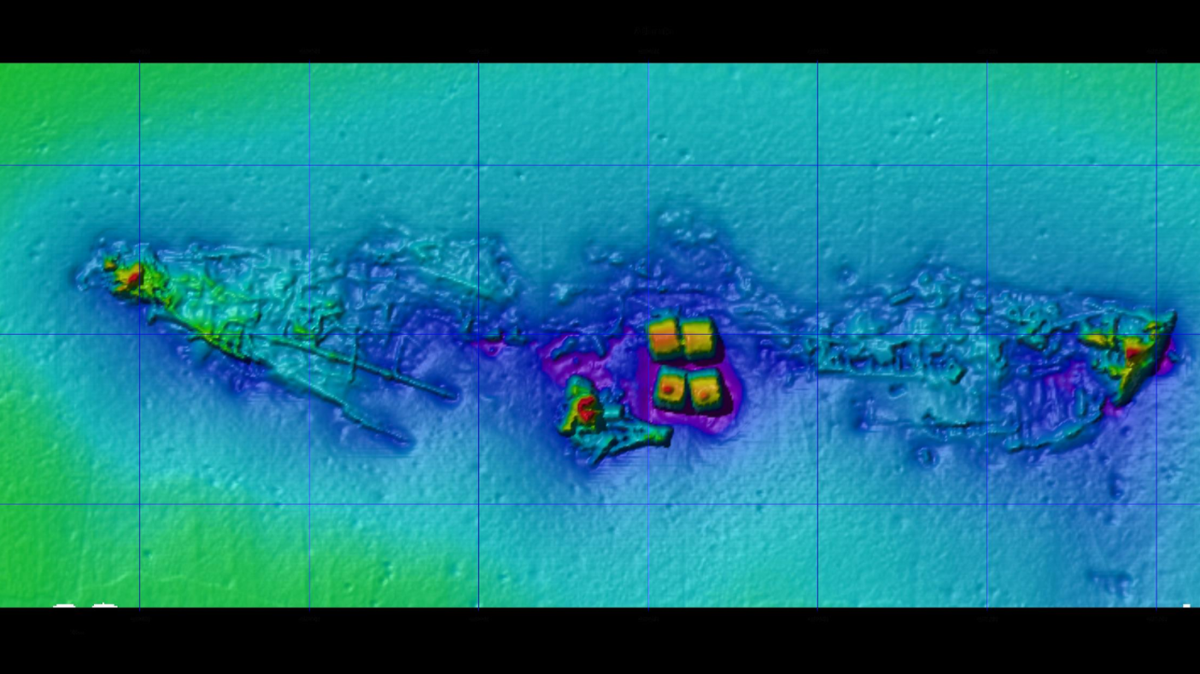
The goal was to create new sonar images of the wrecks and collect data for a proposed expansion of the Monitor National Marine Sanctuary.
“In some of the sites, even at a macro level, we see shifting of sands covering and uncovering portions of sites,” according to maritime archaeologist William Sassorossi, who was part of the expedition team.
“This speaks to the dynamic nature of Cape Hatteras and the impact of the currents moving over the shipwrecks, either adding or moving sand off of them. ... Ships do get covered up and seem to go ‘missing’.”
Among the best known examples of a wreck “moving” off North Carolina happened in 2011, when a shipwreck known as the Spar was “moved about 200 feet by Hurricane Irene,” ScubaDiving.com reports.
Thirteen wrecks were located by the team over seven days in July. However, a 14th wreck — known as the Brewster — was not found at the expected location, 7 miles south of Cape Hatteras.
Maybe the data on its location was faulty or maybe it’s still there, but buried under the sand, Sassorossi says.
13 shipwrecks
Collecting data about the shipwrecks is the latest step in a proposal to expand Monitor National Marine Sanctuary beyond a single Civil War wreck. The sanctuary was created to protect the Civil War ironclad USS Monitor, but historians note there are also “internationally significant” wrecks in the region from World War I and World War II.
A specific list of wrecks being considered for inclusion has not been released, but the proposed expansion “would constitute the largest area designated as a World War II battlefield anywhere in the United States,” NOAA says.
“Off the coast of North Carolina lies the remains of a forgotten World War II battlefield that serves as the final resting place for nearly 1,700 men lost during the Battle of The Atlantic,” NOAA reports in its proposal. “In just three years, from 1942 to 1945, 90 ships were lost off North Carolina alone as a result of this action. The result is an amazing collection of 78 merchant tankers and freighters, eight Allied warships, and four German U-boats resting on the seabed.”
The 13 ships visited by the team included two with ties to WWI (Light Vessel 71 and Merak) and six from World War II (the Portland, F.W. Abrams, Keshena, Kasandra Louloudis, City of Atlanta and San Delfino).
In the case of the City of Atlanta, 43 of the 46 people onboard died, while 28 of 50 perished on the San Delfino.
Undersea ‘national cemetery’
One of the biggest mysteries in the Graveyard of the Atlantic is just how many shipwrecks it holds. Some experts say 5,000, and others say it’s more like 2,000.
No matter the number, the wrecks collectively tell an important story about the U.S., according to Tane Casserley of the Monitor National Marine Sanctuary.
“You can throw a rock and hit a shipwreck off North Carolina,” he told McClatchy News. “We really have the story of America’s rise as a super power off the coast.”
That story includes German U-boats coming to North Carolina, where they sank unarmed merchant ships. Of the nearly 1,700 men lost in the Battle of the Atlantic, about 1,200 were U.S. merchant marines, he says.
The merchant ships they perished on will be a key component of the proposed marine sanctuary expansion, says Casserley, who is resource protection and permit coordinator at the sanctuary.
“Each wreck (story) has two parts: There’s the wreck itself on the bottom, and the history of what it went through to end up on the bottom,” he said. “Most of these wrecks are war graves. People died on these (ships) going down in horrible ways. Some of the vessels lost up to 20 guys that went down in burning flames and drowned.”
Today, many of those vessels are better known to recreational divers than NOAA researchers.
In the case of the freighter Portland, which ran aground in 1943, the July expedition marked the first time NOAA researchers visited the site.
Another visit is planned in the summer of 2022, in partnership with the heritage-preservation organization known as Diving with a Purpose. A member of the group was a volunteer with the July expedition, officials said.
Side scan data was collected at each of the 13 wrecks during the expedition. The new sonar imaging will provide a better idea of what remains of the wrecks on the seafloor, officials said.
This story was originally published September 7, 2021 at 12:37 PM with the headline "Shipwrecks can go ‘missing’ off Outer Banks. Here’s why NOAA team went hunting for 13."