
‘The storm couldn’t have come at a worse time’ for NC’s crops
It’s hard to tell Jimmy Burch had a thriving crop of broccoli, turnips and other vegetables in his fields just over a week ago. After Hurricane Florence dumped 16 inches of rain in the Faison area, many of the fields look like a flat expanse of mud. A few dead brown stems poking out of the dirt are the only sign of the ruined crop.
“It looks like there ain’t nothing there, and there ain’t nothing there,” Burch said. “This just breaks your heart right here.”
Burch is one of the largest vegetable growers in North Carolina. If you’ve bought fresh vegetables at Harris Teeter, Food Lion and Walmart, there’s a good chance some might have been grown in his 8,000 acres of fields. He estimates that at least 1,000 acres were ruined by the days of heavy rain.
Burch’s farm held up OK two years ago during Hurricane Matthew. Florence was different, because the rain and wind stuck around for days. “Between the wind and the rain, it just beat it to death,” he said of his plants. “Like somebody flogging you with a damn hose.”
Burch is among the many farmers in Eastern North Carolina tallying their losses. There’s no damage estimate available yet, but Agriculture Commissioner Steve Troxler told The Associated Press that “it’s easily going to be in the billions of dollars.”
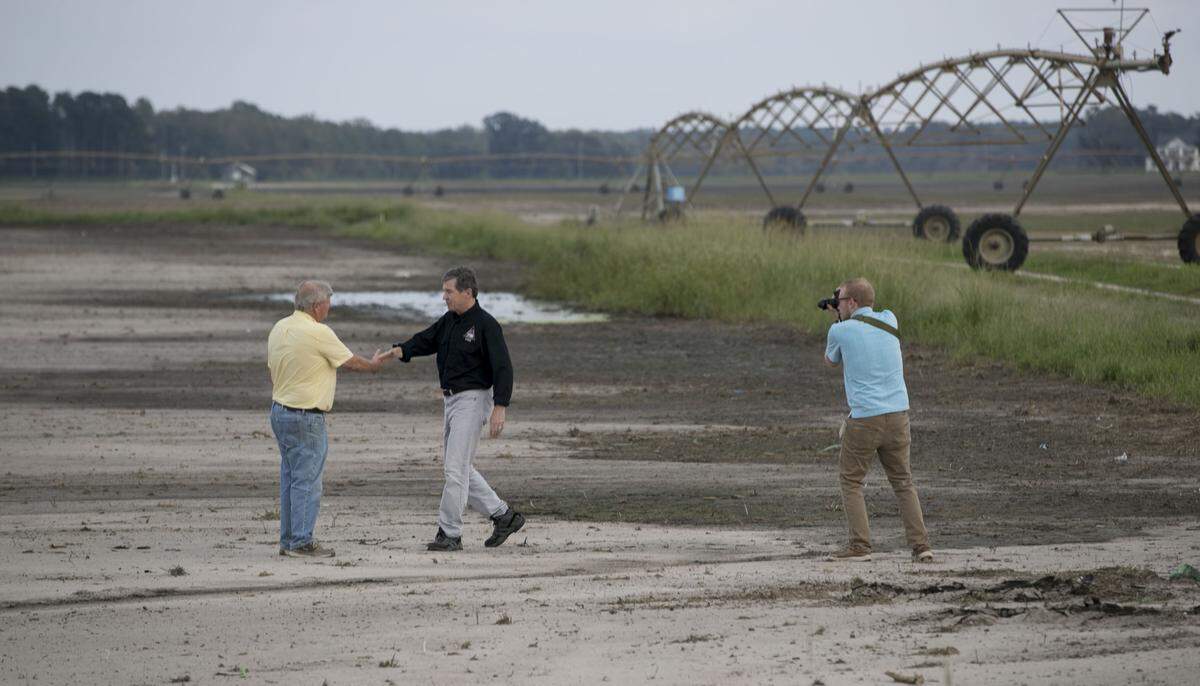
Florence hit as farmers were a few weeks out from harvesting soybeans, tobacco and other fall crops. “This storm couldn’t have come at a worse time for North Carolina agriculture,” N.C. Farm Bureau President Larry Wooten said during a Friday tour of Burch’s farm with Gov. Roy Cooper. Cooper said he’ll meet soon with U.S. Agriculture Secretary Sonny Perdue and “we’re going to see what we can do from a state and federal perspective to help our farmers.”
Burch says he’ll lose $750 for each acre of damaged crops, and he doesn’t have crop insurance. Even farmers with insurance will take a big hit.
“If you can pay half your bills” with insurance money, “you’re lucky,” Wayne County farmer Justin Williams said. Williams is still waiting to see how his peanut crop fared during the storm. “We have to wait until it dries out” before you can tell if the nuts are OK, he said, adding that he’s hoping the area doesn’t get more rain. Sweet potatoes are also an unknown for now: Farmers won’t know if they’ve rotted until it’s time to dig them up.
Duplin County pork farmer James Sauls was one of the lucky ones: His hog houses lost only a few pieces of tin in the storm. But he spent 18-hour days last month cutting 200 bales of hay that are now likely too damaged to sell. “All that work and I may have to put it in the woods, let the deer eat it.”
But even farmers taking a big hit are quick to note they’ve weathered Florence better than some of their neighbors. “Crops can be replaced,” Sauls said. “Human beings can’t.”
This story was originally published September 22, 2018 at 1:13 PM with the headline "‘The storm couldn’t have come at a worse time’ for NC’s crops."