
As Helene’s devastation mounts, insurance commissioner candidates meet in debate

For years, the race for North Carolina’s insurance commissioner operated mostly under the radar.
Not anymore.
As billion-dollar-loss events become more common — like this week’s “biblical devastation” in western North Carolina from the remnants of Hurricane Helene — premiums are skyrocketing. Denied claims and nonrenewals are also on the rise. The role of overseeing these markets is suddenly more critical than ever, and voters are paying attention.
Two-term Republican commissioner Mike Causey is up for reelection on Nov. 5. (North Carolina is one of 11 states that elect their commissioners. The rest appoint them.)
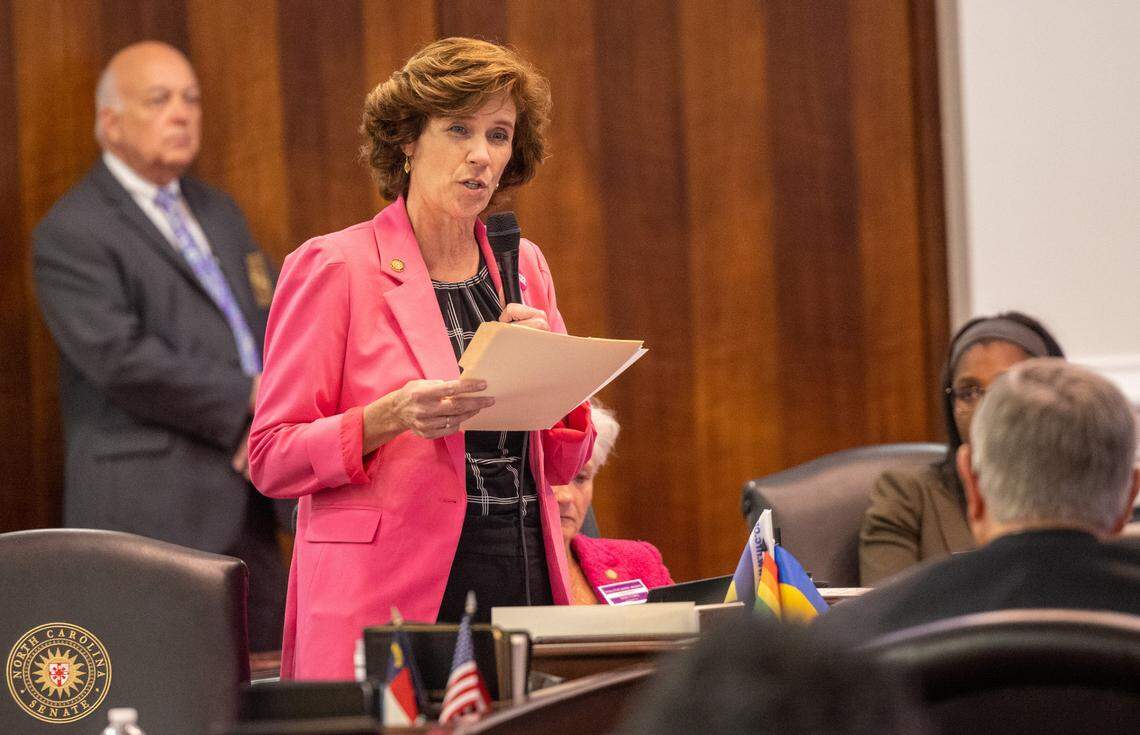
His challenger, Natasha Marcus, a Democrat, is a three-term state senator from Mecklenburg County.
Less than a week from a scheduled Oct. 7 hearing on a new proposed rate increase — and 33 days until the election — they faced off for the first and only time in a candidates’ forum at Caffe Luna in Raleigh on Tuesday night.
Sponsored by the North Carolina Justice Center, they answered pre-screened questions in a timed, debate-style format.
Here are some takeaways:
Hurricane Helene and NC’s vulnerabilities
Causey said he’d toured the storm’s damage in McDowell and Burke counties in western North Carolina hours before the forum. He also continues to receive reports of damage and insurance claims, he said.
“I’ve been on the phone ever since last week. We have people on the ground, and we’ve gone door to door to 144 homes. It’s truly devastating,” he told those gathered as recovery efforts remain underway. (Moody’s Analytics’ estimate Hurricane Helene’s losses could be $34 billion; other outlets say it could be upwards of $100 billion.)
Marcus also cited the state’s losses and drew a contrast with Causey by directly linking the disaster to climate change.
“Climate change is real; we ought to admit and tackle it. My opponent and his party refuse to do that,” she said, adding: “More storms [like this] are coming. North Carolina is particularly vulnerable.”
She also pointed out that flood insurance is not included in standard homeowners’ insurance policies. That means a “million-plus people” likely don’t have coverage, she said. She also faulted outdated flood maps from 2010 in places like Buncombe County as aggravating factors.
“We have to do better,” she said.

A court hearing on a proposed rate increase will go ahead
Despite doubt cast by his opponent, Causey said he plans to hold a hearing on a proposed rate increase for homeowners’ insurance on Oct. 7.
In January, the N.C. Rate Bureau, which represents companies that write insurance policies, asked for a 42.2% average increase across the state. Since then, the department’s actuaries, attorneys and consultants have been working to negotiate a new rate.
Causey said they’ve failed to reach an agreement. At this point, a hearing is the “best solution.”
“It’s happening,” he said Tuesday night, though he and his office have yet to confirm a time or release details. It’s expected to be held at his office headquarters in Highwood Towers at 3200 Beechleaf Court in northeast Raleigh. State law gives the insurance commissioner 45 days to issue an order once the hearing concludes.
Marcus said she welcomed the session. “It’s all about transparency. Without a public hearing, there’s no way to pick a fair number,” she said.
But she also suggested that Causey could still cancel at the last second. In eight years as the commissioner, Causey has raised property insurance rates 16 times — all without a public hearing, she pointed out.
Challenger spotlights commissioner’s record
A week after dropping an attack website, RateHikeMike.com, Marcus continued to shine a spotlight on Causey’s record.
Among her charges is the percentage of homeowners subject to “consent-to-rate” notices. (The state’s current threshold, written into law, allows insurance companies to charge rates higher — up to 250% more — than the state-approved rate.)
In Wake County alone, roughly 46% of policies were subject to consent-to-rate notices in 2023, according to the Marcus campaign. “It makes a mockery of a regulated market to allow insurance companies to charge you 250% above the maximum rate,” she said.
Marcus also questioned his campaign-funding ties to the industry and his transparency. “That’s part of the problem here,” she said.
Commissioner is proud of his record.
Causey defended himself against attacks and used his rural upbringing to appeal to voters. “I was born on the dirt road produce farm in Guilford County where I still live today,” he said.
Under his watch, he maintained that he’s worked to ensure that any proposed increases are “reasonable and as low as possible.”
“I’m proud of my record. North Carolina is in good shape. We have one of the most healthy, stable insurance markets in the nation,” he said.
To be clear: Premiums don’t automatically increase by the percentage of the finalized approved rate. That depends on the insurer’s assessed risk. Many policy holders may see “little to no impact” from a change because they’re already paying above the current base rate, say experts.
The average cost of homeowners’ insurance in North Carolina is $1,975 per year, or about $165 per month, according to a NerdWallet analysis. That’s close to the national average of $1,915 per year, even with the state’s consent-to-rate threshold.
Causey added the insurance commissioner doesn’t set insurance rates. “I follow the law,” he said.
North Carolina is one of the few states — if not the only one — where a Rate Bureau still exists. In almost every other state, each carrier files its own homeowners’ rates independently. But here, the Rate Bureau, created in 1977 by the General Assembly, has the responsibility to file and negotiate rates on behalf of the entire industry.
The challenges are real, he said. “Insurance companies don’t want to write homeowners’ insurance because they’re losing money. We don’t want to end up like Florida or California [where companies start to leave].”
Hearings should be the exception when negotiations fail, he said. “It’s very expensive.”
Many voters feel sidelined from the process.
Mark Kuhn, 70, from Durham, was one of the voters who attended the forum.
He’s worried about Causey’s ties to the industry. “He receives a significant amount of financial support. That creates an inherent conflict of interest,” he said.
His wife, Cindy, 74, added that she feels shut out of the process. “We have family here, a daughter and granddaughters. It’s not just about us. It’s about all the people who don’t have the resources that we have and are facing these big increases.”
As for the upcoming hearing, she said: “I think he will be shamed into it.”
Rebekah Brock recently moved to Harnett County from Colorado. She doesn’t understand why rate negotiations are conducted behind closed doors. “Rates just magically get approved. Why doesn’t the public have more input in that?”
The News & Observer filed a public records request seeking more information on May 15. The request is still undergoing “legal review,” said Barry Smith, a spokesman for the state’s Department of Insurance.
Check the Department of Insurance website for updates on the storm and the hearing: www.ncdoi.gov/helene
This story was originally published October 3, 2024 at 7:00 AM with the headline "As Helene’s devastation mounts, insurance commissioner candidates meet in debate."
