NC superintendent candidates clash over extremism, school vouchers, resegregation
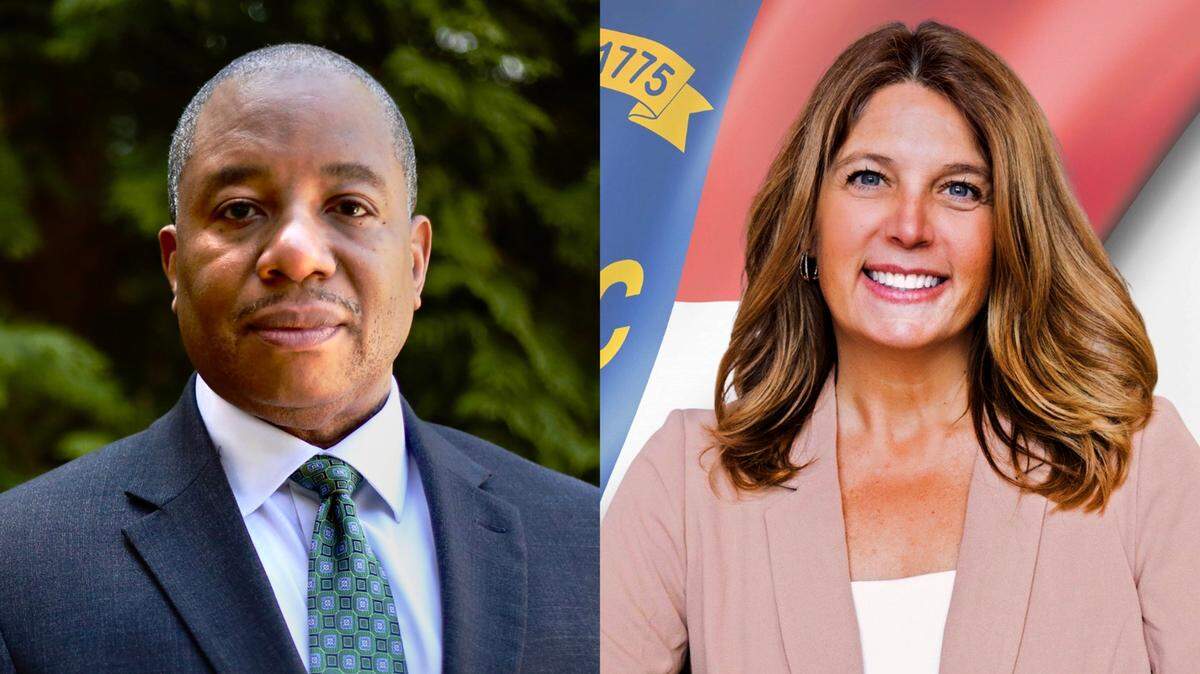
The two candidates hoping to become North Carolina’s new superintendent of public instruction accused each other Saturday of being too radical to lead the state’s public schools.
During Saturday’s candidate forum, Democratic nominee Mo Green pointed to GOP nominee Michele Morrow’s past social media posts about killing Democrats such as former President Barack Obama and encouraging President Donald Trump to use the military to stay in power in 2021.
“This is a person who’s called for the executions of many, many folks, listing certainly President (Joe) Biden ... and Governor (Roy) Cooper and President Barack Obama,” Green said. “I call upon folks — is this the kind of character we want next to our children?”
Morrow accused Green of supporting defund-the-police groups that were part of the Black Lives Matter protests in 2020. Green is former executive director of the Z. Smith Reynolds Foundation, a group that funds progressive causes.
“As a lawyer, he helped people get out on bail within 24 hours so they could go on to the next city of destruction,” Morrow said. “So he can talk a good game, but I want you to know what is at stake.”
Green responded with a “wow,” saying Morrow is “the same person that puts out all kinds of crazy QAnon conspiracy theories, Twix and witchcraft, celebrities drinking blood of children.”
Race has national attention
Saturday’s forum at N.C. State’s McKimmon Center in Raleigh was organized by Public Schools First NC and the NC PTA. The event was closed to the media and public. Only a limited number of guests attended. It was streamed online by WRAL.
The superintendent’s race has gained national attention due to Morrow’s past social media posts, which she has said were taken out of context.
Morrow is a homeschool parent, conservative activist, registered nurse and former Christian missionary who upset incumbent Catherine Truitt in the March Republican primary for state superintendent.
She is running against Green, the former superintendent of Guilford County Schools.
The candidates presented very different visions for public education.
Morrow says she’ll ‘cut CRT, DEI and SEL’
Morrow accused public schools of focusing on activism instead of academics. Morrow said if elected her administration is “going to cut things like CRT (Critical Race Theory), DEI (Diversity, Equity and Inclusion) and SEL (social-emotional learning).”
Morrow called for having at least two school resource officers in every school and removing students from classrooms when they’re out of control. She said schools shouldn’t be deciding whether to “correct” students based on the color of their skin.
“We should not be telling our white teachers that you need to apologize for your whiteness,” Morrow said. “We should not be telling our teachers that our minority students cannot perform because you have inherent racism.
“It’s time for us to recognize that this social, this politically charged, this racially divisive, and this sexually inappropriate content is destroying our children, is destroying their future, and it is using the time that should be spent on academic excellence.”
Public schools have denied teaching Critical Race Theory. But schools have given training on things such as implicit bias, citing the need to consider the changing demographics of school populations.
Morrow said an outsider like herself is needed now to be superintendent.
Green says Morrow would be ‘frightening’
Green said he, unlike Morrow, has the experience needed to be the chief administrative officer of the state’s public schools.
Green pointed to increases in the number of Guilford County students graduating from high school and taking advanced courses during his seven and a half years leading the state’s third-largest district.
The soul of public education in North Carolina is at stake, according to Green.
Green said he’s shown that he believes in public schools by having educated his children there. Morrow homeschools her children.
“Nothing at all against homeschooling, if that’s what you choose to do,” Green said. “But to then go around and talk about our public schools, (that) they’re indoctrination centers and taken over by Satan and cesspools of evil, lies and deception, and calling our teachers groomers.
“To think that this person would be the chief administrative officer and chief advocacy officer for the state of North Carolina’s public schools is frightening.”
Split over private school voucher funding
The candidates also differed on the Opportunity Scholarship program, which helps some families pay for tuition at private schools
Republican state lawmakers just approved spending an additional $463.5 million to clear the 50,000-student waitlist of families who are seeking a private school voucher. Applications surged this year when the state removed income eligibility limits
“These are public dollars, and so they should be in our public schools,” Green said. “This is deeply troubling when you think about now the wealthiest of the wealthy, those who can already afford to send their child to a private school, already have their child in a private school, can now get government assistance.”
Green said the additional $463.5 million for vouchers could go instead to needs in public schools like teacher raises and hiring more teacher assistants.
But Morrow said public schools already have the money they need. Instead, Morrow said the focus on the voucher bill should be about parents feeling that public schools aren’t providing their children with the resources and training they need.
“If you can’t afford right now to pay for a private school, this is a short-term solution,” Morrow said. “The money should be following the student.”
Is school resegregation a problem?
Morrow was also less concerned than Green about whether schools are resegregating.
A report released in May said North Carolina’s public schools are now more racially segregated than they were in the late 1980s. Both candidates were asked what’s driving the trend of school resegregation.
“Segregation is a legal term, and there is no law on the books that I know of that is telling kids that you can or cannot go to a certain school,” Morrow said. “I think what we might be seeing is the fact that we do not have a quality education across the board, so parents are probably choosing to send their kids to another school and frantically trying to get them somewhere else where their kids are going to be able to learn and they’re going to be safe and they’re going to be able to reach their highest potential.”
But Green said resegregation is being driven by factors such as neighborhoods and how charter schools are not required to provide transportation or school meals.
“There’s certainly policy decisions that have been made over the course of time that we’ve moved away from in our state and in our country, with regards to saying that having desegregated schools is a vitally important thing that can help in the education of all children,” Green said.
Support for higher teacher pay
There were some areas of agreement, including looking at restricting the use of smartphones in class, giving calendar flexibility to school districts and raising teacher pay.
The state provides a base starting salary of $41,000 for beginning teachers. School districts often supplement the state base pay.
The National Education Association ranks the state 42nd in beginning teacher pay.
Morrow suggested raising the base salary for beginning teachers to $50,000 to $55,000 a year. Green proposed beginning teachers get between $55,000 and $60,000 a year.
Neither candidate supported setting a ceiling limiting how much teachers could be paid.
This story was originally published September 14, 2024 at 3:58 PM with the headline "NC superintendent candidates clash over extremism, school vouchers, resegregation."