Cunningham and Tillis win, setting up NC as a battleground for control of Senate
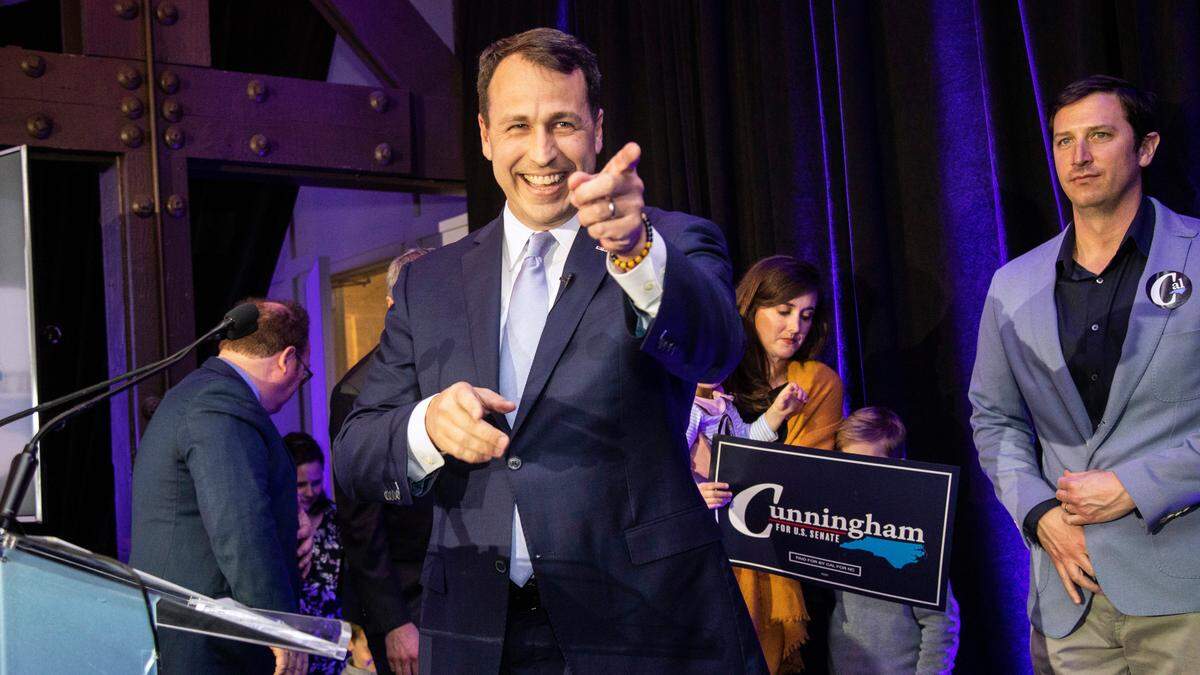
Democrat Cal Cunningham will face incumbent Republican Thom Tillis in a race that could decide which party controls the U.S. Senate.
Cunningham, a lawyer, former state senator and former Army prosecutor from Lexington, won 57% of the vote in complete but unofficial results.
State Sen. Erica Smith, a high school teacher and engineer from Northampton County who was seeking to become the first black U.S. senator from the state, won less than 35% in a Democratic primary marked by massive outside spending. Mecklenburg County Commissioner Trevor Fuller, Raleigh physician Atul Goel and Steve Swenson of Bunnlevel were in the single digits.
“Cal has served his country and his state for his entire career and we know that he will be an independent voice for North Carolina who will never stop fighting for our military families, better health care, and stronger public schools,” said North Carolina Democratic Party chairman Wayne Goodwin in a statement.
Tillis, a former speaker of the North Carolina state House, won the Republican nomination with more than 78% of the vote. Paul Wright, Larry Holmquist and Sharon Y. Hudson each had between 7% and 8%.
“I am honored to have earned the Republican nomination tonight, and pledge to work as hard as I can to hold this seat and get President Trump re-elected so that we can continue to partner on wins for North Carolinians of all backgrounds and political affiliations,” Tillis said in a statement Tuesday night.
Libertarian Party candidate Shannon Bray and Constitution Party candidate Kevin Hayes will also be on the ballot in November.
Tillis, 59, avoided a possible divisive and expensive primary when Raleigh businessman Garland Tucker dropped out of the race before the filing deadline in December and no current elected official, including Rep. Mark Walker, opted to challenge him.
The lack of a real challenger allowed Tillis to stockpile cash for the rest of the campaign.
Cunningham, 46, lost in the Democratic primary for U.S. Senate in 2010. But he quickly built support in-state and nationally upon entering this Senate race in June.
He previously had been running for lieutenant governor, but raised $720,000 in his first two weeks in the Senate race and announced dozens of endorsements right away despite not holding elected office since 2003.
That fundraising total far exceeded what Smith, who entered the race in February 2019, was able to bring in. Smith reported raising $233,000 in the entire election cycle, according to FEC reports, a small number that led a Republican group to spend on her behalf to boost her candidacy.
In late October, the Democratic Senatorial Campaign Committee endorsed Cunningham — an endorsement that Smith had sought and that proved more than a slight annoyance to her. The DSCC backed Cunningham in 2010, too.
“We do know we are the most qualified candidate in this race,” Smith said in February. “Whatever the reason was, they’re just plain wrong.”
Smith, 50, served on the Northampton County Board of Education and as the county’s Democratic Party chair, and is in her third term in the state Senate. She touted her legislative accomplishments and the historic nature of her campaign.
But Cunningham, buoyed by outside spending and his own strong fundraising, was able to advertise on television and travel extensively throughout the state. The campaign’s ads were tailored for a general election and never mentioned Smith.
General election takes shape
The race is expected to be tight — and closely watched by outside observers. Tillis won the seat in 2014 by less than 46,000 votes and 1.5%. Politico calls the race a toss-up, as does Inside Elections. Cunningham led Tillis 48% to 43% in a recent NBC News/Marist poll.
It may ultimately determine which party controls the Senate in 2021.
Republicans hold 53 seats in the 100-member Senate. Any realistic path toward a Democratic majority includes flipping current GOP seats in at least three of these states: North Carolina, Colorado, Arizona and Maine.
Republicans are aiming to flip two Democrat-held seats in deep-red Alabama and Michigan, while Democrats have eyes on seats in Iowa and Georgia.
The contours of the general election have already taken shape.
Tillis has embraced President Donald Trump fully, called out his Democratic challengers as socialists and is seeking to make sanctuary cities and illegal immigration a top issue.
“I want to keep working with President Trump to create jobs, boost wages, secure winning trade deals, rebuild our military, improve health care for veterans, combat sanctuary cities, and confirm well-qualified judges to the federal bench,” Tillis said in a statement.
“My opponent, on the other hand, spent his primary embracing far left positions like removing President Trump from office, repealing the 2017 tax cuts, enabling sanctuary cities, opposing America-First trade policies, and criticizing the killing of a murderous terrorist from Iran.”
Cunningham wants to keep the focus on health care — including Republican challenges to the Affordable Care Act, and funds that were diverted from North Carolina military bases to fund construction of a wall on the southern border with Mexico — while painting Tillis as part of a corrupt Washington.
“In the push and pull of Washington politics, Thom Tillis has decided there are things more important than representing North Carolina,” Cunningham said at a party for Democrats on Tuesday night. “He has put his own political interests, and serving the special interests, ahead of North Carolina’s interests.”
But unexpected issues — North Carolina confirmed its first case of coronavirus on Tuesday — are sure to twist the race in unforeseeable ways.
Tillis spoke at Trump’s rally in Charlotte on Monday night and ticked through a list of accomplishments saying Trump will not back down and will do what he says. Tillis was among Trump’s staunchest allies during impeachment.
“You got to get this man re-elected so we can give you the free stuff that a free country deserves — free markets, free trade, freedom of religion, freedom of speech and the freedom for you to protect yourself with your right to bear arms,” Tillis said. “That’s the freedom that this man represents and that’s the freedom that I represent.”
Trump endorsed Tillis last year and, in his State of the Union address, called for Congress to pass Tillis’ bill allowing crime victims to sue so-called “sanctuary cities” if they did not cooperate with immigration officials. The president called Tillis a “really good friend of mine,” but did reference disagreements between the two.
“We were going at it a little bit at the beginning, but I will tell you — and I would say if I didn’t get along, I wouldn’t be here, I wouldn’t do this. I think he’s been tremendous. He’s been a tremendous supporter,” Trump said.
Tillis wrote a 2019 opinion piece in The Washington Post saying he would oppose Trump’s national emergency declaration allowing the president to shift money from other projects to his long-promised wall. Tillis faced immediate criticism from Republicans. A few weeks later, Tillis voted with Trump on the emergency declaration bill and he has supported the president’s position in several subsequent votes.
The Trump administration moved $80 million slated for North Carolina military bases — a number that includes $32.9 million for a previously canceled school at Fort Bragg — as part of the emergency declaration. Cunningham has been critical of Tillis’ decision, calling it a “flip-flop” and a sign of weakness.
Cunningham, who voted for former South Bend, Indiana, Mayor Pete Buttigieg in the Democratic presidential primary, said he would support whoever wins his party’s nomination, including Sen. Bernie Sanders of Vermont. Throughout the primary, Tillis and his campaign tried to tie Cunningham and Smith to the policies coming from Sanders and other presidential candidates, particularly Medicare for All and the Green New Deal.
Cunningham has said he does not support either program.
“Cal’s focus on taking on the corruption in Washington, expanding access to high-quality affordable health care, and standing up for veterans and military families will continue to show a clear contrast with a vulnerable incumbent,” said Sen. Catherine Cortez Masto of Nevada, chair of the DSCC.
Tillis and Cunningham could have plenty of time to argue their differences before voters. In January, Tillis challenged whoever won the Democratic nomination to a series of five debates, beginning in April. Cunningham accepted.
Outside money
Tillis’ 2014 victory against incumbent Democratic Sen. Kay Hagan was the most expensive in U.S. history at that point with combined spending of more than $120 million by candidates and outside groups. The 2020 race is likely to be very expensive as well.
More than $20.6 million has already been spent in the Senate race, making it the most expensive race in the country so far, according to Advertising Analytics, which tracks political ads and spending. Of that figure, $17 million was spent in the Democratic primary.
Cunningham was boosted by nearly $13 million in outside spending from the DSCC, the Carolina Blue super PAC, VoteVets and the VoteVets Action Fund.
National Republicans have seized on those big money totals, saying it undercuts Cunningham’s pledge not to accept money from corporate PACs.
“There is no doubt North Carolina voters will reject him this fall,” said Joanna Rodriguez, a spokesperson for the National Republican Senatorial Committee.
The Senate Leadership Fund, which is aligned with Senate Majority Leader Mitch McConnell of Kentucky, spent nearly $3 million in support of Smith through the Faith & Power PAC.
Cunningham accused the group of “meddling,” and Smith disavowed the ads saying they sent a message she “could not be trusted.”
“It’s been more successful than we could have imagined,” said Stephen Law, president of the Senate Leadership Fund, in a statement in February.
But the ads did not seem to have any impact on polling. Cunningham grabbed a consistent lead between 20 and 30 points throughout the final weeks of the campaign in numerous polls by different groups.
Cunningham also enjoyed strong fundraising in the pre-primary period, raised nearly $1.4 million between Jan. 1 and Feb. 12, according to campaign finance reports. Tillis reported raising $700,000 during that same period.
Tillis had $5.4 million cash on hand as of Feb. 12. Cunningham had $1.4 million.
Americans for Prosperity Action Fund, which has been doing grassroots work in support of Tillis for months, announced it would spent $250,000 on television ads after Super Tuesday.
For more North Carolina government and politics news, listen to the Domecast politics podcast from The News & Observer and the NC Insider. You can find it on Megaphone, Apple Podcasts, iHeartRadio, Stitcher or wherever you get your podcasts.
This story was originally published March 3, 2020 at 8:18 PM with the headline "Cunningham and Tillis win, setting up NC as a battleground for control of Senate."