Here’s what Orange County commissioner candidates said about taxes, housing and more
One Orange County commissioner likely will retain her seat March 3, while three others face challenges from current and former Chapel Hill-Carrboro School Board members.
Four of the seven seats on the Orange County Board of Commissioners are up for grabs in the March 3 primary. District 1 voters, who live in Chapel Hill and southern Orange County, can vote in the District 1 and at-large races. Voters in District 2, in the northern part of the county, can vote in the District 2 and at-large races.
District 2 Commissioner Renee Price has no primary challenger. District 1 Commissioners Mark Dorosin and Penny Rich are facing a challenge from former city schools board member Jean Hamilton. Current school board Vice Chairwoman Amy Fowler is challenging Commissioner Mark Marcoplos for his at-large district seat.
Although the commissioners race is partisan, no Republican candidates are on the ballot — as is typical in the heavily Democratic county. Whoever wins the primary race is likely to win the Nov. 3 general election.
County commissioners set the county budget and property tax rates, allocate money to schools, social services and public safety, and make policies affecting services, the local economy and more for years to come.
Find your election site
Voters can register at the Board of Elections or an Early Voting location using same-day registration. A valid form of identification is required to register to vote. However, a photo identification is not required to vote in the primary.
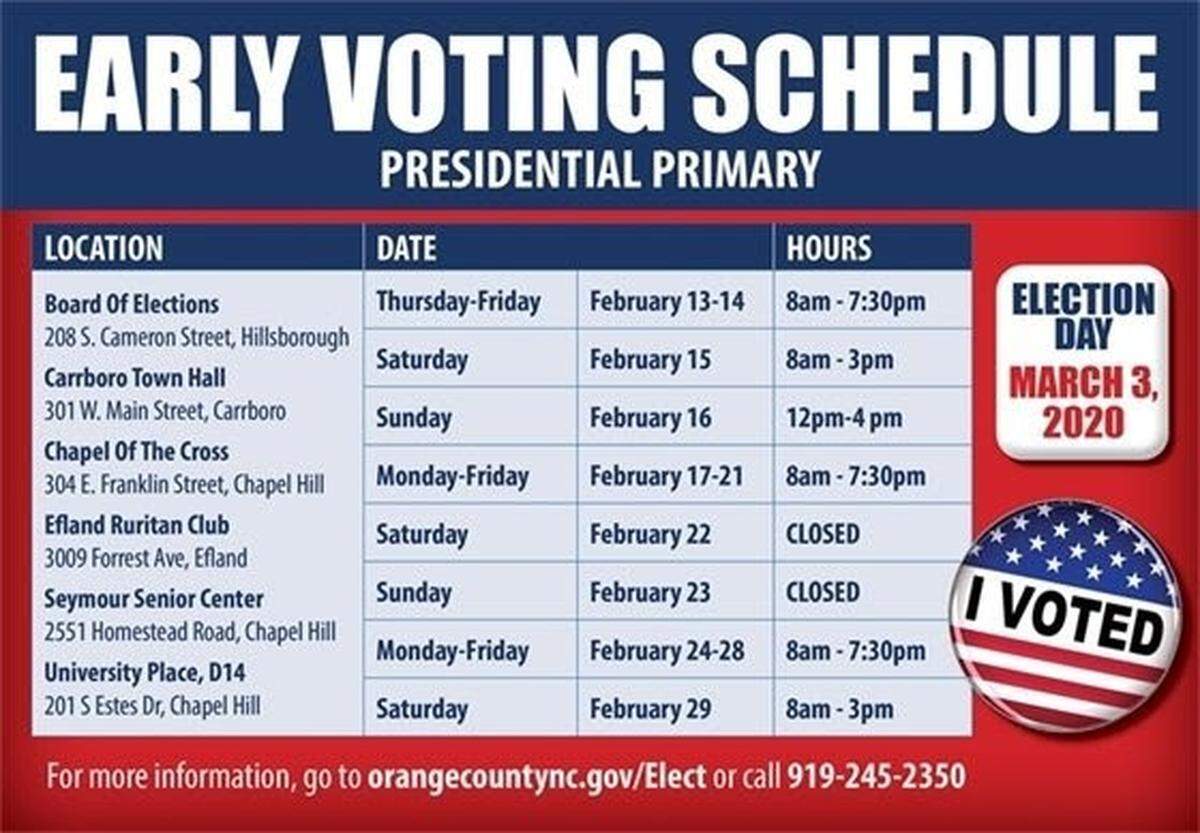
Orange County’s early voting period is Feb. 13-29 at six sites:
▪ Board of Elections office, 208 S. Cameron St., Hillsborough
▪ Carrboro Town Hall, 301 W. Main St., Carrboro
▪ Chapel of the Cross, 304 E. Franklin St., Chapel Hill
▪ Efland Ruritan Club, 3009 Forrest Ave., Efland
▪ Seymour Senior Center, 2551 Homestead Road, Chapel Hill
▪ University Place, Suite D14, 201 S. Estes Drive, Chapel Hill
Early voting sites will be open from:
▪ 8 a.m. to 7:30 p.m., Feb. 13-14
▪ 8 a.m. to 3 p.m., Feb. 15
▪ Noon to 4 p.m., Feb. 16
▪ 8 a.m. to 7:30 p.m., Feb. 17-21 and Feb. 24
▪ 8 a.m. to 3 p.m., Feb. 29
The polls will be closed Feb. 22-23. Voters must be 18 or older, and a resident of the county in which they plan to vote.
Some polling locations also have changed; affected voters should have gotten a bright orange postcard in the mail from the Orange County Board of Elections.
Absentee voting by mail also is available. Orange County voters should request a ballot using the required Absentee Ballot Request form. Requests can be submitted in person at the Orange County Board of Elections, 208 S. Cameron St. in Hillsborough; by mail at P.O. Box 220, Hillsborough, NC 27278; by email at tyoung@orangecountync.gov; or fax at 919-644-3318.
The Orange County Board of Elections also is offering a new, web-based Google Maps tool this year to help voters find their polling location and plan how to get there, whether by car, foot, bike or bus.
“We want to make voting as accessible as possible,” Elections Director Rachel Raper said. “Map Your Trip allows voters to choose their preferred mode of transportation, including public transit, while participating in the electoral process.”
Here is how the Orange County Board of Commissioners candidates responded to our questions:
County property taxes
Are Orange County taxes too high?
District 1
Mark Dorosin: Orange County taxes reflect the community’s demand for a broad range of high-quality public services. As a generally affluent community, our government has historically relied on increasing property taxes to meet those demands. In addition, insufficient efforts and a stringent regulatory process impeded commercial development. I have emphasized the impacts of our tax burden and the growing income disparities in our community. In response, the board has successfully worked to minimize tax increases and to secure new economic development to expand and diversify the tax base. Those efforts should continue, along with efforts to better prioritize critical needs and reexamine non-critical ones. Because many of our funding options and burdens are controlled by the state, we must also work to secure additional funding from the legislature.
Jean Hamilton: Orange County taxes are high due to the level of governmental services that reflect the values and obligations of Orange County and our tax base that is overly dependent on residential property. It will take time and some investment to diversity the tax base and increase revenue. I support efforts to make Orange County a place that is friendly to businesses that reflect our values. However, realistic cost/benefit analyses must be done when county funds are used for incentives or other investments to attract new businesses to make sure taxpayer money is not wasted. The commissioners should look to limit tax increases by evaluating its spending priorities and make sure it is not putting money into inefficient programs and initiatives. Finally, when working with regional partners like GoTriangle, commissioners must make sure they make realistic assessments of costs and benefits of long-term projects and serve the interests of Orange County residents.
Penny Rich: Orange County taxes are high. We needed a shift in policy to diversify the county’s tax base, and in 2019, we began to see the results of years of planning and laying the groundwork for infrastructure. I understand the importance of diversifying our tax base and worked with our economic development director and Economic Advisory Board to present Orange County as business friendly and create a welcoming atmosphere for corporate relocation. We were successful in our efforts and have a commitment of over $100 million invested in the Buckhorn Economic Development District, bringing 650 new jobs, $5.5 million invested in Chapel Hill, bringing 400 jobs, and this is only the beginning.
District 2
Renee Price: Because of the income disparity among the people of Orange County, property taxes are too high for some, while for others, the tax rate is fine ... and they would accept an increase to cover new costs. I believe thecounty commissioners should exercise a few options:
▪ Work with staff to prioritize our spending and phase in tax increases
▪ Expand our commercial and industrial tax bases to offset the burden of taxes on residential property owners
▪ Advise homeowners of the tax exemption and deferment programs as well as the installment plan
At-Large District
Amy Fowler: Orange County taxes are relatively high, but the current tax rate is necessary to provide the requisite infrastructure, namely schools and law enforcement and to work as a community on transportation, supporting senior citizens and individuals with disabilities and economically disadvantaged, preserving the environment, and addressing affordable housing. It’s unfortunate that Orange lost the ability to levy impact fees, as this has shifted the burden of supporting new development from the developers to the taxpayers. The county needs to focus on economic development and attracting businesses to reduce the tax burden on our citizens.
Mark Marcoplos: It is very sobering to look at the wide range of needs that we could meet if we had a state legislature that shared our values or we had unlimited funds. In order to cover the costs of the school bond passed by the voters in 2016, we raised taxes last year and will need to raise taxes this year and likely the next. Additionally (again in large part due to the state legislature that has failed to restore school funding to pre-recession levels) we need to seriously consider allotting funds for priority security and repair needs in the schools. There is no free lunch however, and we understand there are many people living in the county who are barely hanging onto their homes with the current tax rate. There is some light at the end of the tunnel as we look forward to significantly increased tax revenues from our economic development successes beginning to come in over the next several years.
Bus, rail, transit
What do you see replacing light rail as the regional transit solution for Orange County?
District 1
Mark Dorosin: The county is beginning the process of (re)developing its comprehensive transit plan, which must reflect coordination and collaboration with our towns and our neighboring counties. It seems most likely that we will be looking at an interlocking system of bus rapid transit routes, and we must acknowledge we will face many of the same challenges — including costs — as with light rail. Given our past experience, and a renewed commitment to accessibility of information and community education, I believe the collaboration will be more even more effective this time. To be most effective, regional transit should serve Orange County at its key density points and along critical inter-county corridors, and be supported by enhancements to our already successful network of intra-county transit. The county’s emerging “on-demand” type service for more rural areas will help connect residents of lower-density areas to the regional system.
Jean Hamilton: I see bus rapid transit as a better solution for Orange County given the lower upfront cost and the flexibility when you have areas of high and low housing density. Regional transit should move people between their homes, jobs, and public services, e.g., the Department of Motor Vehicles and the Department of Social Services. Specifically regional transit should serve Orange County residents between the populations centers within Orange County, i.e., Chapel Hill-Carrboro, Hillsborough, and Mebane, and between the neighboring counties of Chatham, Alamance, Durham, and Wake. Also, with any regional transit solution, the commissioners should solicit input from riders and the community.
Penny Rich: The LRT was part of a regional comprehensive transit plan. To continue to move us forward, the Board of County Commissioners has created a steering committee composed of two county commissioners and representatives from each municipality, to create and update the comprehensive transit plan for Orange County. We need to continue to: expand bus hours though Chapel Hill transit and support the mid-day connector from Hillsborough-Chapel Hill; support the Hillsborough Amtrak station; support the N-S BRT on Martin Luther King Jr. Boulevard in Chapel Hill; and expand ridesharing, carpool, vanpool, and on-demand services for Orange Public Transit. And I would like to do more. I want to continue exploring multi-modal regional transportation solutions that reflect how our residents want to travel in the future. I want to promote non-automobile transportation alternatives and create connections between all transportation modes. Most importantly, I want to ensure that transportation needs are met for all populations, especially the economically disadvantaged, the elderly, the mobility impaired, and the younger generation who clearly want to become less single-occupancy vehicle dependent.
District 2
Renee Price: Orange County is a significant component of the Triangle, and therefore, a regional transit solution is prudent and essential to the vitality of the county. I support a multi-modal approach, including:
▪ Bus-rapid transit (BRT) along major corridors in Chapel Hill
▪ An inter-related bus system with local connectors, regional routes, express routes and on-demand mini-bus service
▪ Park-and-ride lots to incentivize use of mass transit and ride-share
▪ Commuter rail connecting Hillsborough/Orange County to Durham/Durham County and Raleigh/Wake County, as well as Mebane/Burlington/Alamance County
At-Large District
Amy Fowler: We should apply the lessons learned from the GoTriangle sanctioned autopsy report of the failed DOLRT, which stated that GoTriange lacked sufficient expertise and risk analysis. We should provide more careful oversight of GoTriangle or other regional projects and ensure they have sufficient expertise and stakeholder buy-in before entrusting Orange County funds to such projects. This will be true of any new attempt at DOLRT, as well as the commuter rail from Durham to Garner with future extension to Hillsborough, which is in the planning stages. We should now focus on more achievable plans that actually serve Orange County and can later be expanded. First priority would be the North South bus rapid transit in Chapel Hill with later extension to Hillsborough and Pittsboro. Residents need more frequent service for buses along major routes and connecting from Alamance County to Orange and Orange to Durham. As Wake and Durham build BRT lines, if feasible, Orange should provide connections to those terminals to achieve a regional system along routes that people will use. We should also expand public transport in northern Orange, such as providing a reverse Hillsborough circulator and consider cost effective ways to provide public transportation to residents in rural Orange.
Mark Marcoplos: We need both regional and local connectivity. On the local side, we need more pedestrian and bike options. I’d like to explore the possibility of a major bikeway connecting Hillsborough and Carrboro. In addition to completing the North-South BRT, we need to accelerate adding bus shelters to our stops and generally improving the existing ones that need it. I have discussed the idea of a fixed guideway in the 15-501 corridor that would provide important connectivity between Chapel Hill and Durham. It could start as a BRT route and maybe later be a light rail line or even trackless trams called ART (Autonomous Rail Rapid Transit) which are becoming popular in China, Japan, and other countries.
Rural recreational shooting
Do you support rural recreational shooting?
District 1
Mark Dorosin: Yes, subject to reasonable regulation. There are number of areas that have changed from more traditionally rural settings to more suburban style developments. In those areas, there is a greater need for general regulations related to time and intensity of shooting, as well as basic safety measures (e.g. berms). In more rural areas, such measures may be less necessary. The BOCC has engaged the community in a series of sometimes difficult discussions; however those open conversations have been valuable and led to cooperative solutions among neighbors.
Jean Hamilton: I support rural recreational shooting if there are regulations in place to ensure the health and safety of the neighbors and others who may be affected. For example, the homeowner should make sure a stray bullet does not injure someone on a neighboring parcel of land. Regulations should be reasonable and based on the usual recreational shooting experience. If there are folks who are running an unregulated shooting range, then appropriate consequences should be targeted to them.
Penny Rich: It is our duty to manage and implement policies and initiatives ensuring a fair and unbiased application of the county’s land use and environmental management programs. For several years, elected officials and staff have studied the need for regulations associated with the non-hunting discharge of firearms on private property. This review included the formation of a committee, composed of elected officials, local residents, staff, and the Orange County sheriff. Local governments do not act within a vacuum. Ultimately, we are bound by the limitations of state law with respect to addressing these issues. There are a myriad of land use issues we have had tackled while I served as a commissioner with the central goal of preserving the private use of property that does not impact neighboring land uses.
District 2
Renee Price: Within the Orange County community are women and men who rely on their marksmanship or skills with firearms for their profession or livelihood. Law enforcement, military personnel, livestock farmers and game hunters (for food) need to maintain their skills, and I would support them in securing places for practice shooting. Rules and regulations must apply to assure the safety of people in the area, and to respect the quality of life for people who choose to live in a rural and more peaceful environment.
Such rules would govern:
▪ Days and times of shooting, including length on time
▪ Location of the shooting range, proximity to neighbors and outdoor recreational uses
▪ Types of firearms, including bans on certain military weaponry
▪ Construction of shooting ranges to minimize noise and other disturbances
At-Large District
Amy Fowler: Yes, if done in accordance with North Carolina law and regulation of North Carolina Wildlife Federation. Depending on location and proximity to residential neighborhoods, I would consider means of mitigating the noise either with distance or time limits.
Mark Marcoplos: Yes, but there needs to be some safeguards and courtesy considerations for the neighbors. Things like the bullets should not land on another property unless the shooter has written permission from the property owner, times when shooting is not allowed such as maybe Sunday mornings and maybe between the hours of 7 p.m. and 8 a.m.
Affordable housing
Is the county doing enough to make and/or keep housing affordable?
District 1
Mark Dorosin: While we have made some important advances, the needs far outstrip those efforts. I worked hard to include affordable housing funds in our last bond, but we should have increased the amount. In light of the growing income disparities, we must prioritize affordable housing efforts to serve residents of greatest need, like our new local housing voucher program and support for residents facing displacement from redevelopment. We should also pursue policies to incentivize housing opportunities for public employees, many of whom cannot afford to live in the community they serve. We should revise land use policies to incentivize high-density housing along the pending North-South Bus Rapid Transit route and to allow greater density in all residential zones to accommodate smaller lots, multifamily developments, and mixed use developments. In addition to increasing the supply of housing options, such efforts can help reduce residential racial and economic segregation. Finally, because it is owned by the local governments, the development of affordable housing on the Greene Tract presents our best opportunity to create a significant impact on this front.
Jean Hamilton: The county has to use a wide range of solutions to target affordable housing for those with low and moderate incomes. These solutions would include preserving moderate-priced housing, rehabilitating existing homes, having rental subsidy programs, and developing affordable housing that is targeted to low- and middle-income workers. Affordable housing should be distributed across Orange County and not concentrated in one neighborhood. I would also review zoning laws to consider denser housing in existing neighborhoods. Also, as a commissioner, I would encourage owner-occupied affordable housing to foster connection to the community. I also would prioritize providing permanent housing for the homeless with appropriate mental health and social services. In addition, Orange County needs to assess if more emergency shelter beds are needed while it builds its rapid re-housing program.
Penny Rich: We must collaborate with the municipalities, because that is where the majority of our affordable housing is located. We need to continue to create policy that allows us to preserve and expand affordable housing across all neighborhoods. I believe we need to continue to explore how to reserve a share of all new development for affordable housing and advocate for policy to ensure low and moderate income households can afford to live in neighborhoods where new investment is occurring. We have to be able to accommodate households of all incomes to create healthy, accessible, and sustainable neighborhoods. Stable affordable housing is central to the health of families and communities. Recent data shows that there are roughly 100 families in the CHCCS that are housing insecure or homeless. Children have a difficult time learning when their family is struggling to keep a roof over their heads.
District 2
Renee Price: The question for me is, can the county do enough to make and keep housing affordable? Affordable housing has been and continues to be an issue as upscale developments occur, bringing increased property values and taxes, and the loss of historically affordable neighborhoods and affordable land. I would suggest a coordinated county-wide housing plan that:
▪ Recognizes Orange County as a suburban county with three (and a half) municipalities and adjacent unincorporated areas that all need to share in resolving the affordable housing issue
▪ Partners the county with the municipalities in applying for federal funding
▪ Includes mixed-use development with commercial, helping to offset the tax burden to residential
▪ Develops the Greene Tract
▪ Seeks to preserve established housing stock and affordable neighborhoods — i.e., through zoning and subdivision regulations
At-Large District
Amy Fowler: The county can collaborate with other local governments and nonprofits to provide affordable housing such as is being planned for the Greene tract. Using land already owned by the government can help keep the price affordable. In addition, we need to focus on retaining the current inventory of affordable housing. We must also be cognizant of the affordability for residents who already live in Orange County by mitigating property taxes for the elderly and disabled and avoiding significant tax increases.
Mark Marcoplos: The government-owned Greene Tract in northern Chapel Hill is a unique opportunity to create the largest and best affordable community development in the history of the county. Orange County, Chapel Hill, and Carrboro jointly own about 100 acres and Orange County owns about 60 acres. The county-owned land is envisioned to be a natural area protecting the headwaters of New Hope Creek, which eventually flows to Jordan Lake and would be the largest publicly accessible natural area in Chapel Hill. We could build an amazing mixed-use community there in line with the planning guidance given by the neighboring Rogers Road community. I am committed to moving this forward as quickly as possible. Additionally, I would like to explore affordable housing for teachers on school sites where possible.
Biggest county issues
What are Orange County’s three most important issues? Pick one and offer solutions.
District 1
Mark Dorosin: Affordable housing; economic opportunity and development; and educational equity. See response above regarding affordable housing.
Jean Hamilton: Education, affordable housing, and public transportation. Public education is fundamental to our democracy and a foundation of the Orange County economy. The role of the county is critical in providing local school funding that reflects the needs and values of the community. The county must also continue to provide support to families through social and health services. Commissioners should consider expanding quality prekindergarten programs. The county is responsible for providing safe and secure school facilities. Orange County needs a plan for the backlog of unfunded school facility needs. To pay for the needs, I will advocate for a review of all the funding mechanisms for school facilities. I would look at how we can allocate funds from Article 46 county sales tax, Article 42 sales tax, and the climate tax. I will include planning for a bond issue and using all state funding sources. Finally, I would consider asking the General Assembly to reinstate the authority of Orange County to levy impact fees on new construction. The School Adequate Public Facility Ordinance should be revised to reflect prekindergarten classrooms. Future land for schools should be planned for on the Greene Tract and in Mebane.
Penny Rich: Economic development and jobs; affordable housing; and the failure of the N.C. General Assembly to provide adequate funding and other resources for our public schools. We need to flip North Carolina to get education in this state back on track. Teachers have received dismal raises, and this year, without a budget, they received no raise. We must reopen the teacher pipeline and fully fund the state teaching fellows program at the level it was before the legislature abolished it. The state needs to invest in Universal Pre-K and early literacy programs, as well as quality after-school care. In 2018, the legislature enacted HB90, which required a reduction in class size for the lower (K-3) grades but failed to adequately fund the mandate. Millions are being spent on charter school vouchers without any transparency or accountability. The lack of funding and passing the buck from the state to counties will continue to strain county and school district budgets, making it difficult to ever get ahead of the needs.
District 2
Renee Price: Access to service and programs to ensure decent housing, nutritious food, basic health care, quality education and skills training. Opportunity for the start-up, expansion and retention of large and small-scale economic development. Inclusion of all people to assure fairness and justice.
▪ Inclusion: Orange County still struggles with diversity and inclusion. We must go beyond tokenism and a nice picture of a diverse group of people; we must be intentional about the inclusion of the broad spectrum of views and values from our diverse population.
I have no magic solution, though I remain committed to achieving equality and equity, and suggest:
▪ Strengthening outreach efforts as we seek to design and implement a reliable and robust transit plan
▪ Holding meetings within various communities and neighborhoods to learn of other circumstances and lifestyles as we strategize ways to mitigate climate change
▪ Rewriting application requirements to our advisory boards and task forces as we try to meet the health services needs of stakeholders
▪ Hosting difficult conversations as we work to disrupt prejudice and bigotry, and thus understand one another and build community
▪ Engaging people with lived experiences as we work to reform our criminal justice system and enable all our youth and adults to become contributing members of society
At-Large District
Amy Fowler: The backlog of school reconstruction and renovation needs, growing businesses that are well-paying and environmentally friendly, and climate action. Rather than pouring small amounts of money at various “environmental projects,” the county’s approach should be to align what are county obligations with environmentally sustainable practices. For example, all county and school buildings should be built to be maximally environmentally sustainable, bus fleets for school and town/county operations should be replaced with electric buses as old buses age out, bike paths should be connected in order to serve as commuter routes, and funds should be provided to elderly and economically disadvantaged families to improve insulation and weatherization.
Mark Marcoplos: The issues are interrelated. For example, our successes in economic development, which will result in 800-plus good paying jobs over the coming years, will help with the achievement gap (more parents who can better provide for their children and spend more time with them), affordable housing (more revenue for more subsidized housing, more people earning enough to be able to afford a house), and school funding — just to name a few. Affordable housing and transit are covered in previous answers; climate action is an urgent priority. We need contributions from the federal, state, local, and personal level, as well as the private sector. Transportation is the highest cause of greenhouse gas emissions in the county, so that is a key focus. The expansion of alternative energy with battery back-up is not only a way to reduce dependence on fossil fuels, but an investment that pays off in jobs and energy savings. As the architect of the Climate Investment Tax and the facilitator of the formation of the Orange County Climate Council, I will continue to lead efforts to prepare our communities to withstand the accelerating effects of the climate crisis.
Attract, recruit, retain businesses
Is the county doing enough to attract and support economic development?
District 1
Mark Dorosin: Economic development is vital to maintain affordability, reduce income disparities, diversify the tax base, and create new jobs. It has been a focus of the BOCC for several years, and as a result of infrastructure planning and recruitment in our economic development districts, and improved collaboration with the towns, we are beginning to realize the fruits of those efforts. Medline and ABB are bringing new tax dollars and jobs to the county, and Well and Wegmans will do the same in Chapel Hill. At the same time, the BOCC should continue our successful efforts to support local businesses and entrepreneurs by expanding our small business loan and grant programs; providing more training, resources, and technical assistance to local businesses in navigating local regulatory processes; and enhancing outreach to minority and women owned businesses.
Jean Hamilton: The county has made good progress in bringing commercial projects, including ABB, Medline, and healthcare technology company Well, to Orange County that diversify the tax base and increase jobs. I would continue supporting the efforts of the Economic Development Department and assess which initiatives are most beneficial and if the incentives we provide pay off for the county. I will also encourage regulations and processes that do not put up barriers to new companies and maintain our values around the environment and equity.
Penny Rich: Yes. As chair of the BOCC, I was honored to be on the negotiating team in 2019 to bring business to Orange County, and I will continue my efforts in 2020. See the first question.
District 2
Renee Price: The county has made remarkable progress in recent years to attract and support business development. Looking forward, I would suggest that the BOCC continue to endorse the work of staff members as they partner with state agencies, municipalities and educational and training institutions. In addition, I would like to see an expansion of the grant and loan program to bolster local entrepreneurs and family farmers.
At-Large District
Amy Fowler: The county has made some headway with economic development. I support the small business loan program, providing water and sewer to economic development zones, and providing tax incentives to well-paying, environmentally friendly businesses. I would also support expanding co-working spaces such as the Piedmont Food and Agriculture Center and the new Eno Arts Mill project, a similar arts-related incubator. I would also recommend the director of Economic Development maintain a list of angel investors and facilitate Business Roundtables to foster growth and retention of locally created businesses.
Mark Marcoplos: Our economic development efforts are finally delivering excellent benefits. Not only will there be 800 to 1,000 well-paying jobs from several businesses coming to the county in the near future, we have attracted Medline, a business with a commitment to sustainability, which will be building a LEED Platinum facility in our Economic Development District in the Buckhorn Road area. We are blessed with great staff on this and other initiatives.
Budget cuts, spending
What budget cuts would you suggest as a commissioner? Budget increases?
District 1
Mark Dorosin: Given the high demand for services in our community, the continuing reduction of funding from the state and federal governments, and the growing needs — particularly regarding social and human services — it is challenging to identify specific or substantial potential cuts. The most impactful opportunity for savings comes from reassessing our capital budget and scaling back or delaying lower-priority projects. I also believe that the county has been overly conservative in its fund balance reserve.
Jean Hamilton: My general approach is to make decisions based on the evidence of needs, cost-effectiveness, and values. The evidence would come from discussions with the county board, county staff, other elected officials and the community, as well as research on the issues. The one budget increase that I do suggest is to allocate more money for school facilities.
Penny Rich: We have not had the opportunity to begin discussions of the 2020-21 budget yet. This is one of many issues created by moving the primary election to March!
District 2
Renee Price: As much as I would like to reduce the tax burden, I see little possibility of eliminating budget line items without jeopardizing the stability of ongoing services. I do think that the county should aim to partner with energy corporations so that they use their profits (from us) to fund climate action plans, thus allowing the county to repeal the climate tax. As for budget increases, I recognize the intensifying need to increase funding to provide safe and healthy learning environments for our children, as well as and universal pre-K and early childcare services.
At-Large District
Amy Fowler: I am not advocating a cut or increase. If forced to make cuts, I would postpone parks development and cut the environmental tax that was enacted last year, while still seriously focusing on the environment by aligning every action the county takes with evidence-based environmentally sustainable practices. If needed, I would increase the budget to address the $260 million backlog of school infrastructure needs and maintain our other critical services.
Mark Marcoplos: The fiscal year 2020-21 budget is in the early stages of being compiled by our staff. Until we receive that completed work, it is difficult to answer these questions. It is a thorough process, and the result is a thoughtful assessment of our needs and available resources. We do know that we will continue to support our schools to the best of our ability. The annual budget increases in per pupil funding will continue.
School maintenance, repairs
Is the county doing enough to help address the backlog of maintenance, repairs and security concerns in local schools?
District 1
Mark Dorosin: As board chair, I worked to create a more transparent and collaborative school budget approval process. It is critical that the school boards and the commissioners work together to balance prioritizing our most urgent needs and the responsible use of our resources. Collectively, we did a good job setting those priorities for the last school bond; we have not done as well with the ongoing facility needs. Because the BOCC’s role is limited to funding, we depend on the school boards to make the difficult but necessary assessments of what are the most urgent needs and which can be delayed. We must push aggressively for additional funds from the legislature, since we cannot make up all lost state support with local funds. It is also critical that we recognize that universal student success depends not only on funding for schools, but also on ensuring equal access to affordable housing, well-paying jobs, transit, and clean water. We must also address the impacts on students and families outside our school facilities.
Jean Hamilton: The county is not doing enough to address the backlog of school facility issues. There needs to be a plan. Health and safety should be addressed first, which means prioritizing buildings with mold or other air quality issues, that are not ADA compliant, and that need critical security and safety features. Other issues to be addressed include upgrading HVAC systems and replacing old playground equipment. Finally, we need funding to renovate or replace our older buildings. I will advocate for a review of all the funding mechanisms for school facilities. I would look to reallocate Article 46 County Sales and Use Tax to allocate more than 50% to the schools and determine the percentage based on the needs of the schools. Also, I would look at the amount of revenue generated from Article 42 sales tax and change the 60% formula share. In addition, I suggest we also use some of the quarter-cent climate tax for school facility improvements. In addition to lottery funds, I will ask to use other state funding sources for facilities. Finally, I would advocate for asking the General Assembly to reinstate the authority of Orange County to levy impact fees on new construction.
Penny Rich: The county continues to have a collaborative and productive working relationship with our two local school systems. We currently allocate approximately 48% of the total tax levy to address school needs, with additional funding being made available to the Chapel Hill-Carrboro City Schools system through an existing special tax levy. The county also picks up the cost of (school resource officers) and school nurses and in 2019 paid for racial equity training for all school employees. I am concerned, as all elected officials and parents are, about issues related to the safety and security of our children in local schools. As we continue to collaborate with our school board partners, it is my intention to continue to press for a systematic reporting on various maintenance and repair issues and expedite, where possible, completion of necessary repairs.
District 2
Renee Price: The county provides approximately 50% of its tax revenue to the two school systems, and the school boards and administrations determine the use of that funding, inclusive of maintenance, repairs and security concerns. I would suggest that the two school systems and the county collaborate in budgeting, prioritizing and scheduling improvements to school facilities and campuses.
At-Large District
Amy Fowler: The BOCC needs to do more to address the backlog of maintenance, repairs and security concerns in our local schools. The commissioners passed a bond in 2016 that addressed a portion of the renovation needs; however, collectively, the schools have $260 million remaining in major renovation needs. The BOCC should create a strategic plan to help prioritize the major renovation needs and start planning for a bond in order to chip away at the list of major projects, prioritizing projects that would expand capacity and/or prevent further degradation of buildings. Meanwhile, the BOCC should also increase the amount of yearly funding for ongoing maintenance in order to prevent the need to add more buildings to the list of major renovations.
Mark Marcoplos: The budget process begins with school board and staff prioritization. Difficult decisions need to be made by them. A new program that many parents or staff desire needs to be weighed against repair needs. Their budget request is then presented to the county. The staffs collaborate in a process that considers the school priorities and financial resources. We are fortunate here that we share a strong commitment to education and are No. 1 in funding per student in the state despite being No. 13 in tax revenue per student. The state rescinded impact fees. Local money also has been allocated to school operational needs that the state is underfunding. We do need to address the repairs and maintenance. I am open to considering a tax increase this year for that. It’s never easy since a lot of low-income people could suffer with new taxes.
This story was originally published February 11, 2020 at 12:54 PM with the headline "Here’s what Orange County commissioner candidates said about taxes, housing and more."