NC State Health Plan approves new premium hikes, picks preferred network hospitals
AI-generated summary reviewed by our newsroom.
- The board approved a flat 5% premium increase effective in 2027 for most plans.
- The plan will implement a four-tier network where some providers are preferred.
- Novant Health and UNC Health will be preferred providers.
The North Carolina State Health Plan Board of Trustees approved a series of changes Friday that will affect the hundreds of thousands of members who rely on the plan for health coverage.
Board members approved new benefit changes tied to the plan’s redesigned provider network, and awarded preferred-provider contracts to two major hospital systems. Those are UNC Health, Novant Health and Iredell Health Systems.
The board also voted in favor of increasing premiums for 2027 — by 5% for most members.
Treasurer Brad Briner, who took office in 2025 and is Republican, said in the board’s meeting that 2024 was the “year that revealed how bad the State Health Plan was,” with a deficit projected at $500 million for 2026.

The issue was “a lack of a coherent strategy,” said Briner, noting that its large membership gives the plan bargaining power to negotiate lower rates with providers and saying that members “are smart and they are engaged.”
Those two factors underpin the plan’s new network strategy, in which the plan has built more favorable contracts for itself with some providers and steers members toward them. Members who are able to go to one of those preferred providers could see thousands in savings, particularly if they are high users of healthcare.
That’s a pretty different way of doing things, at least when compared to prior years. Tom Friedman, the executive administrator of the plan, said “the status quo isn’t morally innocent. Care is too expensive, too fragmented, too bureaucratic, too inaccessible, too exhaustive for clinicians, and too humiliating for patients.”
“It’s also bankrupting” the plan, he said.
Ardis Watkins, executive director of the State Employees Association of North Carolina, told board members in a comment period before the announcement of the premium hikes that a 3% average raise for state employees, which was passed in the state budget this month, “is not going to cover inflation for this year alone and much less the increase y’all gave them for their health plan last year, and then what I assume will be an increase for them all this year.”
The State Health Plan covers about 750,000 state employees, teachers, retirees and their families. Of those, roughly 572,000 are enrolled in the plan’s self-funded options, in which the state pays medical claims while a private insurer administers benefits. The network changes apply only to members on those plans, not those enrolled in Medicare Advantage plans.
Details on preferred provider contracts
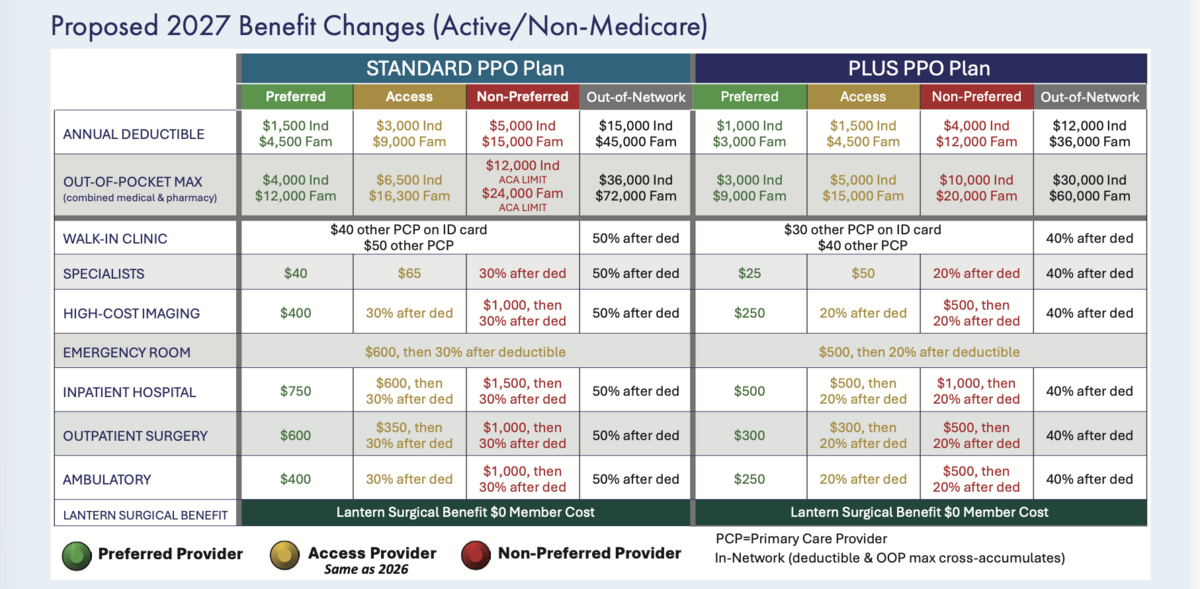
In 2027, the State Health Plan will move to a four-tier provider network: preferred, access, non-preferred and out-of-network. Members who receive care from preferred providers will pay the lowest premiums, copays, deductibles and out-of-pocket costs. Meanwhile, the State Health Plan also saves money through more favorable contracts negotiated with those providers.
Costs for members using access providers will remain largely unchanged from today, while those who choose non-preferred providers will face significantly higher out-of-pocket costs.
For example, a member enrolled in the Standard PPO plan who visits a specialist will pay a $40 copay at a preferred provider, a $65 copay at an access provider, or 30% coinsurance after meeting the deductible at a non-preferred provider.
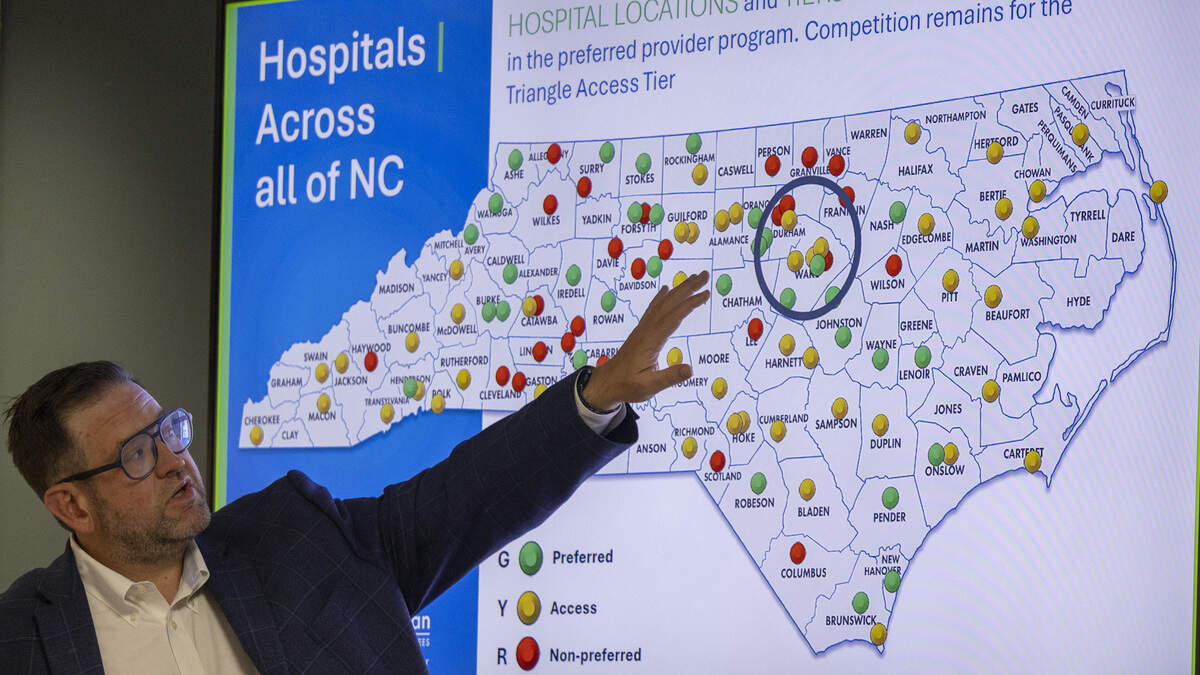
Board members went into closed session at about 10:30 a.m. to discuss which hospital systems would get preferred-provider status, along with related benefit changes and premiums. Plan officials said all major health systems in the state have been invited to participate in the preferred system, but that not all would be picked. When they emerged, they announced that Novant Health, UNC Health and Iredell Health Systems would get preferred-provider contracts, signing on as full systems. That means all care provided there will be charged at the preferred provider rates starting in 2027.
Friedman said Friday that the access tier in the Triangle was still being negotiated and that it would be either WakeMed or Duke.
Atrium Health, Granville Health and some Duke LifePoint facilities were designated as non-preferred providers.
In urban areas, members will have both preferred and non-preferred hospital options. In rural areas, however, where hospital systems are less able to lower costs, providers will remain in the access tier. Negotiations have so far focused on larger health systems and Briner said negotiations were ongoing.
Despite growing healthcare costs, Briner said that state employees could drop their healthcare spending down to where it was 15 years ago, if they go to preferred providers.
Earlier this year, the plan’s board of trustees had already approved contracts with three clinically integrated networks, or groups of health care providers: Aledade, Community Care Physician Network and UNC Health Alliance. Last year, the plan also implemented a surgical benefit with Lantern, a specialty care platform, to offer certain surgeries at no cost to plan members.
Hospital systems are being offered multi-year contracts to provide greater stability and avoid forcing members to repeatedly change providers. Emergency care at any emergency department will be covered at the access level regardless of the hospital’s network designation.
Maternity, cancer care and transplant benefits will remain unchanged for at least the first year after the new network takes effect in 2027. Deductibles and out-of-pocket maximums will cross-accumulate across all in-network tiers.
Premiums for 2027
More premium increases are coming in 2027 for most everyone covered by the State Health Plan.
Increases for 2026 were approved in 2025 for active members, using a sliding scale based on salary — those who earn less saw lower increases, those who earn more saw higher ones. Higher deductibles and other plan design changes were also approved that year. Medicare Advantage members will see separate increases and benefit changes in 2027, approved by the board in June.
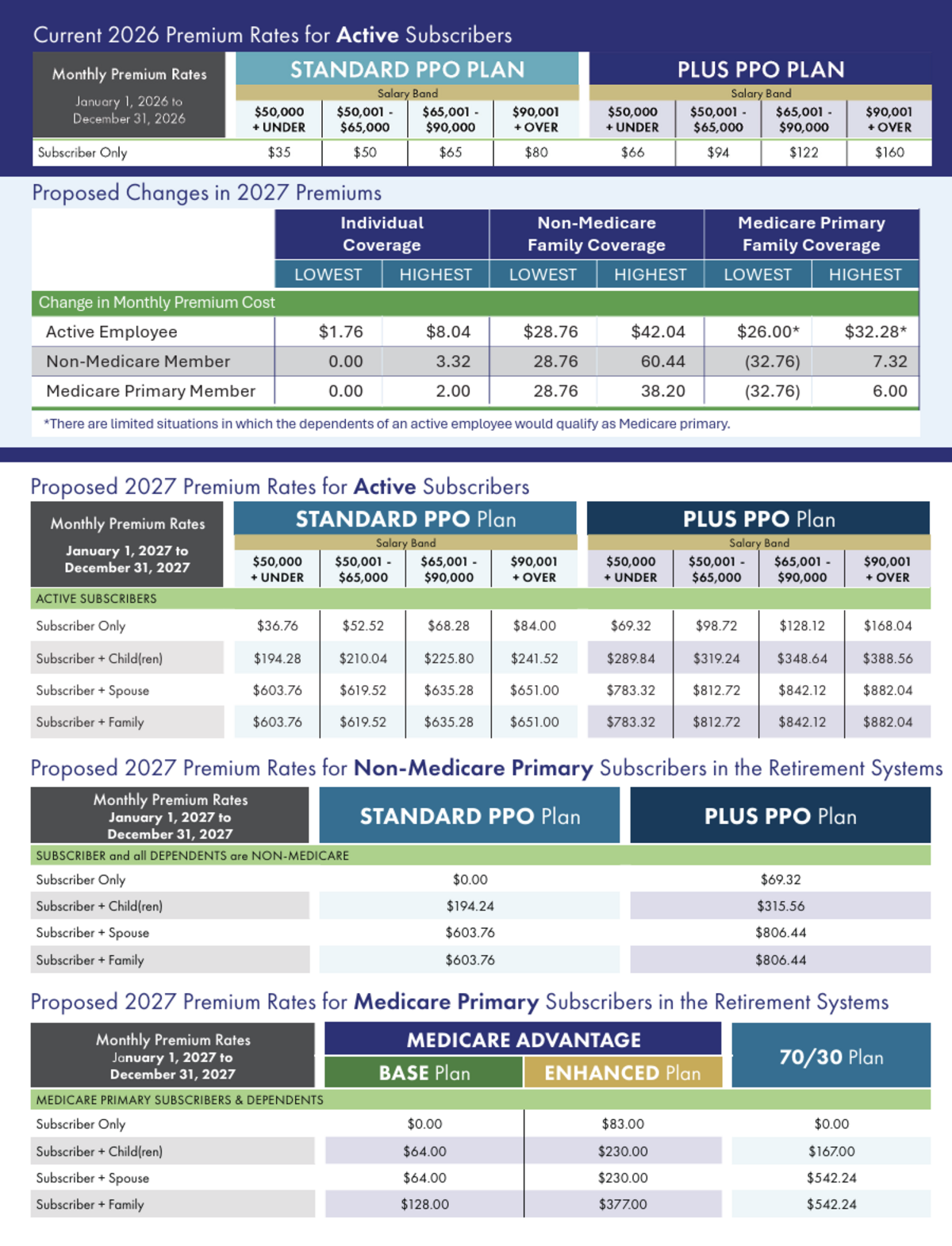
On Friday, what was unveiled and voted on is a flat 5% increase on most everyone’s current premium.
A single subscriber on the Standard PPO plan who earns between $50,001 and $65,000 currently pays $50 a month. Their premium would go up by 5%, or $2.52.
That 5% increase applies across every salary band for active employees. But the dollar amounts vary depending on how much someone earns and the plan they are on.
For individual coverage for active employees, the monthly increase ranges from $1.76 for the lowest-earning employees to $8.04 for the highest earners. Family coverage for active employees costs more to begin with, so the increases are bigger, too — from about $26 to $42.04 more per month.
Two groups see no increase at all for individual coverage: non-Medicare retirees on the Standard PPO plan and Medicare-primary retirees on the Medicare Advantage Base Plan and the 70/30 Plan. They all stay at $0. Retirees adding dependents, however, will still see an increase.
There are more changes. Later in the day, at 1:30 p.m., plan officials are holding a press conference where they will announce who won the contract to serve as the plan’s third-party administrator for health benefits, and who will administer pharmacy benefits. Aetna currently holds the health contract, and CVS Caremark the pharmacy benefits contract.
This story was originally published July 10, 2026 at 11:15 AM with the headline "NC State Health Plan approves new premium hikes, picks preferred network hospitals."