After 13-year-old’s killing, NC lawmakers push tougher gang prosecution
AI-generated summary reviewed by our newsroom.
- Jaleeyah’s Law would impose tougher penalties for soliciting or giving guns to minors.
- The bill lowers the threshold to label someone a gang member from three criteria to two.
- The bill would let expert witnesses alone prove gang activity, membership, or leadership.
After a 13-year-old girl was killed in Goldsboro last year, state lawmakers are considering legislation aimed at prosecuting and deterring gang violence.
Known as Jaleeyah’s Law — named after Jaleeyah “Lee Lee” Tune — the bill would require stricter punishments for crimes like providing guns to minors, as well as add to definitions of criminal gangs and gang violence already enshrined in state law.
Jaleeyah was killed in Goldsboro the week before Christmas last year. Three teenagers were arrested and charged in connection to her death, ABC 11 reported.
Jaleeyah’s mother, Whitney Brown-Tune, spoke to lawmakers at a committee meeting on Tuesday.
“Our lives are forever changed,” she said. “ ... We’re hoping to make change, save lives with prevention, intervention and being aware. And bringing spaces for these kids so that we can try to make a difference within our community.”
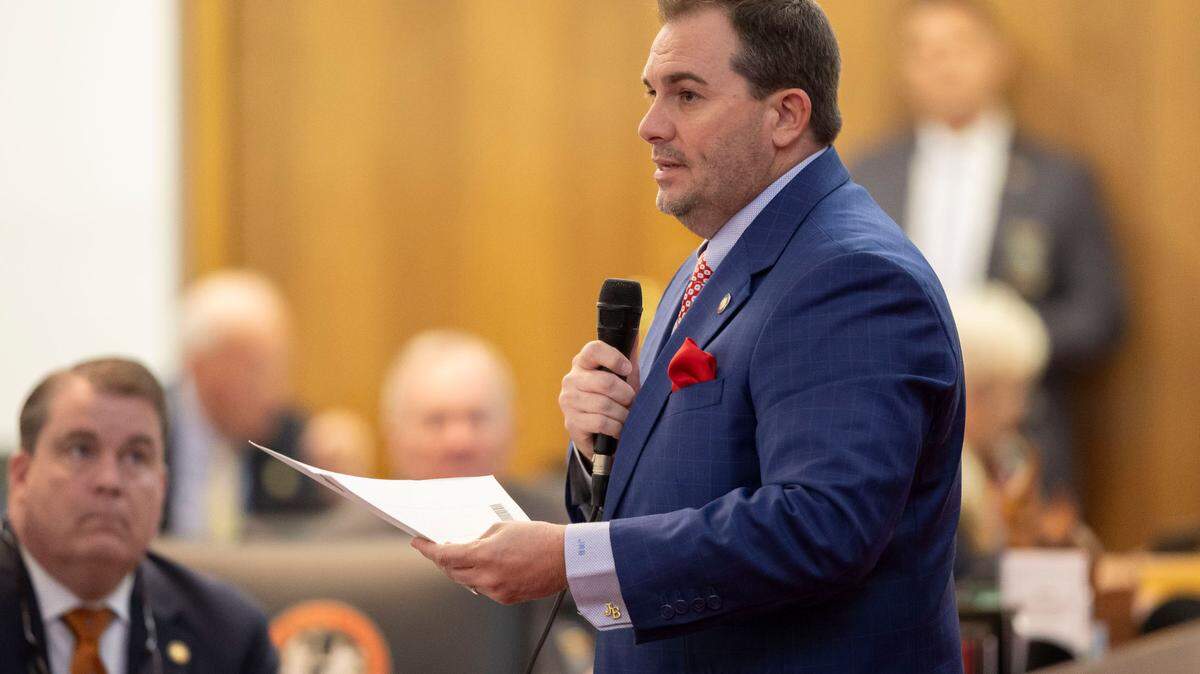
Rep. John Bell, a Goldsboro Republican, said he met with Brown-Tune and the family who “wanted to do something in a big way to help make sure that hopefully, this will never happen to another family in this state again.”
Critics of the bill said the new definitions could be too broad and criminalize people who are associated with gangs but have not committed a crime.
The bill passed the House Judiciary 2 Committee and was sent to the Rules Committee, which is usually the last stop before the floor of the House.
Gang member criteria
The bill would reduce the number of criteria it takes to be labeled as a gang member from three to two. Some of the criteria include using symbols or hand signs associated with a criminal gang, wearing colors or a style associated with a gang and appearing on social media “to promote a criminal gang.”
Bell during the committee meeting said some members might oppose that section because it “raises First Amendment or due process issues.”
“However, it is important to point out that we are not convicting people merely for being a gang member,” he said. “Being a criminal gang member is just one element of the crime, and that conviction requires that a member engage in a criminal gang activity, which encompasses drug trafficking and sex trafficking, homicide, etc.”
Rep. Deb Butler, of New Hanover County, said to Jaleeyah’s family that she was “sorry for your loss ... and certainly everybody on this committee wants to ensure that we are tough on gang violence and that we put people who are guilty of crimes in jail.”
Butler, a Democrat, said that the committee does not want to “create a dragnet so broad that it targets people who are merely guilty by association.”
“Casting a broader net is something that I see this bill attempting to do, and I’m not so sure that that is advised,” she said.
Reighlah Collins, policy counsel for the American Civil Liberties Union of North Carolina, told lawmakers that “what happened to Jaleeyah is a horrible tragedy, but this law isn’t the solution.”
“A lot of the criteria includes things that, when considered individually, are forms of protected speech,” she said.
Other specifics of the bill
The bill would also bump up the felony class of crimes already enshrined in state law.
Soliciting or coercing a minor to participate in criminal gang activity is proposed as a Class D felony rather than Class F.
While felony punishment in North Carolina depends on multiple factors, Class D punishments are harsher than Class F.
A criminal gang member giving or selling a firearm to someone under the age of 18 would be considered a Class G felony.
Also, the bill would not require testimony from a factual witness, or someone with a firsthand account of what happened, to prove criminal gang activity, membership or leadership. The bill would allow expert witnesses alone to prove those allegations.
Butler said that factual witnesses are “obviously the best,” and “what we don’t want is purely expert testimony, a specialist about gangs who comes in and says, ‘This is what this gang symbol means. This is what this color means. This is what this behavior means.’”
“They are sometimes able to convince a jury of something that no one actually witnessed, and we don’t want that,” she said.
Task force developing recommendations on gangs
Reported crimes involving gangs have dropped overall in North Carolina, but those involving juvenile gang members rose nearly 50% in five years to 587 in 2024, The News & Observer previously reported. That’s according to data from a national reporting system.
Gov. Josh Stein established the Gang Prevention and Intervention Task Force by executive order last summer.
The Tune family spoke about Jaleeyah and their work with Bell at the task force’s most recent meeting, according to the North Carolina Department of Public Safety.
In a statement to The N&O, Caroline Farmer, executive director of the Governor’s Crime Commission, said the members “listened closely.”
“We will be keeping an eye on HB 1173 as we develop recommendations to reduce the presence and impact of gang activity in North Carolina,” she said.
This story was originally published June 8, 2026 at 5:00 AM with the headline "After 13-year-old’s killing, NC lawmakers push tougher gang prosecution."