What teacher protest will demand from NC lawmakers, and where things stand
AI-generated summary reviewed by our newsroom.
- Thousands of North Carolina teachers plan a downtown Raleigh march with policy demands.
- NCAE demands $20,000 per student by 2030 and at least 25% pay increases.
- NCAE seeks keeping the corporate income tax and restoring collective bargaining.
Thousands of teachers are expected to march in downtown Raleigh on Friday with a long list of demands for state lawmakers.
The demands from the North Carolina Association of Educators’ “Kids Over Corporations” rally include higher teacher pay and more public school funding. The list also covers other areas including ending private school vouchers and keeping the state’s corporate income tax.
Here’s a look at some of the NCAE demands and the challenges they’ll face getting them approved by the Republican-controlled General Assembly.
Increase per-pupil spending
NCAE wants state lawmakers to spend $20,000 per student by 2030, which would make North Carolina the highest in the Southeast.
A new report from the National Education Association said North Carolina has dropped to 46th in the nation in per-pupil spending. NEA estimated that the state is spending $13,680 per student this school year, which is $5,190 below the national average.
State lawmakers didn’t adopt a budget for this fiscal year. So, aside from a few adjustments, schools are largely being funded by the state at 2024-25 school year funding levels.
Republican legislative leaders note that the state has spent more money on education every year.
Increase school employee pay
NCAE wants state lawmakers to increase pay for teachers and other school employees by at least 25%.
The new NEA report estimated that North Carolina had dropped this school year to 46th in the nation in average teacher pay. NEA estimated the average salary for a North Carolina teacher is $59,971, an amount that includes both state base pay and local salary supplements.
One of the reasons for the budget impasse has been the amount of teacher raises. Both Democratic Gov. Josh Stein and House Republicans want to raise starting teacher pay, including supplements, to the highest in the Southeast. Senate Republicans want to raise teacher pay, but not as high as House Republicans want.
House Speaker Destin Hall said he wants “to make North Carolina a leader on teacher pay.”
The House and Senate will have to agree on a final amount of teacher raises . On Wednesday, Hall told reporters that they are “relatively close” on a deal.
Stein and House Republicans want to raise starting pay to around $50,000 a year, and to reduce a mid-career pay plateau. In the fall of 2025, the legislature passed a small spending bill that also authorized step-increase raises for teachers, so some teachers did receive raises from the state in 2025.
Eliminate private school vouchers
The NCAE was part of unsuccessful state lawsuits trying to stop the creation of the Opportunity Scholarship program. The program has gone from originally serving only low-income families to now being open to every family in the state regardless of income.
As of April 6, a record 106,789 students are getting $586.7 million in private school vouchers. A majority of the state’s private school students are getting a voucher since state lawmakers allowed existing private school families to join the program.
Republican lawmakers have promoted Opportunity Scholarships as a way to expand school choice and have rejected calls to end or scale back the voucher program. It has been a non-starter for them to eliminate the program, as it aligns with thinking that public money follows the student if they choose not to go to a public school.
End corporate tax breaks
NCAE says the state “should end corporate tax breaks and redirect that money to public schools and healthcare.” NCAE has produced what it calls an invoice for $3 billion it says corporations owe public schools due to the state steadily lowering the corporate income tax rate.
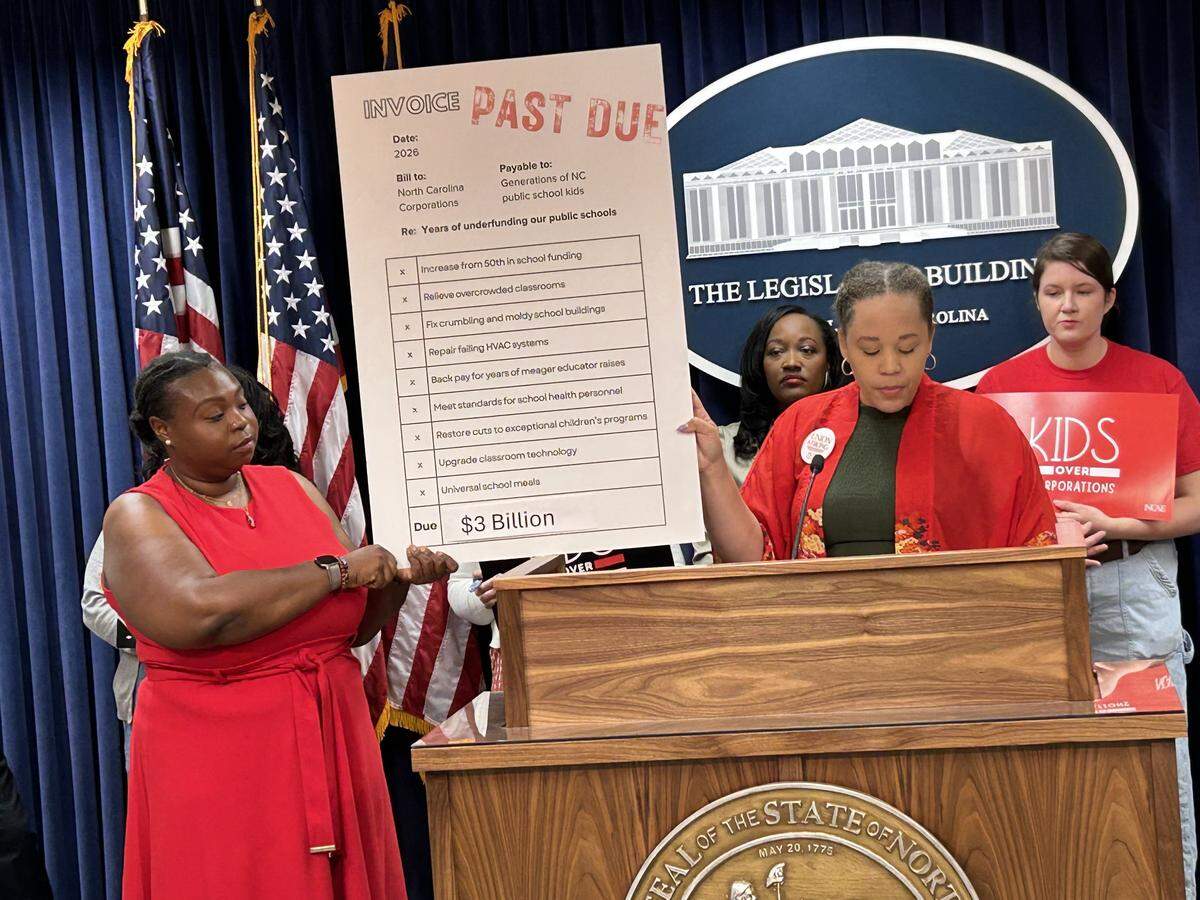
Now the state is scheduled to phase out corporate income taxes altogether by 2030. NCAE has backed a bill from Democratic state Sen. Natalie Murdock to keep the corporate income tax and raise it to 5%.
The corporate income tax rate for 2026 is 2%. However, the speed of future corporate income tax cuts, as well as individual income tax cuts, are being negotiated as part of the budget deal. The vast majority of the state’s revenue comes from individual income taxes, not corporate income taxes.
Pass fair maps
NCAE says the public needs to “reclaim our democracy.” That includes passing election maps that aren’t as heavily favored to help Republicans win seats in the General Assembly and Congress.
In 2025, Republicans passed maps that give the GOP an advantage in NC-1, the Eastern North Carolina congressional district currently held by Democratic U.S. Rep. Don Davis.
Allow collective bargaining
NCAE wants the state to lift the ban on collective bargaining for public school workers.
Democrats in the legislature have long pushed to overturn the ban on collective bargaining, but that too has been a nonstarter with Republicans.
The ban, which became law in 1959, means that public sector employees do not have negotiating power. North Carolina has one of the lowest union membership rates in the country.
Other demands on the NCAE list include providing free school meals for all students, protecting voting rights, making “the wealthy finally pay what they owe” and working to “protect the constitutional rights of all.”
This story was originally published April 30, 2026 at 5:30 AM with the headline "What teacher protest will demand from NC lawmakers, and where things stand."