NC Republicans may soon outnumber Democrats. But they’re competing for 2nd place
AI-generated summary reviewed by our newsroom.
- Registered unaffiliated voters outnumber Republicans and Democrats in NC.
- Republicans may soon surpass Democrats in registration, trailing only independents.
- Younger voters and distrust in parties fuel rise of independent political identity.
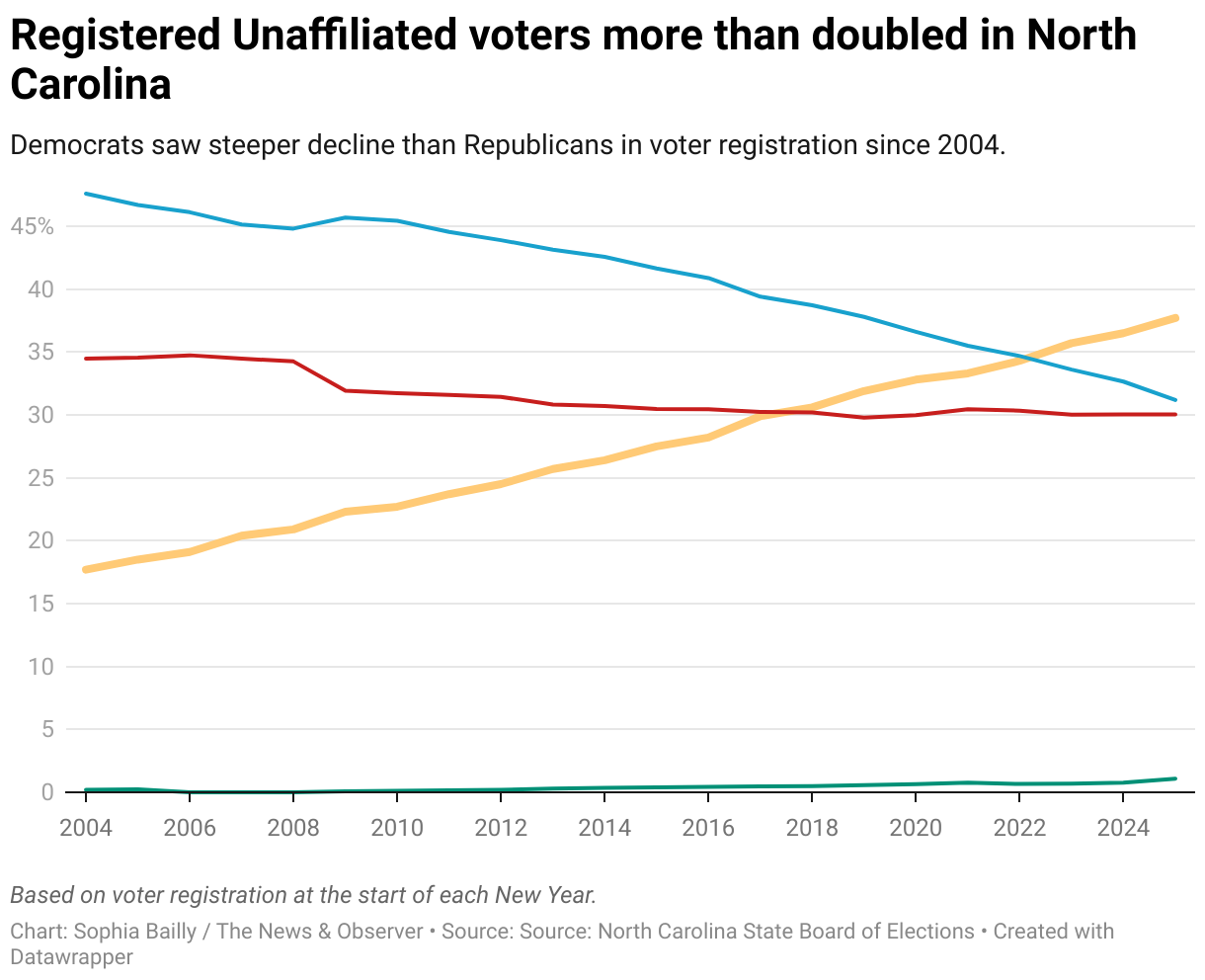
Typical for a purple state, North Carolina’s two major political parties are neck-and-neck for the No. 2 spot in voter registration — behind unaffiliated voters — with Republicans projected to surpass Democrats for the first time in the state’s history.
Driving the shift, experts say, are multiple factors, including disillusionment with the parties, fear of public backlash for identifying with one or the other, and an independent-focused movement from younger voters.
The largest number of North Carolina voters has abandoned party registration altogether and has instead opted to be unaffiliated. North Carolina first introduced the unaffiliated category in the late 1970s, before the Republican party opened its primaries to unaffiliated voters about a decade later. Democrats followed suit in the mid-1990s, and unaffiliated voters were officially cleared to vote in either of the state’s primaries.
In 2017, the unaffiliated category surpassed the Republican Party in voter registration; about two years ago it took the lead above Democrats, and it has continued gaining traction.
Now, Republicans and Democrats are vying for second place. That status might indicate success for a party — but it means little if those voters are not engaged and committed to the party and its candidates, said Davidson College political science professor Susan Roberts.
“Registration does not always turn into votes,” Roberts said.
A two-party toss-up in North Carolina
Historically, North Carolina Republicans have fared better in federal elections, while Democrats tend to more easily clinch state leadership races.
According to Chris Cooper, a political science professor at Western Carolina University, Republican registration has remained steady since the late 1970s, while the number of registered Democrats in North Carolina has gradually declined.
With about 100,000 party switches per year among the state’s roughly 7.8 million registered voters, Cooper said switches barely factor into the state’s shifting political landscape. Rather, he said, generational replacement has the largest impact on voting demographics as people are born, die and migrate in and out of the state.
North Carolina Republicans have made notable gains in the state’s political scene over the past few decades.
Mac McCorkle, a former political consultant and current Duke University professor, said he traces a shift away from strong Democratic allegiance back to 1972, when the late Republican Jesse Helms won North Carolina’s U.S. Senate race and began his 30 years in the Senate.
The GOP cemented its gains by taking over the General Assembly majority in the 2010 elections. But the state remains purple, with rural, conservative voters balancing urban, liberal voters. Both parties need to engage with voters outside of their typical demographics to expand their bases, McCorkle added.
The unaffiliated electorate is composed of both die-hard independents and partisan-leaning voters who opt for a more neutral alias, according to McCorkle.
The lack of strong party allegiance among North Carolina’s liberal base has lent itself to unaffiliated appeal, especially among younger, college-educated liberals, McCorkle said.
Still, it’s hard to pin down unaffiliated voters as leaning one particular way.
“I do not believe that there is a hidden Democratic or liberal majority in the state,” he said. “I think the Democrats are just a tad behind, or it’s very close.”
Voter registration only tells part of the story
For Anderson Clayton, chair of the North Carolina Democratic Party, registration only tells part of the story, especially with the state’s semi-open primary structure and unaffiliated voters’ strong lead. Additionally, she said the semi-open primary structure allows liberal-leaning unaffiliated voters to cast a ballot in Republican primaries to create their ideal general election match-up between the two parties.
“I don’t rely on voter registration as much to tell me how somebody’s going to vote in an election,” Clayton said. “A lot of it is strategy.”
The state party’s priority is the needs of North Carolina, Clayton added, and educating residents about upcoming elections and their influence is always a priority. The party launched a rural tour to visit about 54 counties throughout eastern and western North Carolina to local, state and federal election engagement.
“I really don’t care how you’re registered,” Clayton said. “I think that you care about what’s happening in Raleigh, and I think you also care about what’s happening in Washington, D.C.”
Meanwhile, Matt Mercer, the communications director for the North Carolina Republican Party, said the Republican Party is focused on attracting fringe voters to become “reliable Republican voters.”
“We think that these voters can actually become Republicans based on where their values are,” Mercer said.
Mercer noted the party’s recent success in local elections in Democratic strongholds as a sign the Republican party could gain more traction through local and state elections. President Donald Trump’s political influence over the past decade has drawn more attention to the party overall, Mercer said, which has helped broaden the GOP coalition.
Mercer said he thinks the GOP’s recent success in flipping largely blue county seats signals that Democratic strongholds across the state could have more conservative representation than previously expected.
“It’s [about] identifying those people who are Republicans, but they don’t know it yet,” Mercer said.
Younger voters’ influence
The social benefits of being unaffiliated have risen, according to Cooper.
Because voter registration is public record, being unaffiliated can help prevent friends, family or employers from passing judgment.
“People are now discriminating more based on partisanship than race,” Cooper said. “In other words, it’s more acceptable to date across racial lines than to date across partisan lines.”
Historically, voters ranging from 18 to 24 years old vote at the lowest rate among all age groups. The unaffiliated category is the largest voting group for registered voters below the age of 45; for those older, it’s the smallest group.
Younger people might “not be sure where they stand” politically, according to Roberts, the Davidson College professor.
Growing distrust among youth in the electoral process has made the younger pool of voters more likely to engage in community activism and projects — such as marches or protests — than turn out to vote.
Winning elections
North Carolina’s 2026 midterm elections include all 14 U.S. House seats and all 120 seats in the state’s General Assembly. U.S. Sen. Thom Tillis’ seat will also be filled in what is expected to be the most expensive race.
Raising voter turnout among already loyal Democrats or Republicans will be campaigns’ first objective, Roberts said.
Political campaigns gain little from spending valuable time and effort trying to persuade other voters to cast a ballot for their candidates, according to Roberts.
Determining which unaffiliated voters lean which way is a difficult task, Cooper said. It requires time and money for political parties and campaigns to sift through data to find what Cooper said are called “shadow partisans” – voters with partisan leanings who register as independent voters.
But regardless of how many “shadow partisans” exist, according to Cooper, unaffiliated voters could pose more of a threat to Democrats and Republicans than the two parties do to each other.
Unaffiliated candidates don’t win elections. As more eligible voters gravitate toward a political affiliation with little to no power, the Democratic and Republican bases will dwindle, leaving slim pickings for the two parties’ candidate recruitment.
“I think the warning shot should come to both parties that people are opting out of the party system,” Cooper said.
“And they can shrug that off in the short run,” he said. “But in the long run, it’s going to create a real problem for parties, for candidate recruitment, and ultimately, really for democracy.”
This story was originally published July 16, 2025 at 5:00 AM with the headline "NC Republicans may soon outnumber Democrats. But they’re competing for 2nd place."