NC House passes bill banning books with sexual activity from school libraries
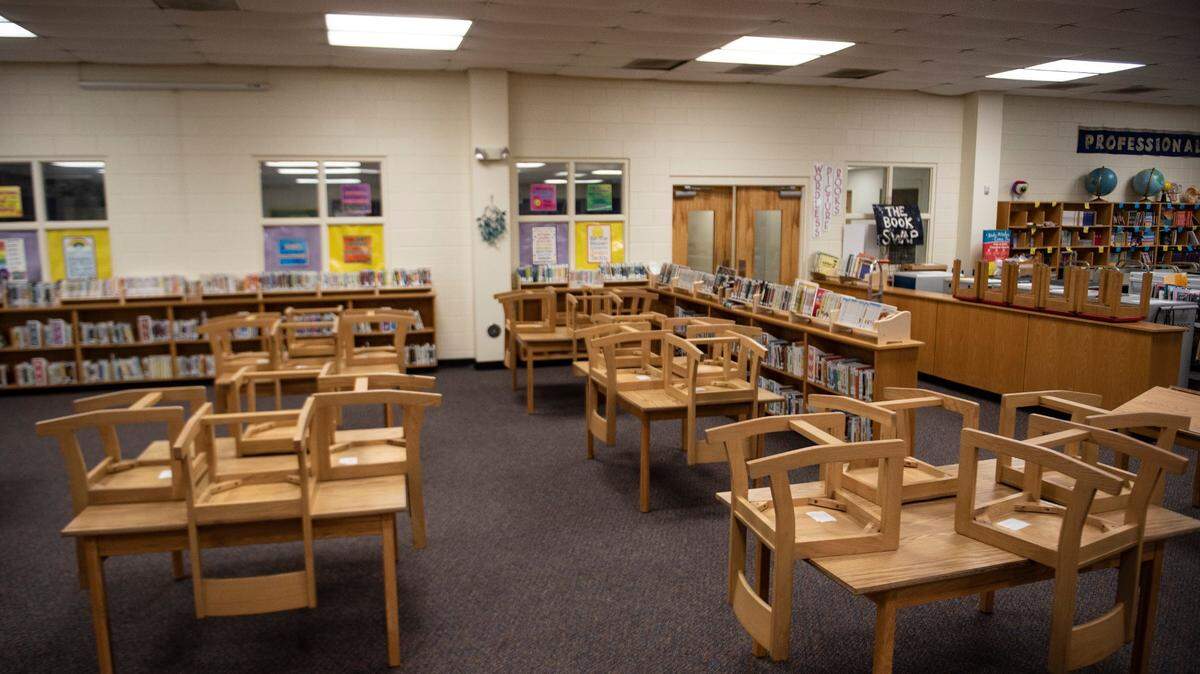
North Carolina House Republicans have passed legislation that would allow the public to sue schools for having library books that they feel are harmful to minors.
The state House voted 63-46 on Wednesday to pass a bill that says schools will not have books in school libraries that include “descriptions or visual depictions of sexual activity or (are) pervasively vulgar.”
The “Promoting Wholesome Content for Students” bill would allow people to seek damages of up to $5,000 per violation of the bill.
The bill comes amid a raging debate in North Carolina and nationally about whether school libraries contain books that are too sexually explicit. Many of the targeted books feature LGBTQ+ themes and characters.
“Very simply, it’s about pornography and not allowing pornography in our public school libraries.” said Rep. Neal Jackson, a Moore County Republican and one of the bill’s primary sponsors.
Democratic lawmakers argued that the bill will lead to book banning if it becomes law..
“This is in fact book-banning and a very slippery slope because what you define as wholesome may not be the same for me,” said Rep. Laura Budd, a Mecklenburg County Democrat.
The bill now goes to the Senate.
Keep ‘pervasively vulgar’ books out of schools
Under the bill, local superintendents would give the job of recommending new books for school libraries to a 10-member community library advisory committee formed by the district or charter school. The committee would make recommendations for books that are “appropriate for the age, grade level, intellectual development, and ability level of the students that will have access to the library.”
“Library media is not appropriate for the age, grade level, intellectual development, and ability level for any age or age group of children if it includes descriptions or visual depictions of sexual activity or is pervasively vulgar,” the bill says.
The district or charter school would post publicly what materials are under consideration, with a 60-day deadline for the school board to make a decision.
If a book receives at least 10 letters of objections during the review period, the superintendent would refer it back to the library advisory committee to investigate. The advisory committee would make a recommendation on the book challenge to the school board.
The advisory committee would also investigate challenges for books that were acquired before the bill became law.
House Republicans rejected an amendment Wednesday from Rep. Amos Quick, a Guilford County Democrat, to remove the library advisory committee from the bill. Quick said it should be up to the superintendent to recommend books and investigate book challenges.
The bill would require the State Board of Education to maintain a publicly available database of library books rejected by schools.
The bill doesn’t go as far as another bill filed by House Republicans that would subject school librarians to prosecution by removing their exemption from state obscenity laws.
Will the bill lead to book banning?
The bill drew heated debate during the Education Committee meeting on Tuesday.
Rep. Marcia Morey, a Durham Democrat, argued that the bill could lead to banning of classic but controversial books such as “To Kill a Mockingbird,” “The Color Purple” and “1984” because some people object to individual scenes.
“I have very serious concerns that this is total censorship, that the book ‘1984,’ which has been banned in many libraries, is coming true to be 2025,” Morey said.
But Republicans denied they were calling for book banning. Rep. David Willis, a Union County Republican and one of the bill’s primary sponsors, said they’re talking about books that could get people arrested if they were read aloud in public to children.
“No one is going to get arrested for reading ‘The Color Purple,’” Willis said. “No one’s going to get arrested for reading ‘1984.’ You might get arrested if you’re standing there talking about how to penetrate yourself with toys as a 9-year-old. Thank you. That’s what we’re talking about.”
Examples of books that critics have targeted at school board meetings around the state include:
▪ “Gender Queer: A Memoir” by Maia Kobabe. It’s an autobiographical graphic novel that explores Kobabe’s path to identifying as nonbinary and asexual. It was cited by then-North Carolina Lt. Gov. Mark Robinson because of some illustrations of people having sex.
▪ “Lawn Boy” by Jonathan Evison. It’s a coming-of-age story about a 22-year-old man who is growing up in poverty. It’s been challenged for scenes such as describing how two young boys engaged in oral sex while at a youth group gathering at their church.
Multiple Republican lawmakers said the bill isn’t a ban because parents on their own can get any books removed from school libraries.
“If you want your children to look at pornography or inappropriate stuff, order it off of Amazon or go to the public library,” Jackson said. “When it comes to the school library we say we don’t want it there.”
House Democratic Leader Robert Reives accused Jackson of taking cheap shots at Democrats by accusing them of wanting children to be exposed to porn.
Bill allows lawsuits over book violations
An earlier version of the bill said people could seek damages for violating the Parents’ Bill of Rights law. That was clarified Tuesday to refer to violations of this legislation.
Under the new proposal, a parent or resident of a county in which a school district is located can seek civil remedies such as declaratory relief, injunctive relief, damages of $5,000 per violation, reasonable attorneys’ fees and costs, and any other appropriate relief in the determination of the court..
People would need to exhaust all administrative remedies before they can file a lawsuit.
“This is a parent-initiated thing, and it’s all about protecting our kids,” said Jackson, the legislator. “So we’ve tried to keep it very focused and very centralized, that it is about keeping pornography and stuff that we do not want children and that is harmful for our children to be exposed to.”
But Democratic lawmakers said the bill will subject schools to lawsuits from people who aren’t even parents.
“This is a waste of taxpayer money,” said Rep. Phil Rubin, a Wake County Democrat.
‘We are not peddlers of pornography’
School librarians who attended the legislative hearings on Tuesday denied that they’re exposing students to porn.
“I can’t believe I have to say this, but we are not peddlers of pornography,” Julie Stivers, a former Wake County school librarian and past National School Librarian of the Year, said in an interview with The News & Observer. “The word pornography is getting thrown a lot in this bill.
“We do not have pornography in our schools. I don’t know any librarian who has pornography in their schools.”
Rebecca Stacy, the school librarian at Jordan High School in Durham, said they do police the books. She cited how they recently removed a book that was “a little bit racy.”
“We make mistakes when we order books,” Stacy said in an interview. “But we are also trying to do the right thing and make sure that things are age appropriate for our students. That’s something that really does matter for us.”
Staff writer Kyle Ingram contributed to this report.
This story was originally published April 15, 2025 at 4:30 PM with the headline "NC House passes bill banning books with sexual activity from school libraries."