In contested Supreme Court race, NC Republicans test their ability to overturn an election
Ever since November, North Carolina has wrestled with a fundamental question whose answer could have wide-ranging implications for the future of voting both in the state and across the country:
Is an election final once the votes are counted — or can the losing candidate selectively discard ballots until they win?
This is the ultimatum presented by Jefferson Griffin’s effort to overturn his narrow loss in the 2024 state Supreme Court race by challenging over 65,000 votes.
The campaign is unprecedented in its scope; in the legal arguments that Griffin and the North Carolina Republican Party are using to make their case; and in the solution that the courts have moved to impose.
As Griffin’s challenge continues to painstakingly wind its way through the courts system, voters, activists and politicians are watching intently, wondering what sweeping precedent could be set by overturning the results of an election.
As Western Carolina University political scientist Chris Cooper put it: “Pandora’s box doesn’t even begin to describe what would be opening up if he ends up winning.”
Where the election stands now
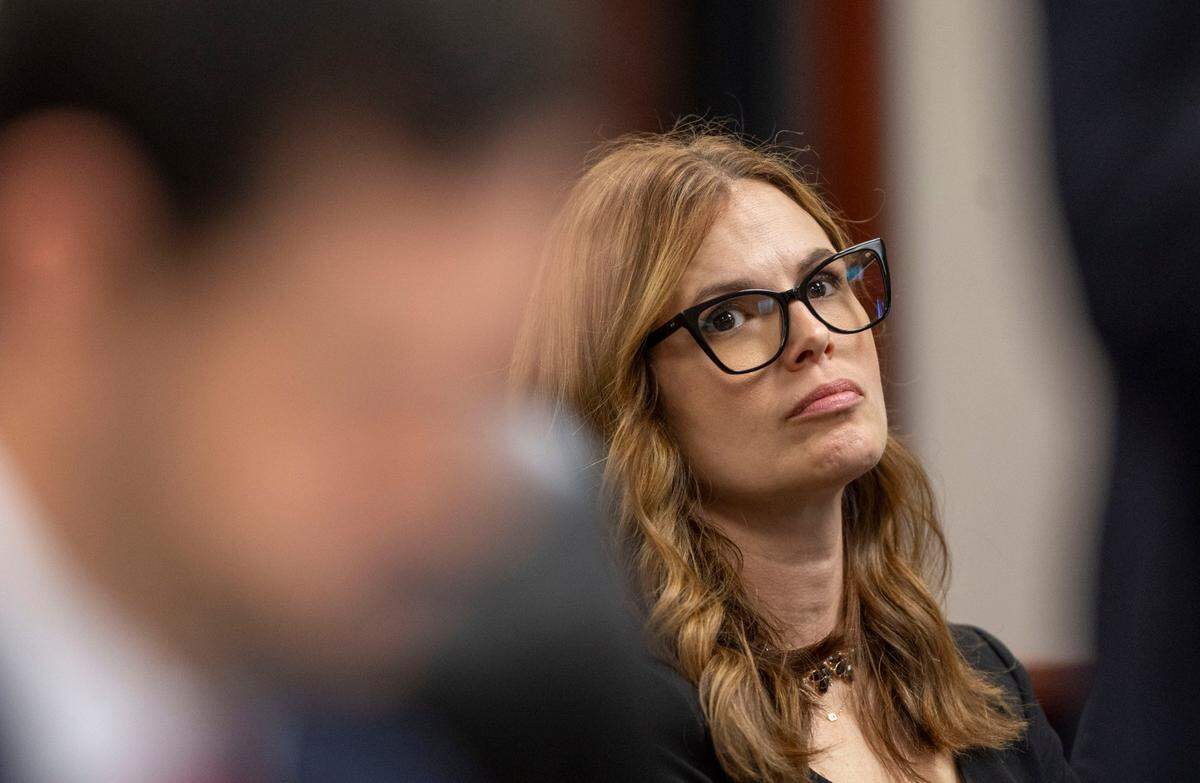
Two recounts confirmed that Griffin’s opponent, Democratic incumbent Allison Riggs, won by 734 votes — a narrow margin, to be sure, but such is often the case in a purple state with increasingly expensive and contentious judicial races.
But rather than conceding defeat, as Democrat Cheri Beasley did in 2020 after a recount confirmed her 401-vote loss to Republican Paul Newby, Griffin and state Republicans instead embarked on a legal battle to discard votes on a scale heretofore unseen in the state’s history.

His arguments, which have never before been used to cancel votes after an election, largely revolve around registration and ID rules that he concedes are likely not the voters’ fault. Nevertheless, he suggests these perceived violations should disenfranchise citizens who have participated in North Carolina elections for years without issue.
Most recently, the state Supreme Court on Friday ordered that some challenged ballots would be thrown out and a larger number of voters would be given 30 days to prove their eligibility or risk having their votes thrown out, too. The court, however, reversed an order by the state Court of Appeals calling into question a much larger number of ballots, over 60,000. These votes will counted, based on Friday’s ruling.
The case may ultimately be headed for federal courts, which have reserved jurisdiction over any outstanding federal issues that are not resolved at the state level.
What’s the justification for throwing out NC ballots?
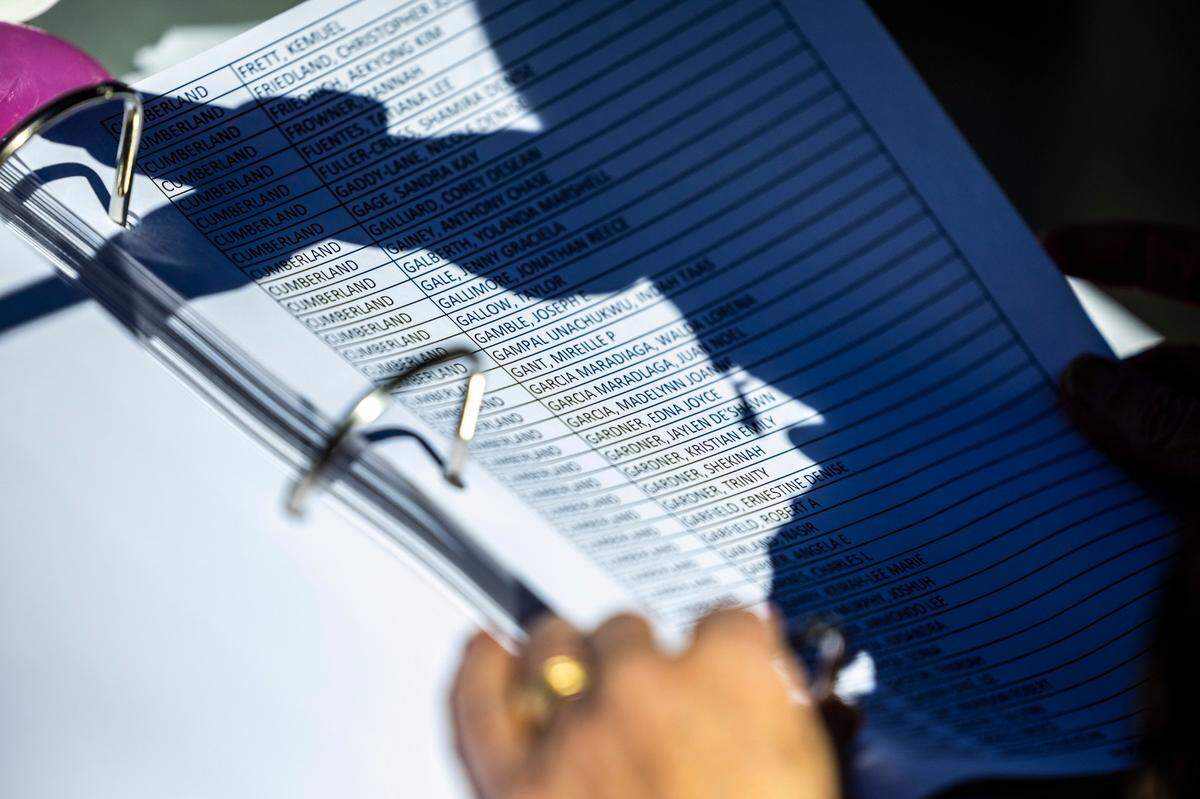
The stage was set for Griffin’s case well before any ballots were cast.
In the summer of 2024, the Republican National Committee and the NC GOP filed a flurry of lawsuits against the State Board of Elections alleging that a litany of registration and voting practices could lead to ineligible votes being cast.
One of their most notable lawsuits sought to purge 225,000 voters from the state’s rolls because they lacked a driver’s license number or Social Security number in the voter registration database.
A Trump-appointed federal judge eventually dismissed part of the case and said that, even if the claims did have merit, there should be no court-imposed solution affecting the 2024 election.
But that same argument was revived months later when Griffin came up short in his election. Over 60,000 of the voters included on his challenge list are disputed for having “incomplete registrations” because the identifying numbers did not show up in an initial pull of the state’s registration database.
Griffin’s other challenges also mirror pre-election lawsuits.
He seeks to disqualify certain military and overseas voters who did not provide an ID, even though the State Board of Elections approved a specific exemption to the rule for those voters. And his final protest challenges what he calls “Never Residents.” These are the adult children of North Carolina residents, who live abroad and have never resided in the state, but are American citizens. A law passed unanimously by the legislature in 2011 allows these voters to participate in North Carolina elections, but Griffin argues it’s unconstitutional.
The “Never Resident” issue was raised in pre-election litigation brought by Republicans. The case reached the state Supreme Court, but it never weighed in, allowing the election to go forward with the prior rules in place.
Andy Jackson, a researcher at the conservative John Locke Foundation, said he agrees with many of the issues raised about registration and ID — but not with the remedy Griffin seeks.
“I think that there should be some changes. But after Election Day is not the time to make them,” he said. “You don’t want to get in a situation where folks think, ‘Well, if this is a close enough election, if I just sue, I can alter the outcome on the backside.’”
Much of the arguments so far have centered around Griffin’s incomplete registration argument, as it involves, by far, the largest category of voters.
The State Board of Elections has argued in court that a variety of harmless reasons could account for the missing data. It could be due to clerical errors from the county election worker who processed the voter’s paperwork, or it could be a matching issue with the national Social Security database, which can occur when a voter changes their name.
And in an affidavit, the elections board later claimed that about half of the voters challenged for this reason actually did provide the identifying documents in question — they just didn’t show up in the database.
Griffin’s lawyers have conceded, at times, that this issue is unlikely to be the voter’s fault. The chair of the NC GOP himself, Jason Simmons, told The News & Observer that he was “very sympathetic” to these voters “because, again, they did nothing wrong.”
Nevertheless, Griffin and the party have continued to argue that these votes should be thrown out, saying that the missing identification could result in a vote being counted from an ineligible voter, such as a noncitizen falling through the cracks.
“At bottom, this case presents a fundamental question: who decides our election laws?” his lawyers wrote in legal filings. “Is it the people and their elected representatives, or the unelected bureaucrats sitting on the State Board of Elections? If the board gets its way, then it is the real sovereign here. It can ignore the election statute and constitutional provisions, while administering an election however it wants.”
In the five months of litigation that have followed, Griffin has yet to identify a single voter among his challenge lists who is actually ineligible.
If the case does ultimately go to federal court, Griffin could face an uphill battle defending the specificity of his protests. Riggs and the State Board of Elections have raised the possibility of making a claim to the courts based on the fact that Griffin’s challenges do not apply equally to all voters — violating, they say, equal protection guarantees in the Constitution.
For one, he only challenges voters who cast their ballots early or by mail — anyone who cast their ballot in-person on Election Day is not included. This is because Election Day ballots, unlike other forms, are not retrievable and therefore could not be found and canceled. But Riggs could argue that this treatment unfairly targets voters who used alternative means of voting.
Secondly, Griffin’s challenge to military and overseas voters who didn’t provide ID is limited to only four heavily Democratic counties. His original challenge included only Guilford County, though he later sought to add voters in Durham, Forsyth and Buncombe to this category of protest.
His lawyers claim that this is only due to deadline complications that prevented them from compiling comprehensive data on time. But his opponents could argue that this is another instance of unequal treatment between different classes of voters.
Is there historical precedent for tossing ballots?
Throughout this battle, Griffin has had to argue not only that these issues constitute a violation of the law — but also that it is even possible, within the law, to throw out so many votes after they’ve already been cast.
To do so, he’s had to reach back 20 years to another contested election, when the state Supreme Court ordered that over 11,000 ballots be discarded.
In 2004, the results of the state superintendent race were challenged after the State Board of Elections allowed voters to cast provisional ballots outside of their assigned precincts.
It led to a Supreme Court case called James v. Bartlett, in which the court ultimately sided with the challengers in a unanimous decision.
“To permit unlawful votes to be counted along with lawful ballots in contested elections effectively ‘disenfranchises’ those voters who cast legal ballots, at least where the counting of unlawful votes determines an election’s outcome,” the court wrote. “Mindful of these concerns, and attendant to our unique role as North Carolina’s court of last resort, we cannot allow our reluctance to order the discounting of ballots to cause us to shirk our responsibility.”
While Griffin has cited this case as precedent for the remedy he seeks, Riggs and the State Board of Elections argue that the case actually demonstrates precisely why he cannot throw out votes in this situation.
The 2004 election was the first time in North Carolina history that out-of-precinct provisional ballots had been cast.
“By contrast, the voters who Judge Griffin challenges have been told for years, and multiple election cycles, that they can vote in precisely the way they voted in this election,” Riggs’ lawyers argued in legal filings. “Accordingly, Judge Griffin had years to challenge the laws he now wants this Court to take up and overturn.”
This interpretation of the James case was also endorsed in January by Republican Justice Richard Dietz when the Supreme Court weighed in on Griffin’s attempt to bypass the normal appeals process.
“In James, counting the out-of-precinct votes was unlawful under the election rules that existed at the time of the election,” he wrote. “In other words, the State Board of Elections violated the election rules by counting those votes. Here, by contrast, the State Board of Elections complied with the election rules existing at the time of the election. Judge Griffin’s argument is not that the Board violated the existing rules, but that the rules themselves are either unlawful or unconstitutional.”
The James case was ultimately decided by the state legislature after the Democratic candidate, June Atkinson, petitioned lawmakers to determine the outcome of the contested race. Even though the Supreme Court had ruled in the Republicans’ favor, Atkinson still came out on top after the Democratic-controlled legislature overwhelmingly voted in her favor.
Early into Griffin’s case, rumors floated that the legislature would do the same thing this time around, settling the score by voting a Republican in. But a law allowing the General Assembly to decide contested elections does not apply to judicial races.
Playbook for overturning results
While North Carolina may have a history of close and contentious judicial races, the state Supreme Court is not typically top of mind for most voters. But Griffin’s challenge has ignited opposition throughout the state and country.
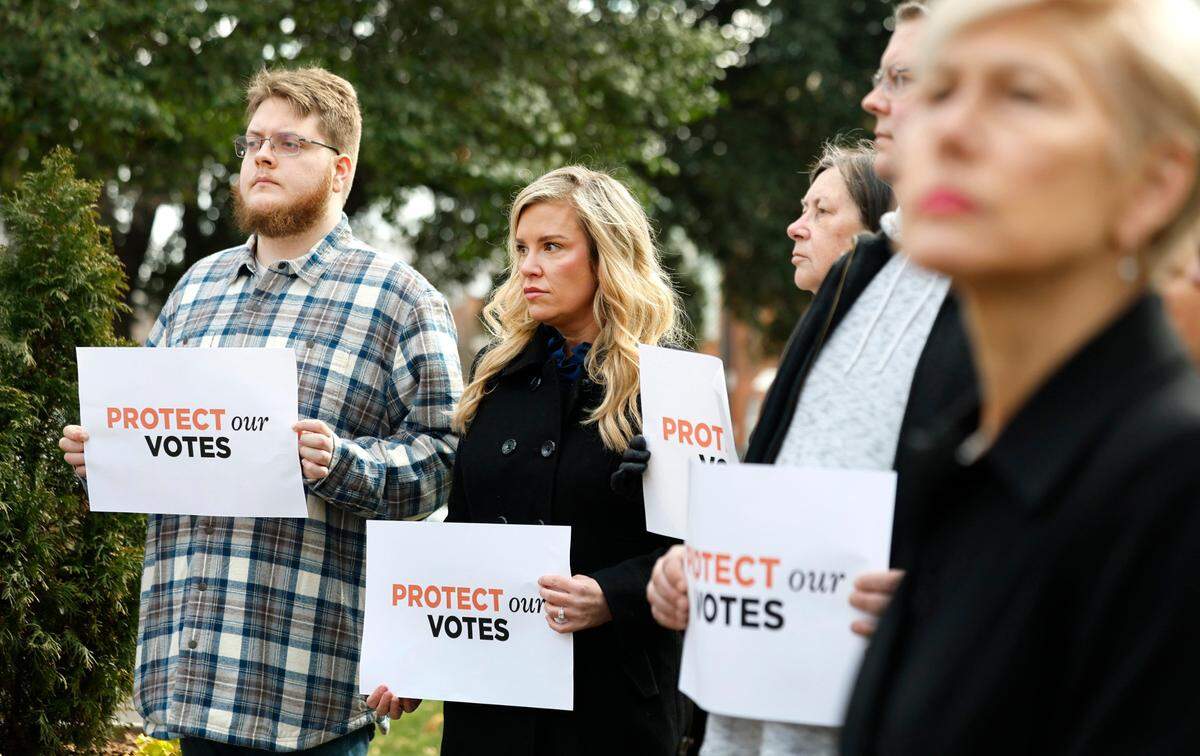
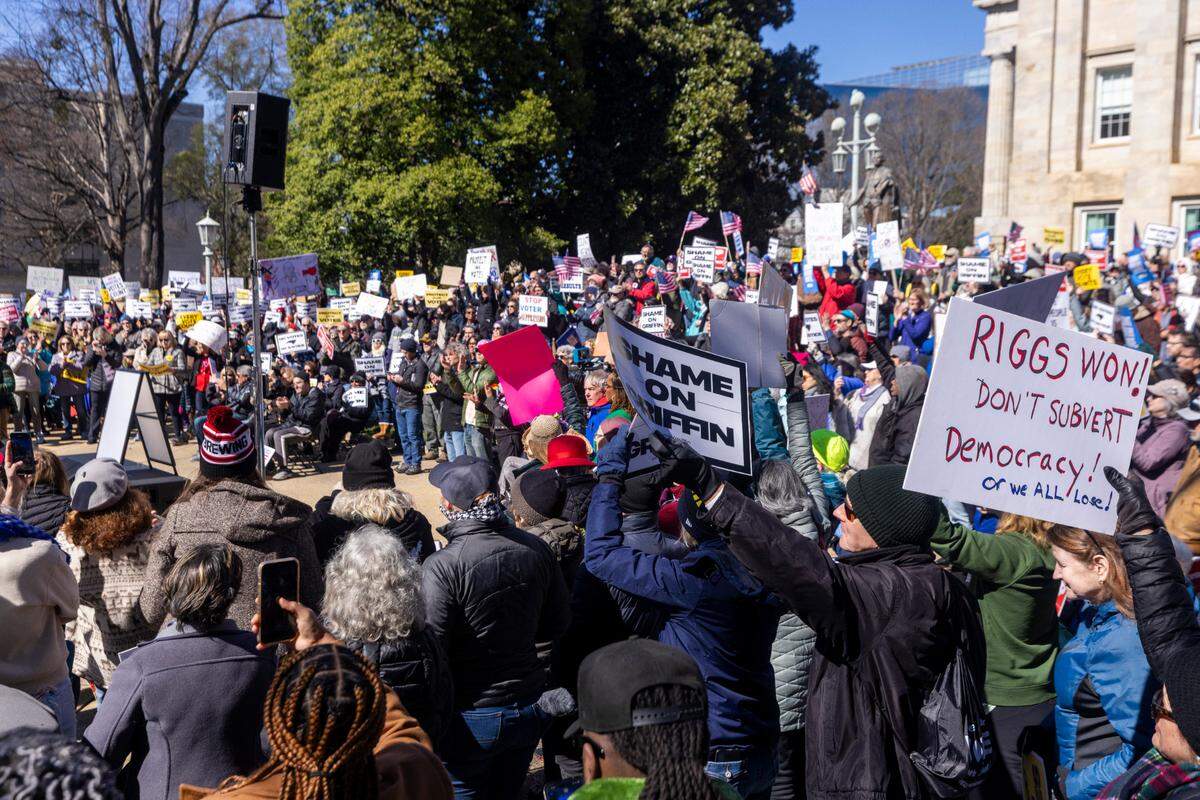
Voting rights groups have organized massive rallies to protest his case. Over 200 judges and lawyers across the political spectrum signed on to a letter calling for Griffin to drop his litigation. And the Democratic National Committee has taken notice, saying Thursday that they’ve begun marshaling resources and volunteers to protect voters.
The stakes, critics say, are high. Not only because of how it would endanger Democrats’ plans to eventually retake control of the 5-2 Republican majority court, but also for the perverse incentives it could create for losing candidates.
“I have no doubt that Republicans, if they prevail here, will use this throughout the country,” DNC Chair Ken Martin said during a press call Thursday. “... When we talk about the insurrection on Jan. 6, this is Jan. 6 with a robe and suits.”
Dietz, a Republican and member of the high court himself, shared the fear of what a Griffin victory could mean for the future of elections.
“Permitting post-election litigation that seeks to rewrite our state’s election rules — and, as a result, remove the right to vote in an election from people who already lawfully voted under the existing rules — invites incredible mischief,” he wrote in a January opinion. “It will lead to doubts about the finality of vote counts following an election, encourage novel legal challenges that greatly delay certification of the results, and fuel an already troubling decline in public faith in our elections.”
Fears about the possibility of an overturned election may sound familiar — hearkening back to President Donald Trump’s false claims that he won his reelection campaign in 2020. Though his attempt to litigate the election results ultimately failed, five years later, another Republican may succeed.
Eliza Sweren-Becker, a lawyer with the left-leaning Brennan Center for Justice, said that Trump’s false claims of election interference “created a fertile ground for this kind of attempt to manipulate and exploit litigation as a way to effectively stop Americans from having their voices heard in our democracy.”
What’s next for challenged voters?
The Court of Appeals’ decision to implement a 15-day cure period for the challenged voters was without modern precedent.
If it had gone into effect, over 60,000 voters would be given just about two weeks to provide identifying documents to election officials or have their votes thrown out in the Supreme Court race.
Throughout their order, the two Republican judges who wrote the majority opinion stressed that, under their interpretation of the James case, they could have thrown out all of the ballots without giving voters a chance to cure them, had they wished to.
Instead, they made the choice to “split the baby,” as Jackson described it.
“It doesn’t give Griffin the satisfaction that he wants, which is to essentially overturn enough ballots that would probably give him the election,” he said. “But it doesn’t satisfy what Riggs wants, which is just to have the whole thing get dropped.”
The sheer scale of the operation ordered by the Court of Appeals, not to mention the cost, drew considerable skepticism from conservatives and liberals alike.
“The likelihood of this cure period working in a fair and consistent manner across the board for every voter involved is a very difficult thing to envision,” Marshall Hurley, former general counsel for the NC GOP, said of the 15-day cure period ordered by the Court of Appeals.
The court’s order gave little details on how the process should be carried out. It did not contemplate how voters who have died since the election could have their ballots cured, nor how military and overseas voters with little access to internet or mail may be reached.
But the cure period, at least as the Court of Appeals envisioned it, will not happen.
Instead, a smaller number of voters — the military and overseas voters who did not provide photo identification — would have 30 days to show ID under Friday’s order by the Supreme Court. It’s unclear how many voters are in that group, but it would be enough to flip the election.
The NC GOP praised the ruling, with spokesperson Matt Mercer saying in a statement Friday: “The decision today brings this election one step closer to a conclusion ensuring every legal vote will be counted.”
However, Riggs is taking the case to federal court seeking to block the Supreme Court’s order.
In the meantime, onlookers continue to fret about the dramatic changes this case may bring — and wonder how it came to this point.
Bob Stephens, former general counsel for Republican Gov. Pat McCrory, blames partisanship, a force he says has been steadily rising in the judiciary over the years. Nevertheless, he has hope that principles will win out over politics.
“I’m trying to hang on to some hope that in the end, that our judicial system will get this thing right,” he said. “And right, in my mind, means you count the votes of people who followed the law and who did nothing wrong.”
This story was originally published April 11, 2025 at 7:30 AM with the headline "In contested Supreme Court race, NC Republicans test their ability to overturn an election."