Could days of cellphones in schools be numbered? NC legislators advance proposed limits
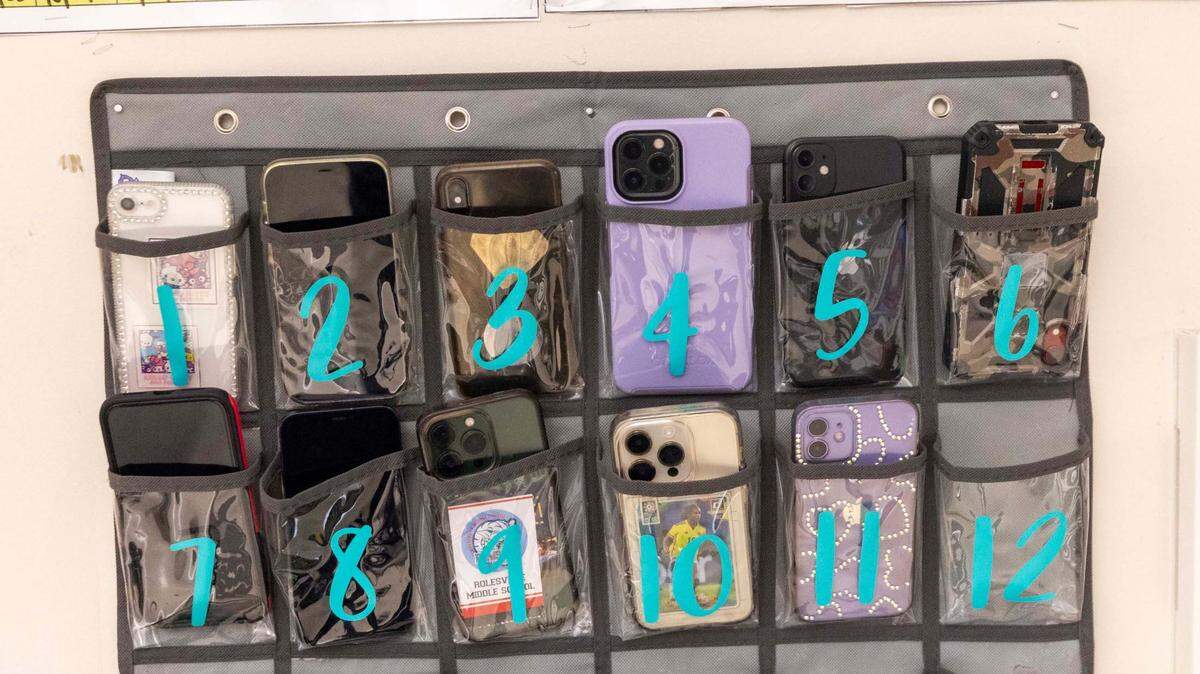
North Carolina’s state lawmakers are moving ahead with plans to limit the ability of students to use cellphones in schools, as other states have already done.
On Tuesday, a House committee backed a bill that requires school districts and charter schools to adopt a policy that eliminates or severely restricts student access to cellphones during instructional time. Then on Wednesday, the Senate Education Committee moved its own cellphone bill ahead.
Both bills are coming amid concerns that students have become addicted to social media and that having their phones on in class is disrupting their ability to learn.
Rep. Neal Jackson, one of the House bill’s primary sponsors, shared a conversation with a Moore County principal about how things have improved since students were required to place their phones in a container when they entered a classroom.
“It removes distractions from the kids,” Jackson, a Moore County Republican, said during the House K-12 Education Committee on Tuesday. “It keeps them from playing games on their phones. It keeps them from cheating and it keeps them from being addicted to their phone.”
The “Cell Phone Free Education Act” moved ahead to another House committee, as did the Senate bill on Wednesday.
North Carolina could join at least 19 states that already have passed laws or enacted policies that ban or restrict students’ use of cellphones in schools statewide or recommend local districts enact their own bans or restrictive policies, according to an Education Week analysis.
Differences in House and Senate school cellphone bills
House Bill 87 only covers cellphones. It also says school boards and charter schools will notify parents of all their students about their Cell Phone-Free Education Policy at the beginning of the school year.
The Senate bill is more restrictive and covers all wireless communication devices, including tablet computers and laptop computers.
Senate Bill 55 requires school boards and charter schools to create a policy that at a minimum prohibits students from using, displaying or having a wireless communication device turned on during instructional time. Schools would establish consequences for violations, including confiscation of the device and any other disciplinary measures.
Republican Sen. Michael Lee of Wilmington, the bill sponsor, said that based on research, having phones off is the best plan, but school district policies could allow phones to be on in emergency situations.
Democratic Sens. Woodson Bradley of Mecklenburg County and Sophia Chitlik of Durham said Wednesday that the short time it may take to turn on a cellphone could be too long in case of a school shooting or other emergency.
“I do share that concern that in an emergency every second counts, and that the time to power on a phone could for some children be the difference between life and death,” Chitlik said.
The Senate bill says schools can make exceptions such as teachers authorizing the use of wireless devices for educational purposes, or if a student has a medical need or if it’s part of their special-education plan.
Sen. Jay Chaudhuri, a Raleigh Democrat who is a parent of students in Wake County public schools, called the legislation “much overdue.”
During the public comment part of the meeting, Tiffany Gladney of advocacy group NC Child spoke in support of the bill, saying, “it’s worth mentioning that smartphones and social media are not all bad.”
“Some research shows that they can make you feel more connected and find more ways to express themselves, but mostly it shows that smartphones are disconnecting our youth,” Gladney said.
Leaves restrictions up to school boards
The legislation comes at a time when there’s wide variation across the state and even within some school districts in how they handle cellphone use. For instance, Wake County have been working on updated phone policy because it varies within individual schools on how to handle cellphones.
Seventy-seven of the state’s 115 school districts have already adopted their own cellphone use policies, according to the N.C. School Boards Association.
Some schools allow students to have phones out when they’re not in class, such as during lunch or while they’re in the hallway changing classes. Some schools have a complete ban all day long.
The legislation doesn’t mandate how restrictive schools should be. Jackson said they’re not telling school boards they have to do it a certain way.
Jackson said the legislation lets schools decide when phones would be allowed in class.
“If you go to Chatham County, they have the little pouches that the kids put it in the pouch with a magnetic thing that the kids don’t have access all day long,” Jackson said. “But in Moore County, they have access in between classes. So we’re not saying there’s one size fits all. We’re saying local control is the best control.”
Phone ban could reduce bullying
Lawmakers and committee members talked Tuesday about how restricting phones during class will make it a safer space for students.
Now students have to worry about classmates video-recording them or putting out a Snapchat post about them in class, according to Rep. Brian Biggs, a Randolph County Republican. Biggs said restricting phone use will make students less worried when the teacher calls them up to the whiteboard.
“Now somebody’s not Snapchatting you, they’re not taking a picture of you,” said Biggs, a primary sponsor of the bill. “You’re going up there and you’re more comfortable. And so I think it’s going to help with bullying.”
Gladney, of NC Child, also spoke in the House committee, citing the negative impact of social media on the mental health of teens as a reason for supporting the legislation.
“Smartphones are disconnecting youth from the real world,” Gladney said. “It’s impacting their learning, cyberbullying, teacher morale, in addition to mental health. And while this legislation will not completely solve the youth mental health crisis, it is a great first step.”
Phones during school emergencies, active shooter situations
One of the challenges with banning phones in schools is winning over parents. National surveys have found that parents support putting limits on phone use in class but still want their children to have devices on them in case of an emergency.
Rep. Marcia Morey, a Durham Democrat, said parents are reaching out to her with concerns about the bill.
“They’re worried about being in touch with their child, especially. If it’s an emergency,” Morey said. “if it’s an active shooter, they want to be in touch with their kids.”
But Rep. David Willis, a Union County Republican, said parents shouldn’t be distracting their children from listening to their teacher during an emergency.
“The last thing we want them doing at that point, if there is something an emergency going on, is fiddling with their phone,” Willis responded to Morey. “They need to be following instructions.”
This story was originally published February 25, 2025 at 3:58 PM with the headline "Could days of cellphones in schools be numbered? NC legislators advance proposed limits."