
Pipeline project seeks federal approval for revised plan to bring natural gas to NC
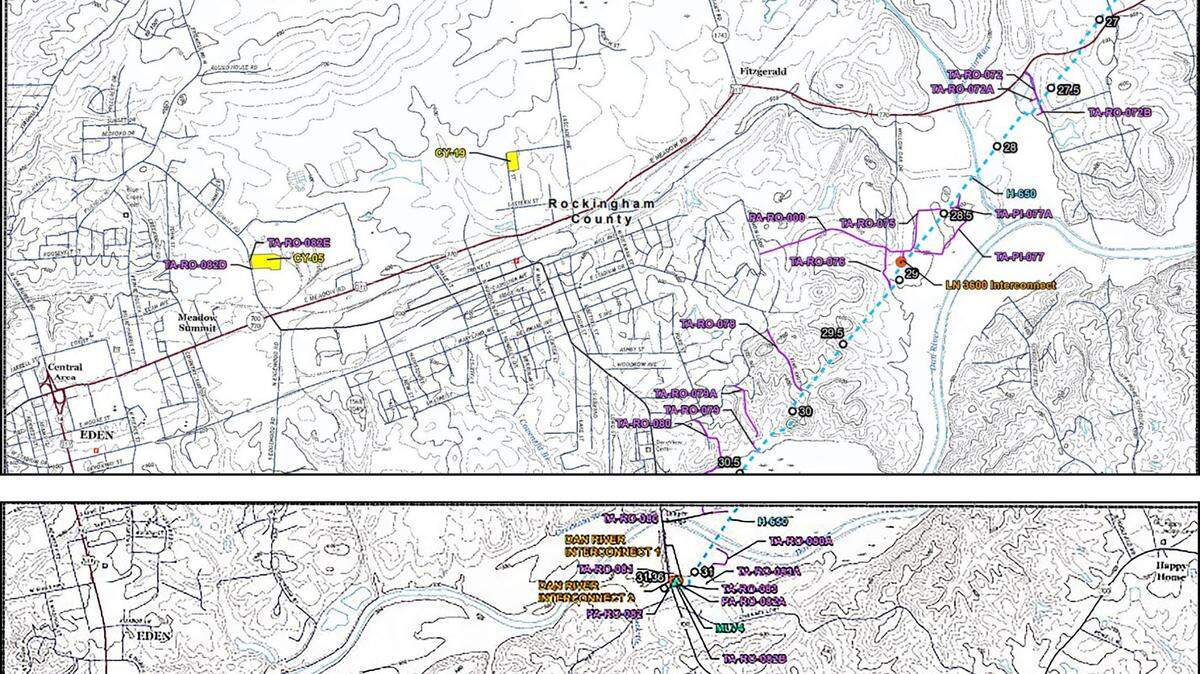
The Mountain Valley Pipeline project has asked federal regulators to approve a 31-mile extension that would reach into North Carolina, an effort that would supply gas to Duke Energy and Enbridge.
In a request to amend a 2020 Federal Energy Regulatory Commission approval known as a certificate of public convenience and necessity, MVP said it hopes to complete the 30-inch pipeline by mid-2028. When completed, the pipeline would take gas from the now-in-service Mountain Valley Pipeline that terminates in Pittsylvania County, Virginia, and bring it 26.1 miles southwest to the North Carolina state line, where it would continue another 5.2 miles into Rockingham County.
In late 2023, FERC granted MVP a three-year extension for the so-called Southgate project, allowing it to take until as late as June 2026 to finish building the project. Another such extension would be necessary under the timeline MVP laid out in its proposed amendment this week.
Supporters of MVP Southgate have said the project is necessary to provide an alternative to the Transco pipeline, which is the only one providing natural gas to North Carolina. But environmental groups are concerned about the permitting, arguing that FERC should consider Southgate as an entirely new project rather than an amended version of the original pipeline proposal due to shifts in the route that bring it in close proximity to existing or planned pipelines.
Shawn Day, a spokesman for MVP, wrote in a statement, “The MVP Southgate project will diversify the state’s natural gas supply and bolster North Carolina’s energy and economic security. This project will also meet the growing demand for affordable, reliable and lower-carbon energy for electricity generation, commercial and manufacturing uses, and home heating and cooking.”
Enbridge, which recently purchased Public Service Company of North Carolina from Dominion Energy, is set to receive 300,000 dekatherms per day of gas from the pipeline. Duke Energy Carolinas will receive the additional 250,000 dekatherms. A dekatherm is a measurement of energy rather than volume and is roughly the equivalent of 1,000 cubic feet of natural gas. So Enbridge will receive about 300 million cubic feet of gas per day, Duke Energy about 250 million cubic feet.
Just 10 days after it received the extension, MVP announced that it was altering the project’s scope, building a 31-mile pipeline from Pittsylvania County, Virginia, instead of a 75-mile route that would have reached Alamance County. While the new pipeline would be shorter, MVP also wanted to make it wider, using a 30-inch pipe instead of 18- and 24-inch pipes.
Environmental groups have contended that because the shorter pipeline will likely require a different route, MVP should need to start its application from scratch instead of amending existing approvals.
“The company’s new proposal for the MVP-Southgate extension is drastically different from its original proposal, and FERC should treat it as such. A new application and Environmental Impact Statement are the only way to ensure transparency, accountability, and a meaningful opportunity for impacted communities to have their voices heard,” Caroline Hansley, a campaign organizing strategist for the Sierra Club, wrote in a statement.
Appalachian Voices, the Sierra Club and other environmental groups have also challenged FERC’s approval of the construction extension in federal court, a case scheduled for oral arguments in the D.C. Circuit Court of Appeals on Feb. 20.
The Southgate extension is one of several ongoing efforts to bolster gas infrastructure in North Carolina. Another of those is Transco’s proposed expansion, a project known as the Southeast Supply Enhancement Project.
For about 20 of its proposed 31 miles, Southgate would parallel Transco.
FERC has typically deemed that co-location is a positive because it lowers the amount of new land and water that is disturbed during construction. But groups like the Sierra Club argue that isn’t the case, particularly considering the potential public safety risk of having multiple pipelines carrying gas near each other.
“Co-location does not eliminate environmental impacts, and it’s critical that regulators assess the public safety risks and cumulative effects of co-locating multiple high-pressure methane gas pipelines,” Hansley wrote.
Making permitting easier?
The Unleashing American Energy executive order President Donald Trump signed on his first day in office could add another wrinkle to the project. Trump directed the Council on Environmental Quality to rescind some sections of the National Environmental Policy Act, directed agencies to ease any delays in the permitting process and directed the National Economic Council to make recommendations to Congress about easing the permitting process for interstate pipelines like Southgate.
“The biggest challenge to building new natural gas infrastructure is the lengthy permitting process, causing years of delays, along with persistent judicial challenges, that add even more uncertainty. A clear and timely permitting process, at both the federal and state levels, is essential to building the energy infrastructure North Carolina and our nation need,” Trisha Ostrowski, the executive director of the Carolinas Natural Gas Coalition trade group, said in an email.
Mahyar Sorour, the policy director of the Sierra Club’s Beyond Fossil Fuels campaign, said the executive order has introduced uncertainty but that environmental reviews would still be necessary.
“There are a lot of unknowns, but even as the current administration is trying to expedite reviews for fossil fuel projects, Mountain Valley will still have to comply with commonsense bedrock environmental federal laws like NEPA, to ensure communities have a voice in permitting decisions,” Sorour wrote.
Even if the project receives approval from FERC, there are a number of other regulatory hurdles at the federal and state levels in both Virginia and North Carolina.
Southgate would need U.S. Army Corps of Engineers approval for impacts to wetlands, U.S. Fish and Wildlife Service approval for potential impact to endangered species and multiple environmental approvals in Virginia. The N.C. Department of Environmental Quality would need to approve a water quality certification and a permit for impacts to wetlands, among other steps.
This story was produced with financial support from the Hartfield Foundation and Green South Foundation, in partnership with Journalism Funding Partners, as part of an independent journalism fellowship program. The N&O maintains full editorial control of the work. If you would like to help support local journalism, please consider signing up for a digital subscription, which you can do here.
This story was originally published February 6, 2025 at 2:13 PM with the headline "Pipeline project seeks federal approval for revised plan to bring natural gas to NC."