More money requested for Eastern NC recovery, but lawmakers question trust in state agency
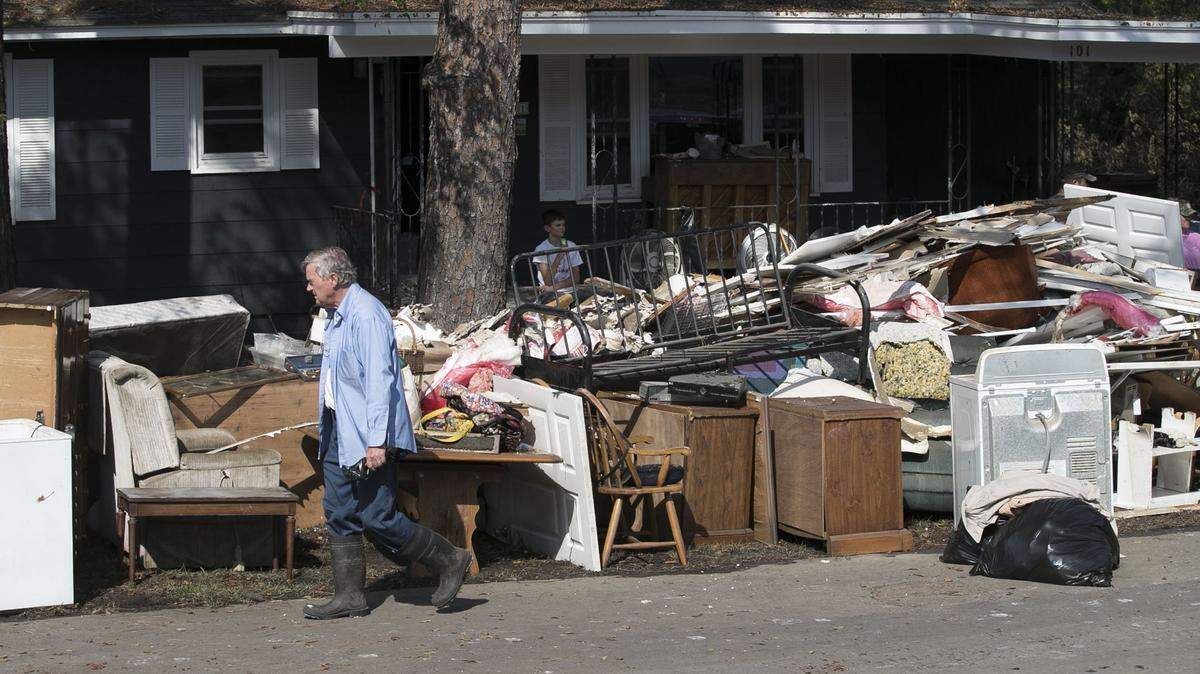
An official from the troubled agency ReBuild NC testified before a legislative committee Thursday to defend his request for more funding to complete housing projects for people affected by hurricanes Florence and Matthew.
As they have before, lawmakers expressed frustration over repeated funding requests and questioned whether the agency could deliver on its promises.
“’Give us the money. We’ll do it.’ You come back. ‘Give us the money.’ When does it stop? We can’t afford to go through this again. Something’s got to change,” Republican House Majority Leader Brenden Jones said. Someone has to be “held accountable,” he said.
Pryor Gibson, who was named interim director of the agency under former Democratic Gov. Roy Cooper, and who was testifying before the committee, said he would “commit to get eastern recovery finished in 2025 if we get funding to do it now.”
He said ReBuild NC (which is formally known as the North Carolina Office of Resiliency and Recovery) needs $217 million to finish housing projects in Eastern North Carolina. Rebuild NC was created by Cooper.
As of December, 3,069 projects had been completed, 659 were under construction, and 541 lacked a notice to proceed — authorization for contractors to begin work — according to data Gibson shared.
Gibson said Rebuild NC needs about:
▪ $89 million to complete projects already under construction.
▪ $41 million for homes not yet under construction where homeowners are in temporary housing paid for by the state
▪ $56 million for homes not under construction where homeowners are not in state-funded housing
▪ $30 million for what was described as backfill funding.
That brings the total request to $217 million.
And this is on top of $80 million provided by the General Assembly last year.
Funding requests stack up for Eastern NC recovery
NCORR received about $779 million in funding for hurricanes Florence and Matthew from the U.S. Department of Housing and Urban Development. Of that, about $650 million was designated for housing needs, Gibson said.
In October, financial issues became apparent, prompting Cooper to recommend an additional $175 million in state money for the homeowner recovery program. “This funding is needed immediately to avoid stopping work on in-progress homes,” Cooper said in a funding proposal otherwise focused on Western North Carolina recovery.
Republican lawmakers rebuked the request, questioning how the agency had spent its funds and saying they had not been made aware of issues in a timely way. Still, lawmakers allocated $30 million to keep operations running.
They later added another $50 million for home owner recovery projects, after a November hearing in which Gibson and Laura Hogshead, former chief operating officer of ReBuild NC, clarified funding needs.
There, Hogshead said the “worst-case scenario” for ReBuild NC’s funding needs totaled about $265 million. However, an Office of State Budget and Management document estimated about $324 million would be needed if contingencies were included. Gibson requested that the General Assembly provide at least $40 million a month for the next three months to cover necessities and help ReBuild NC catch up on arrears.
Gibson said Thursday that unmet funding needs go back years. In 2019, he said, the state requested $1.3 billion for recovery efforts but received less from the federal government.
In September, as funding shortfalls and contractor payment issues arose, ReBuild NC internally transferred $30 million, he said. Another $44 million is expected to be added in about 10 days.
Uncertainty and contractor concerns
While Gibson committed to getting Eastern North Carolina recovery finished in 2025 if funding was received, that came with a caveat.
Asked by Sen. Steve Jarvis, who represents Davidson and Davie counties, about applicants who had dropped out, Gibson said he did not know the number offhand since the program’s inception, but about 80 projects “have some pretty big issues” that could lead to them being cut.
That likely means not all of the 1,150 homes left to go will be completed.
Additionally, without more funding — and quickly — Gibson said contracting issues could arise, as notices to proceed, the authorization for a contractor to begin work, have plummeted.
The drop is due to concerns from contractors that ReBuild NC won’t have the necessary funds, and because “we could not issue, in good conscience and accounting principles, the notice to proceed unless we knew we were going to have the money to finish,” Gibson said.
“We desperately need a dependable source — whatever amount it is — we’re hoping enough to finish. A dependable source that we can plan around finishing these projects,” he said.
“If we don’t get it, we will not be able to finish it. Even if you do it, if you wait until June or July, we will not only lose our contractors, but we’re already in free fall with key personnel in our operation,” he said.
Sen. Ralph Hise, who represents Western North Carolina counties hit hard by Hurricane Helene, questioned why lawmakers should trust ReBuild NC again and provide more funding.
Gibson responded, “How can we trust you? You shouldn’t … You are in place to be the appropriators and to take care of your constituents. You shouldn’t trust anybody. You should verify and confirm and if it’s working, you should fund it.”
He pointed to improving statistics, saying 144 homes were completed in December. “This program is working … and if we can afford to — with state funds — finish these matters, then please let us before we lose the infrastructure,” he said.
When asked by Hise what he would have done differently, Gibson said the eastern recovery effort was slowed by offering too many choices, such as rental assistance and storage for homeowners’ belongings.
“You as policy members and the governor’s office — especially the western office — are going to have to make some really hard decisions about what the parameters are,” he said.
Western NC Recovery
After Gibson’s testimony and questioning — which lasted more than two hours — Stephanie McGarrah, deputy secretary of the Division of Community Revitalization, and Jonathan Krebs, Western North Carolina recovery advisor for Gov. Josh Stein, briefly spoke on Helene recovery efforts.
Discussing lessons learned from Rebuild NC, Krebs said, “Doing too many programs that are too complex will cause problems, and we have a reality of scarce resources.”
“We do not have enough money to do everything that is needed in Western North Carolina. So the No. 1 mission that we have is to manage scarce resources. That means setting priorities now before spending money,” he said.
Lawmakers are expected to provide additional funding — on top of the approximately $900 million already allocated at the state level — to bolster federal funds for Helene recovery efforts.
This story was originally published January 30, 2025 at 4:44 PM with the headline "More money requested for Eastern NC recovery, but lawmakers question trust in state agency."