
NC Republicans propose stricter laws targeting migrants. A look at what they want.
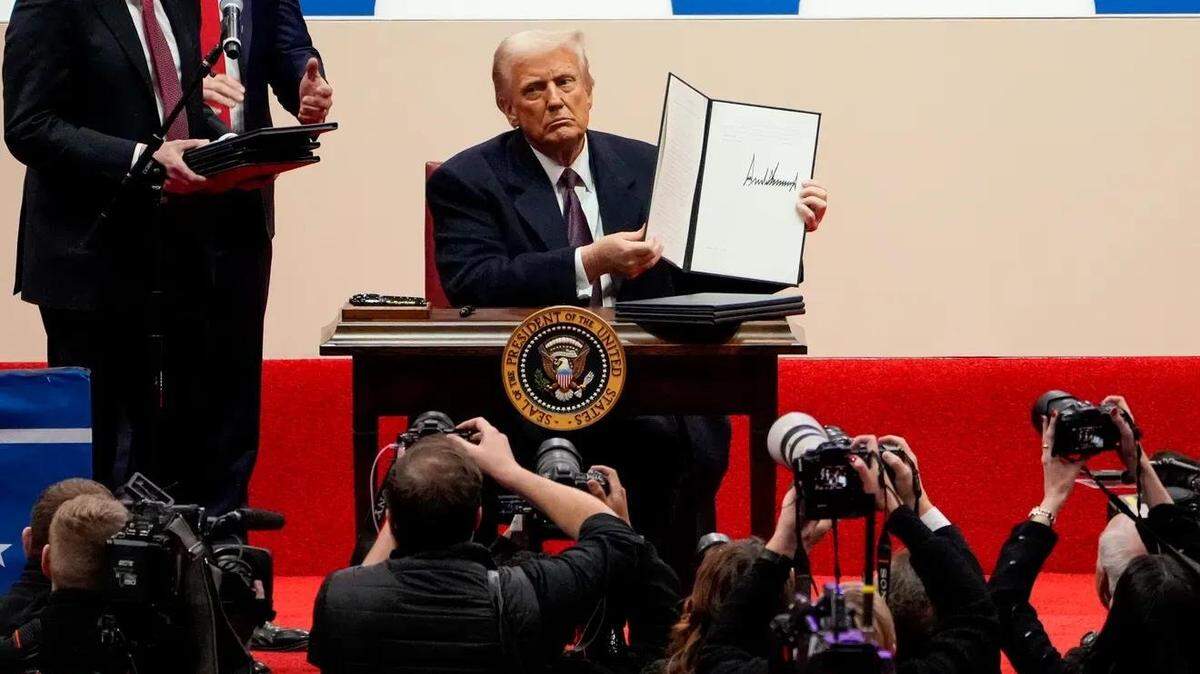
As President Donald Trump prepared to take office, Tom Homan, Trump’s appointed “border czar,” was asked what Americans could expect regarding immigration on day one of the president’s second term.
“Shock and awe,” Homan said twice.
At the start of the new session of Congress, Republican lawmakers prepared for the president’s arrival by filing and co-sponsoring bills to make his campaign promise for “mass deportations” easier.
That includes all but one of North Carolina’s Republican lawmakers. Sens. Thom Tillis and Ted Budd and Reps. Brad Knott, Chuck Edwards, Richard Hudson, Virginia Foxx, David Rouzer, Greg Murphy, Addison McDowell, Mark Harris and Pat Harrigan are working on legislation regarding immigration. As of Tuesday afternoon, only Rep. Tim Moore, a Republican from Kings Mountain, had filed none.
The bills range from creating more crimes for which an immigrant could face deportation, to requiring DNA to prove the relationship of a child traveling with someone who crossed the border, to allowing border communities to create temporary barricades to prevent crossings.
“There just feels to me to be kind of a race to position themselves as, ‘who is the most anti-immigrant,’” said Nikki Marín Baena, co-director of Siembra NC, a local immigrant rights and worker defense organization.
Marín Baena added that the No. 1 issue North Carolinians consistently said throughout the campaign they were most concerned about was the economy, and immigration legislation does nothing to help with those matters.
Many of the bills filed in early January don’t yet have legislative text available to look at, but their titles and related news releases offer a glimpse into what members are attempting to do.
Crimes
Many of the bills focus largely on crimes.
Already, Congress has passed the Laken Riley Act. Trump signed the bill Wednesday.
The bill requires the Department of Homeland Security to detain any non-national charged with burglary, theft, larceny or shoplifting, and allows states to sue the federal government for failing to uphold certain immigration laws.
Rouzer, a Republican from Wilmington, put out a statement upon the bill’s passage pointing out the difference between last session when Democrats controlled the Senate and the White House and this session when Republicans controlled both, plus the House.
“In the previous Congress, the U.S. Senate wouldn’t even allow debate on the House-passed Laken Riley Act,” Rouzer said in a news release. “This new law will make it easier for our law enforcement to take illegal criminal offenders, including (murderers) such as the one who killed Laken Riley, off the streets and ensure their deportation.”
The bill was named after a 22-year-old student at Augusta University who was killed by a Venezuelan man. He did not have permission to be in the United States and had been arrested multiple times, including in Georgia for theft from Walmart.
Marín Baena said that ICE has said it didn’t have the capacity to follow through on the Laken Riley Act, under which “you don’t have to be convicted of a crime, just kind of suspected of a crime to be detained.”
Lawmakers from North Carolina have co-sponsored two other bills to increase penalties for knowingly fleeing a federal officer and committing a crime that inflicts serious bodily injury or death.
They’ve also signed onto bills that would make it easier to deport an individual for the following crimes:
“Violence against women and children is an unforgivable betrayal of humanity, and our government must act decisively to root it out,” Harrigan, of Hickory, said in a news release. “This bill ensures that predators who commit these heinous crimes are barred from finding refuge in our nation.”
Rouzer also introduced a bill that would put permanent restrictions on an immigrant who is ordered to be deported for failing to appear at a removal hearing, unless there were exceptional circumstances. This would prevent that person from ever becoming a permanent resident.
Critics said Trump’s mass deportation effort has sown fear in North Carolina.
Siembra NC said the week before Trump took office the organization received just 39 calls to its ICE Watch detention hotline. Since he took office, 289 calls have been placed.
Marín Baena told McClatchy the calls her organization is receiving were more about rumors than truth.
“It is just more of a show,” Marín Baena said. “Part of what they’re trying to do with this kind of theater is create this environment of fear and panic and chaos, because one of their goals is what (top Trump aide) Stephen Miller calls ‘self-deportation,’ which is just basically intimidating people into them leaving on their own.”
Sanctuary
North Carolina lawmakers are also tackling sanctuary cities or jurisdictions.
Sanctuary cities do not have a blanket definition, but are often seen as being reluctant to work with federal officials on matters of immigration. The Center for Immigration Studies, which favors low immigration, points to nine North Carolina counties it describes as sanctuary communities where the county sheriff’s office has refused to cooperate with U.S. Immigration and Customs Enforcement by honoring what is known as a detainer. These are requests from ICE to detain suspects so agents can take custody of them. A recent state law makes such cooperation mandatory.
The counties include:
Buncombe
Chatham
Durham
Forsyth
Guilford
Mecklenburg
Orange
Wake
Watauga
Murphy, a Republican from Greenville, co-sponsored a bill that would restrict federal funding to sanctuary cities.
Edwards, a Republican from Flat Rock, and Tillis, a Republican from Huntersville, filed bills that restrict federal funds to those cities and also allow victims and their families to sue sanctuary cities for failing to uphold a lawful detainer request.
“Sanctuary cities cannot continue to jeopardize Americans’ safety without being held accountable for their role in the illegal immigrant crime crisis we are facing today,” Edwards said in a news release.
Numerous studies show that immigrants in the country without authorization commit crimes and are arrested at a number substantially less than American citizens.
Edwards represents Buncombe County.
Election laws
Edwards and Murphy proposed requiring proof of U.S. citizenship to vote in a federal election.
The Illegal Immigration Reform and Immigration Responsibility Act of 1996 makes it illegal to vote in a federal election as a noncitizen, but the United States does not have a required process for each state to verify voters’ legal status.
According to the Bipartisan Policy Center, some states use the Social Security Administration to verify voters, other states use Department of Motor Vehicle records and some states use both.
A noncitizen caught voting in a federal election can face a year in federal prison and deportation.
The Bipartisan Policy Center states there are a limited number of local elections where noncitizens are allowed to vote including in Washington, D.C., San Francisco, Maryland and Vermont.
Remain in Mexico
Foxx, a Republican from Banner Elk, co-sponsored a bill that would implement the Remain in Mexico policy, formally known as the Migrant Protection Protocols. Tillis co-sponsored a mirroring bill in the Senate and Foxx, along with McDowell, Hudson, Harris and Harrigan, co-sponsored a similar bill in the House.
The Remain in Mexico policy started under the initial Trump administration and turns away migrants at the southern border seeking asylum, telling them to wait in Mexico until a future court date before an immigration judge. Often they’re assigned to courts far from where they entered the country.
The American Immigration Council, a nonprofit and advocacy group for immigrants in the United States, reports that only 7.5% of people turned away under this program were able to speak with a lawyer and of the 42,012 cases created by December 2020, only 521 were helped by immigration courts.
The policy, first implemented in 2019, kept 70,000 immigrants in Mexico.
Biden ended the program due to what he considered logistical issues and human rights violations. But he would restart it, in December 2021, for less than a year, affecting more than 7,500 people, according to the American Immigration Council.
Mexico opposes the law.
Building a (temporary) wall
Rouzer introduced a bill that would allow border states to build temporary barriers to prevent immigrants from crossing the border illegally.
“The Biden administration failed to enforce our laws and secure our border, even suing border states for executing more robust measures,” Rouzer said in a news release. “This commonsense bill will bolster the strong border policies of President Trump and allow an all-of-the-above approach to securing our Southern Border.”
Budd co-sponsored a bill in the Senate that may mirror Rouzer’s bill.
Monitoring
Budd also co-sponsored a bill that would prevent migrants from being released under the Alternatives to Detention program unless all detention beds have been filled, there are no other options to hold a person in detention and the secretary of Homeland Security has exhausted all reasonable efforts for detainment.
If someone is released, they must comply with a series of rules including being GPS monitored and remaining at their permitted address between 10 p.m. and 5 a.m.
Failure to comply would result in their removal from the country.
Census
Edwards filed a bill, co-sponsored by Knott, Rouzer and Harris, requiring a citizenship question on the census that that would be used to modify congressional districts.
In a news release, Edwards cited a 2020 Pew Research Study that found Texas, Florida and California would each lose a seat in Congress if noncitizens were not included in the population used to determine representation. It would also allow Alabama, Minnesota and Ohio to each gain a seat, Edwards said.
“America will be paying the consequences of the previous administration’s open border policies for decades to come,” Edwards said in a news release. “Mass illegal immigration has already diluted the voice of American citizens in the U.S. House and Electoral College. ... Americans deserve fair and equal representation, something that will not be possible until we eliminate the influence of non-citizens in our elections.”
The frustration from Marín Baena was palpable through the phone as she heard about this proposal. It reminded her of the Three-Fifths Compromise during the 1787 Constitutional Convention that counted three out of every five enslaved people toward the state’s total population to figure out representation and taxes.
“A lot of immigration organizers have seen this coming, where they are really pushing the boundaries here, and “it’s not just who gets to be an American, but it’s like, who gets to be a person in this country,” she said.
Other notable bills
Tillis co-sponsored a bill that would require DNA testing to prove a family relationship between an immigrant and a minor traveling with him or her.
Budd sponsored a bill to prevent the obstruction of immigration, border and customs control.
This story was originally published January 30, 2025 at 6:00 AM with the headline "NC Republicans propose stricter laws targeting migrants. A look at what they want.."
