New NC poll looks at fears of political violence, strength of democracy. What it found.
North Carolinians are going into the upcoming election largely dissatisfied with the economy, especially when it comes to the impact of inflation and housing costs on their finances. Nor are they thrilled with the presidential candidate options from either of the major parties.
Still, they are interested in voting considering recent events, such as President Joe Biden’s withdrawal from the race and the assassination attempt on GOP nominee Donald Trump, according to a new Elon University Poll survey.
“A lot of people were going into 2024 thinking this was going to be a snooze-fest, kind of a boring rematch of 2020,” Jason Husser, director of the Elon Poll, told The News & Observer.
The “volatility that has happened — and by that, I don’t mean to say it was good things — but have generated some positive effects of people paying more attention than they would have otherwise,” and the poll results have reflected that, he said.
Trust in elections was tepid, and post-election violence was a concern for many. Violence was also a concern in 2020 — which would be borne out — when Elon asked a similar question.
And there are mixed views about how the presidential election will affect democracy.
Asked what would happen to “the basic principles and systems that make up American democracy,” 39% of respondents predicted they would be “strengthened,” 32% thought they would be “harmed” and 29% thought they would “not be affected to any great degree.”
Democrats were more likely than Republicans and independents to predict democratic systems would be strengthened, with independents being the least likely to think so. Young voters were less likely to think they would be strengthened and more likely to think they would be harmed. Black respondents were also more likely to think they would be strengthened than non-Hispanic white respondents.
The poll had a sample of 800 adults who are 18 and older, residents of North Carolina and registered to vote. The margin of error for the data was 3.86%, according to Husser.
Here’s a deeper dive into the results of this new poll.
Voters’ economic and housing outlook
The poll asked a series of questions about the economy. Asked to grade the state of the current economy at a nationwide, state and local level, the majority of voters across the three categories were not too pleased, with roughly a third, the largest group, giving it a C.
Respondents were also asked whether since Biden took office in 2021 their financial situation had gotten better, stayed the same or gotten worse. Almost half of all respondents said their financial situation had gotten worse, while 21% said it had gotten better. The remainder said it had stayed the same.
Almost 80% of respondents said that inflation had affected them and their family “very negatively or “somewhat negatively.” Just over 70% of respondents also said they did not think they could afford to rent or buy a house today like their current one in their area of residence. Over half of respondents, 56%, also said housing prices in their area were “much higher” than two years ago.
Asked to what extent the Biden administration was to blame for the current state of the economy, 42% said it was “very responsible,” 26% said “somewhat responsible” and 18% said “not very responsible.” The remainder had either not thought about it much or thought he was not at all responsible.
Candidates left ‘unfavorable’ impressions
Biden is no longer in the running for reelection, but his vice president, Kamala Harris, has taken his place.
Voters surveyed were largely not content with their options for president. The largest group, 46%, had a “very unfavorable” impression of Trump while 29% had a “very favorable” impression of him. The remainder were more lukewarm in their opinion. Similarly, the largest group of respondents, 42%, had a “very unfavorable” impression of the GOP’s candidate for governor, Mark Robinson.
Meanwhile, 42% of respondents had a very unfavorable impression of Harris and 28% had a very favorable impression. Josh Stein, the Democratic candidate for governor, fared better, with 23% of respondents having a “very favorable” impression of him and 19% a “very unfavorable” impression of him.
In North Carolina, voters sometimes split the ticket, voting for candidates from different parties across the ballot. Asked how likely they were to split the ticket in terms of the gubernatorial and presidential race, 85% of respondents said they would vote in these races for the same party, while 15% said they would vote for a different party.
Confidence in election results, voter enthusiasm
Confidence in elections was higher at a state level than on a national level: 48% of respondents believed this year’s election would produce a “fair and accurate” count of the votes cast nationwide. Just under 20% said they did not think there would be a “fair and accurate” tabulation.
On a state level, 59% said they thought counts would be “fair and accurate” while 13% said they did not think that. The remainder of the people in both the state and national counts were not sure. Democrats were more likely to trust the results than Republicans on both counts.
For Husser, this is in large part because “North Carolina’s ballot-counting process has gotten a lot of good publicity. North Carolina has a number of restrictions and measures in place.”
And voters “don’t necessarily know what other states are doing in that regard,” he said.
Younger voters between ages 18 to 44 were more likely to trust results, with 48% saying they believed national counts would be “fair and accurate” and 9% saying they wouldn’t be. Meanwhile, 42% of respondents over 45 believed they would be “fair and accurate.” This is a change from 2020. That year, nearly 70% of North Carolina registered voters trusted that the 2020 election would be fair. But voters between 18 and 24 years old were about twice as likely as all other age groups to say that they were “not at all confident” that it would be, The News & Observer reported.
Asked about their interest in voting after recent events in the presidential race, including the assassination attempt on Trump during a rally in Pennsylvania and the withdrawal by Biden, 37% of respondents said they were “much more interested,” 14% said they were “somewhat more interested” and 41% said they had “about the same level of interest.”
Looking at it by party preference, 38% of Democrats and 41% of Republicans were “much more interested.” Meanwhile, 16% of Democrats and 12% of Republicans were “somewhat more interested.” Just over 40% of Republicans and Democrats alike said they had about the same level of interest.
Violence concerns, and willingness to compromise?
Asked about concerns with violence breaking out before the election, 14% of respondents said they were “very concerned” and 31% said they were “somewhat concerned.”
But those worries increased when it came to possible violence shortly after the election, with 36% “very concerned” and 38% “somewhat concerned.” Democrats, at 39%, were more likely to be “very concerned” than Republicans at 25%.
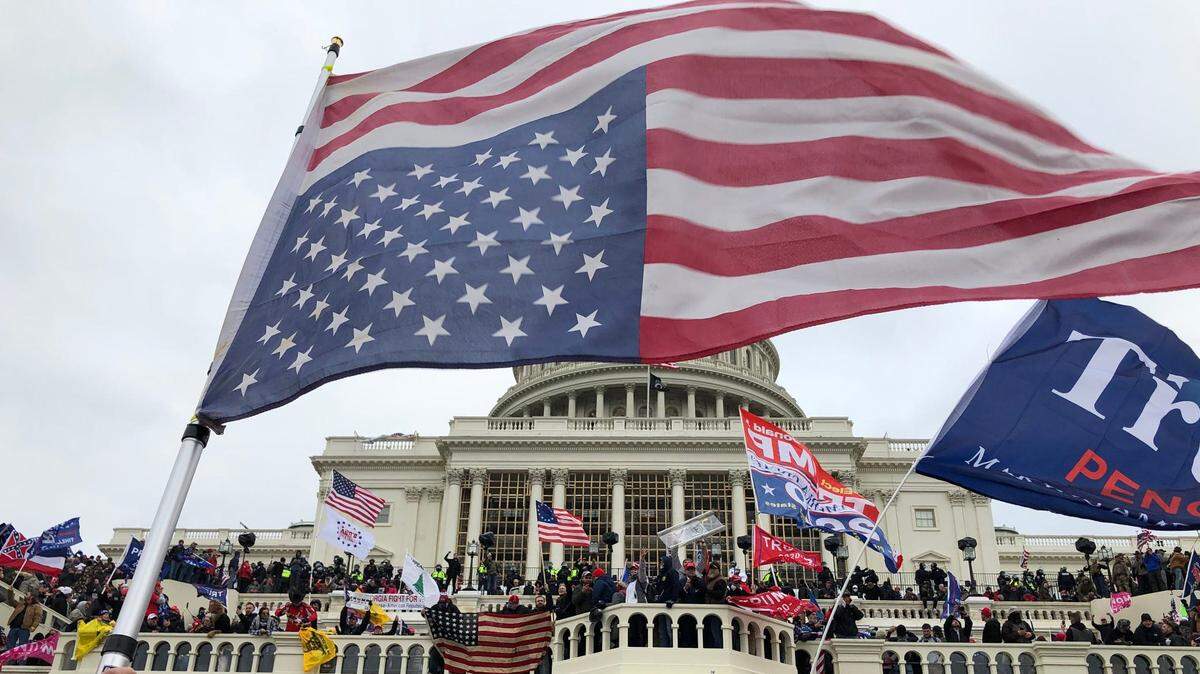
In 2020, Elon conducted a poll that showed similar levels of concerns about post-election violence. Indeed, violence grew in the aftermath of Biden’s win and culminated in the Jan. 6 storming of the U.S. Capitol by pro-Trump supporters.
Husser said these results were “disheartening. Not disheartening that people think it, but disheartening that that’s the world that we live in after both Jan. 6 as well as the Trump assassination attempt.”
He said he was “not surprised at all,” but that these sort of results from 2020 and 2024 were for him “a historical aberration,” and fears of violence would likely have been lower in many other years.
And while fears of violence remained high, willingness to compromise was mixed. Asked to think of a political issue of high concern personally, and whether they would be willing to compromise getting what they wanted on it in exchange for U.S. politics becoming less divisive and polarized, respondents were largely locked into their opinions: 15% of respondents were “very willing’ to compromise, 43% were “somewhat willing,” 24% were “a little willing” and 18% were “not willing.” Democrats and independents were slightly more likely to compromise than Republicans. Men and younger respondents were also slightly more likely to compromise.
Abortion, other issues
The poll asked a series of questions on a slew of other topics, from abortions to the disclosure of the use of artificial intelligence in political ads. Respondents largely (44%) favored decreasing restrictions on abortions in North Carolina, as well as largely favored (69%) a state law to require political ads to induce a disclosure if using AI.
Respondents also thought that the Republican Party, more so than the Democratic Party, had become “more extreme” on its positions on issues since the 2020 presidential election.
This story was originally published August 27, 2024 at 6:00 AM with the headline "New NC poll looks at fears of political violence, strength of democracy. What it found.."