
Triangle utilities plot forever chemical removal to meet new EPA drinking water rules
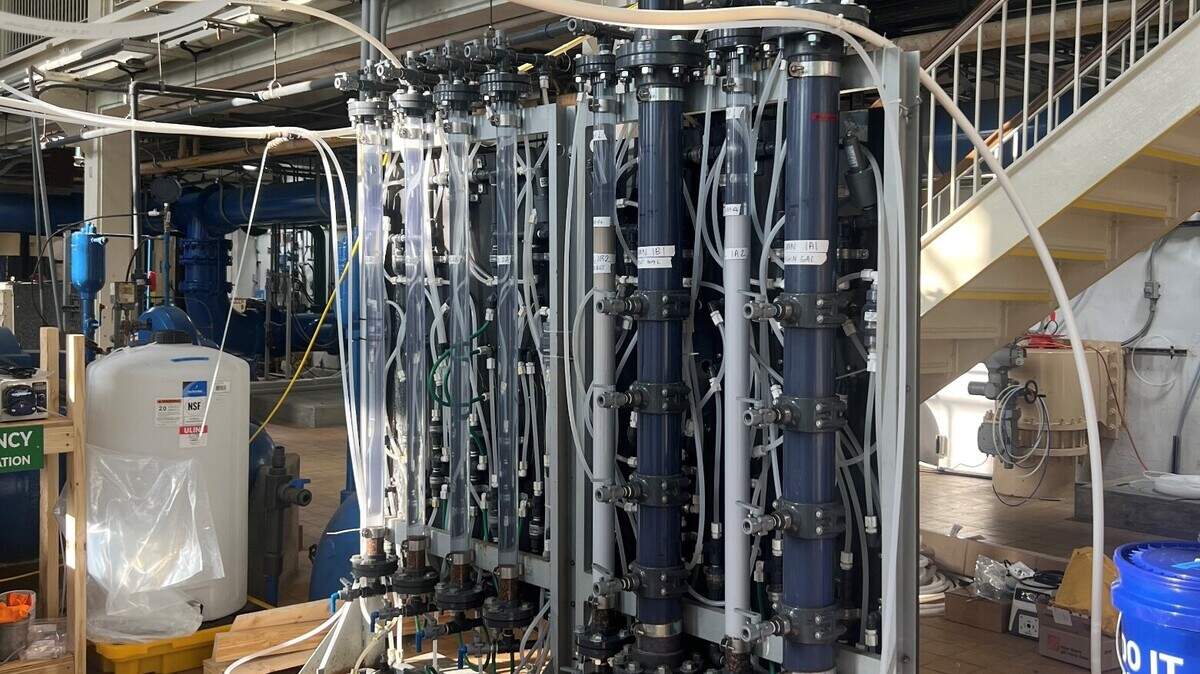
Drinking water systems in North Carolina are racing to build drinking water treatment systems that will let them meet the U.S. Environmental Protection Agency’s new drinking water limits for several forever chemicals.
In April, the EPA approved rules for several per- and polyfluoroalkyl substances. PFAS are complex synthetic chemicals found in consumer products like nonstick pans and stain-resistant clothes, according to the National Institute of Environmental Health Sciences. They can leak into air, soil or water and make their way into drinking water and food sources. Once there, they tend to degrade slowly and move around easily.
Scientific research conducted over the last few decades has linked PFAS with increased risk of certain cancers, cardiovascular disease and lower birth weight, said Melanie Benesh, vice president of government affairs at the Environmental Working Group.
The EPA rules, which administrator Michael Regan announced at a Fayetteville water treatment plant , set drinking water standards known as maximum contaminant levels for six different PFAS. Notably, the agency set the standard at 4 parts per trillion for PFOA and PFOS, two of the most common forever chemicals found in water. That’s the lowest level a utility can reliably detect, Benesh said.
“For compliance purposes, they set it at that level,” she said. “But really, if you look at what they consider safe levels, they’re pretty close to zero.”
A part per trillion is equal to a drop of water plopped into the equivalent of 20 Olympic-sized swimming pools, according to the Orange Water and Sewer Authority.
The N.C. Department of Environmental Quality is pushing for limits for several forever chemicals in groundwater and surface water. Part of the reason department leaders say they are calling for the surface water limits, in particular, is that cutting down on the amount of forever chemicals in raw water will help downstream utilities reduce their treatment costs, including increasing the amount of time filters can last before becoming saturated.
In recent years, many Triangle water utilities have measured forever chemicals at levels that fluctuate above and below the new regulations, which the EPA doesn’t intend to enforce until 2029.
Here’s how some are planning to address PFAS in the coming years.
Raleigh Water
As part of its existing treatment process, Raleigh Water is already injecting powder activated carbon into the water it draws from Falls Lake and Lake Benson. Utilities frequently use powder activated carbon to improve taste and odor in their finished drinking water, with the carbon settling out later in the treatment process.
Raleigh Water has typically measured PFOA levels between undetectable and four parts per trillion, with PFOS levels ranging slightly higher, from undetectable to 5.5 ppt.
To assure that it can push levels of PFOA and PFOS below the new four parts per trillion drinking water standard, Raleigh Water plans to increase the amount of powder activated carbon it uses.
Instead of injecting five to seven parts per million to treat taste and odor, the utility plans to inject around 10 to 12 parts per million, Ed Buchan, Raleigh Water’s assistant director, told The News & Observer.
Raleigh Water has embarked on a $12 to $14 million project to build a pair of 80,000-pound silos to keep powder activated carbon on site at the E.M. Johnson Water Treatment Plant in Northeast Raleigh. Buchan said the project, which will also include the capacity to inject up to 30 to 35 parts per million of powder activated carbon into raw water, is slated for completion by December 2025.
“It’s not like we’re investing in a chemical system that we weren’t already using, we’re just going to have to improve it and make it more robust,” Whit Wheeler, Raleigh Water’s executive director, told N.C. Department of Environmental Quality Secretary Elizabeth Biser and U.S. Representative Deborah Ross during a June tour of the Johnson plant..
By comparison, Raleigh Water officials estimated that building a granular activated carbon system with water filtered through deep wells filled with carbon would cost them an estimated $150 million to $170 million to design and construct.
Orange Water and Sewer Authority
With an average detected PFOA level of 12.1 parts per trillion and PFOS level of 6 parts per trillion between 2018 and 2024, Orange Water and Sewer Authority has been “just shy” of meeting the EPA’s April regulations, spokesperson Katie Hall said.
The utility has tested under the EPA’s limits for the four other PFAS classes, according to its website.
Detected PFAS levels sometimes fluctuate for OWASA. That’s because the utility draws water from two reservoirs that have different PFAS concentrations, Hall said. Cane Creek reservoir has PFAS concentrations above the EPA’s new standards, while University Lake doesn’t, she said.
“We use a different combination of volumes of water from each reservoir based on how the water quality is,” she said.
Factors like algal growth and precipitation can affect those volumes on a day-to-day basis, she said.
In May, OWASA started pilot testing two technologies to treat water for PFAS: Granular activated carbon and ion exchange resin. OWASA already uses powder activated carbon — which also works to remove PFAS — in its current water treatment process.
The pilot project will last into next year and hopefully inform the utility about what combination of strategies to implement in its new $75 million PFAS treatment facility at OWASA’s Jones Ferry Road water treatment plant, Hall said.
These upgrades to drinking water cleaning will cost ratepayers. As a first step, the OWASA Board of Directors approved a 15% rate increase, which amounts to $12.32 more on monthly water bills, Hall said.

Durham’s Department of Water Management
Durham’s water utility has also fluctuated in and out of compliance with the EPA’s new PFOA and PFOS standards, according to publicly available data. From 2018 to 2024, Durham Water Management detected between 2.4 and 5.5 parts per trillion of PFOA and 3.7 to 9.2 parts per trillion of PFOS.
The utility asked HDR, a consulting firm, to study potential PFAS treatment plans, acting assistant director Sydney Miller said. Ultimately, Durham Water Management could implement HDR’s recommendations at its two existing water treatment plants, Miller added.
HDR started its initial phase in February, drinking water lead Katie Walker said. In addition to making sure Durham Water Management’s testing procedures align with EPA standards, the firm will also look at incorporating powder activated carbon, granular activated carbon or ion exchange resin to existing treatment facilities.
Walker said her group hasn’t yet determined cost estimates for different treatment plans. However, factors that can affect what customers ultimately have to pay include the size of the current treatment system, what other impurities facilities have to process for and disposal needs, she said.
The HDR study’s initial phase will end in February 2024, Walker said, though additional phases could follow for additional technology testing.
Town of Cary
When PFAS were discovered in Cary’s drinking water in 2017, town officials started exploring a number of treatment options. They settled on powder activated carbon adsorption, similar to what Raleigh is planning to use.
Since implementing the technology in 2018, Cary has consistently measured levels of PFOA and PFOS in its finished drinking water that are lower than the EPA’s new regulation.
“The combination of PAC with our existing process including ozonation provides an even higher level of sophisticated multiple barrier water treatment technology to support advanced treatment of both regulated and unregulated substances for removal from Cary’s drinking water,” Cary utility officials wrote on the town’s website.
This story was produced with financial support from the Hartfield Foundation and Green South Foundation, in partnership with Journalism Funding Partners, as part of an independent journalism fellowship program. The N&O maintains full editorial control of the work. If you would like to help support local journalism, please consider signing up for a digital subscription, which you can do here.
This story was originally published August 2, 2024 at 7:30 AM with the headline "Triangle utilities plot forever chemical removal to meet new EPA drinking water rules."
.jpeg)