
NC Republicans are poised to expand private school vouchers to all students
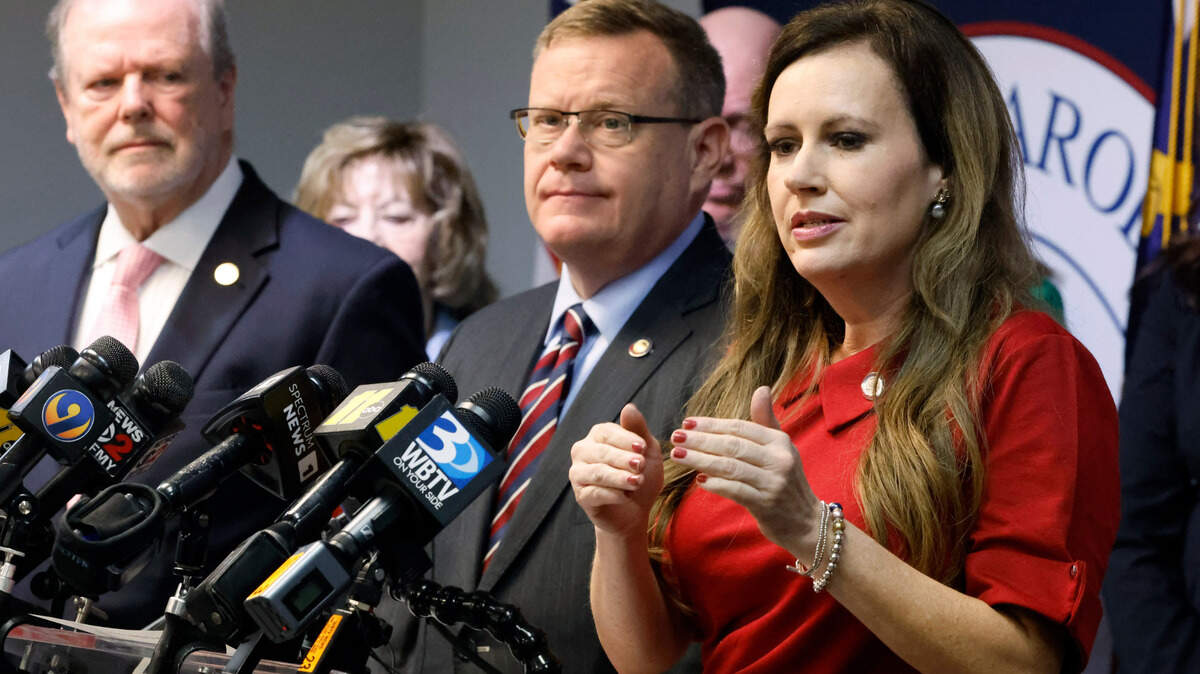
School choice — in the form of publicly funded scholarships to private schools — is being fast-tracked now that Republicans have a supermajority in the North Carolina General Assembly.
Rep. Tricia Cotham, a Mecklenburg County Republican who switched parties from the Democrats this month, is a primary sponsor of a bill expanding vouchers for private school tuition, which are known as Opportunity Scholarships and have been championed by Republicans.
Until now, the use of the scholarships has been limited, but a new bill likely to coast into law will expand the program to all students.
School choice is the term used to describe families being able to use public funding to educate their children in a variety of school options beyond traditional public schools.
House Bill 823, called Choose Your School, Choose Your Future, also has a key Republican among its primary sponsors: House Speaker Tim Moore. Others include Republicans Reps. David Willis of Union County and Donnie Loftis of Gaston County. With Moore as a sponsor on a bill that already has a companion version in the Senate, the bill is virtually guaranteed to become law.
Republicans have a three-fifths supermajority, which if all Republicans vote together is enough votes to override a veto from Democratic Gov. Roy Cooper.
The bill has already received national attention, including from school choice proponent Corey DeAngelis, who tweeted that it would “fund students instead of systems. All North Carolina families would be eligible. Cotham was a Democrat who just changed her party registration to Republican this month. This is the way.”
Cotham shared the tweet Tuesday night, adding her own comment: “Children first.”
The bill would expand eligibility to all K-12 students, regardless of if they have already been in public school. Vouchers can be used for tuition along with fees for books, transportation and equipment. Lower-income families would receive higher scholarship amounts than those with higher incomes.

Democrats vs. Republicans on school choice
Most Republicans support the private-school scholarships while Democrats largely do not. Cooper has spoken against the vouchers.
However, he signed a proclamation recognizing School Choice Week in January 2022. The News & Observer reported that Cooper issued the proclamation at the request of charter schools. Charter schools are public schools that receive public funding but not the same amount of oversight as traditional public schools. The N.C. Association of Educators has opposed charter school expansions and private school scholarships.
The president of Parents for Educational Freedom in North Carolina, which advocates for school choice, told The N&O on Wednesday that the bill “is an incredible step towards funding students over systems in North Carolina.”
President Mike Long said the bill “will further empower families to place their tax dollars into their child’s backpack allowing them to attend the school of their choice.”
Long noted that the bill prioritizes lower-income families to receive more money.
The group also said Wednesday that a lawsuit against the Opportunity Scholarships program, which included the NCAE, had been dropped.
Opportunity Scholarships expansion
The bills would significantly raise the income eligibility for the vouchers that started a decade ago as need-based.
When the Senate filed its bill last month, Sen. Amy Scott Galey, an Alamance County Republican, said education funding “should follow the student, and we must fund students not systems.”
“Expanding Opportunity Scholarships encourages school choice and broadens the options available to families. We must empower moms and dads to make the best decisions for their children,” Galey said in a March statement.
The Opportunity Scholarship Grant Fund would come close to doubling in future years.
This fiscal year, there is $94.8 million allocated to the fund, with $176.5 million for the upcoming year and $191.5 million for the 2024-25 school year. Under the House bill, instead of $206.5 million for 2025-26, the fund would receive $366.5 million. And in 2026-27, instead of $221.5 million, it would get $419.5 million.
Scholarships would be expanded beginning later this year, for the 2023-24 school year.
Timing and money for the scholarships
As for when the bill could go forward, state Rep. John Torbett, a Stanley Republican and chair of the House Education Committee, told The N&O on Thursday it will not move through committee this coming week.
Moore told reporters on Thursday that he wanted to negotiate with the Senate so the two versions of the bill match before it moves forward. He said they want to “at the end of the day make sure dollars follow children.”
“We have some amazing public school systems around our state. Both of my children as well as myself are products of the public schools. And so we need to continue to invest there and do that,” Moore said.
“But we do have some areas of our state that have some significant challenges, where some of the schools get D’s and F’s, and where even more money is put in, but these children are still being being deprived of a sound, basic education. So in those instances, I think that we need to have these opportunities,” he said.
Moore said increasing funding for vouchers does not mean there will be less money for traditional public schools.
“When it comes to the opportunity scholarships, I mean, that is a fraction [of the state budget]. You’re talking miniscule,” he said.
Moore said the money will come from uncommitted funds.
“There have been those on the other side, say, ‘Oh, you’re taking funds from public schools, you’re depriving [them].’ No, it’s, you have additional money and you use it for [the scholarships],” Moore said.
This story was originally published April 19, 2023 at 4:29 PM with the headline "NC Republicans are poised to expand private school vouchers to all students."
.jpg)