
Medicaid expansion will be tied to the NC budget. But that won’t be the only thing.
The House and Senate’s big news of a Medicaid expansion compromise comes with a very important qualifier: It would pass when the state budget passes.
The passage of Medicaid expansion would come at the same time that tens of thousands of state employees and teachers find out how much money they’re going to make the coming year.
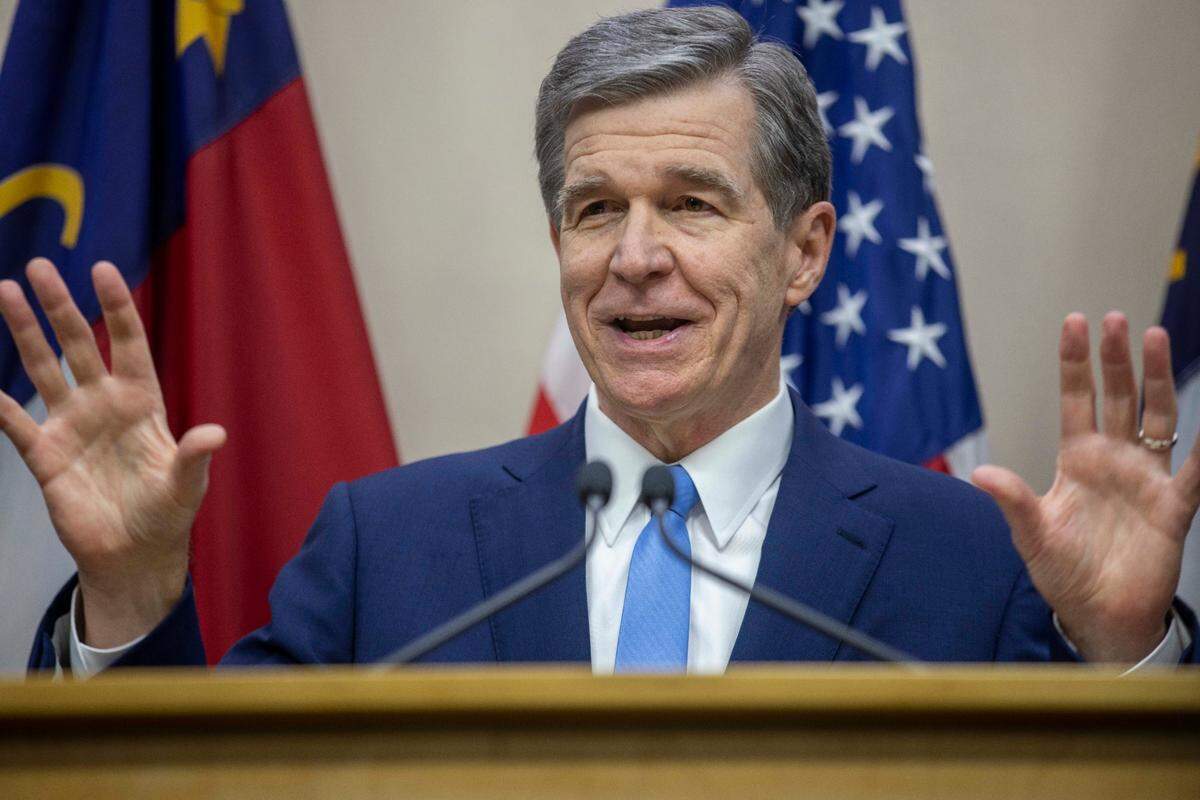
Signing a budget with Medicaid expansion in it has been Gov. Roy Cooper’s goal for years. But tying expansion to the budget — as it has been for the past several years of negotiations — means there will be trade offs.
The legislature is just one vote away from a veto-proof Republican supermajority. It will take the Democratic governor’s budget proposal — set to come out on March 15 — into consideration, but Republicans are calling the shots. The budget is a two-year spending plan, but also contains major policy.
Governor’s powers
Because any policy provision could be in the budget, that could even mean abortion. But it’s more likely to be something limiting the governor’s powers. That has been a priority of Republican legislative leaders the past few years, mostly because of Cooper’s actions during the pandemic.
A new law from the 2021 budget went into effect Jan. 1, 2023, requiring the governor to get more agreement from other statewide leaders on the length of states of emergency.
And in February, both House Speaker Tim Moore and Senate leader Phil Berger said they want to see more changes to the “balance of power” in the state.
Moore told The News & Observer that he wants to see legislation “restoring the appropriate balance of powers to the people.”
And he added that “you may see a lot of those things dealt with in the budget.”
Raises, taxes, education, projects all in the budget
Typically, Democrats want higher raises for workers than Republicans do, and Republicans want to cut taxes more than Democrats do. So those two big issues — along with overall funding of public education, construction projects across the state and money for the 170 lawmakers’ districts — are all part of this, too.
Republicans are already lowering the individual income tax rate and want to phase out the corporate income tax completely. This budget could speed that up.
There has been at least a 20% shortage of state employees statewide for a year now, with higher vacancy rates in the Department of Public Safety and Department of Health and Human Services.
Last week, the State Board of Education, which includes both Democrats and Republicans, voted unanimously to request raises in excess of 10% for teachers, The N&O reported.
Teacher pay and total education spending have been a top priority of Cooper throughout his time as governor.
Medicaid expansion will be in the budget
Cooper was to give his fourth State of the State address, and the final one of his second term, on Monday evening. He was expected to talk about Medicaid expansion, along with other priorities for the remainder of his term through 2024.
Cooper would prefer Medicaid expansion isn’t tied to the budget.
“Since we all agree this is the right thing to do, we should make it effective now to make sure we leverage the money that will save our rural hospitals and invest in mental health,” Cooper said about the Medicaid expansion deal on Thursday.
Cooper’s office confirmed to The N&O he spoke later that day with Berger and Moore.
Berger said last week that his primary reason for tying Medicaid expansion to the budget bill “has to do with matching it up with other money provisions.”
“And we generally, I mean, from time to time, we will pass something that deals with the spending outside of the budget, but it’s usually a small, one-time thing. This is a recurring situation, as far as expansion is concerned, will impact various parts of the budget, and it needs to be coordinated with the passage of an overall budget,” Berger told reporters on Thursday.
Budget by June?
A big fight every budget season is the amount of raises for teachers and state employees. The 2019 budget battle finally fizzled out when Cooper vetoed a bill, tied to passage of the budget, to give teachers raises he deemed “paltry.” No budget deal was reached.
In 2021, the budget was five months late — nearly halfway into the next fiscal year — and Cooper signed it, he said, because the good outweighed the bad.
This year, Moore has told reporters that the House budget process could wrap up by April 6. Rep. Donny Lambeth, a Winston-Salem Republican and powerful chair of the House Appropriations Committee, told reporters on Wednesday that the House is still on track to hopefully pass its version of the state budget in early April before Easter.
Lambeth said after Cooper’s proposal comes out March 15, top Republican budget writers will focus over the next two weeks on finalizing the House budget bill.
“Quite frankly, the motivation for all the folks who work long hours in March is: We’ll get you out of here for a little bit of a spring break. And if you don’t get it done, we’re gonna keep working right into April,” Lambeth said.
“So it’s quite motivating to say, Hey, OK, I’ll work a couple Mondays, I’ll work Friday, I may work Saturday to get that done. So that’s really the motivation. And I think we will actually meet that deadline, but it’s very, very aggressive,” he said.
If the House budget comes out at the end of March, lawmakers would move it through committee and to the House floor the first week of April.
The General Assembly would then take the second week of April off. The next steps would be a Senate budget, then a compromise budget. Lambeth said final budget votes could take place by June 15. The plan would then go to Cooper’s desk.
The target time is optimistic. “There’s always things that hold it up,” Lambeth said.
One holdup which is already a factor: The House and Senate, as of Thursday, had not agreed on a total spending amount for the budget. They have to make that agreement soon.
“I see no reason that we won’t have a budget enacted in June,” Moore said. “June 30 is the magical date for all of this.” That’s the last day of the 2022-23 fiscal year.
Cooper would have 10 days to sign it, veto it or let it become law without his signature. And that decision will depend on what’s in the budget.
This story was originally published March 6, 2023 at 10:58 AM with the headline "Medicaid expansion will be tied to the NC budget. But that won’t be the only thing.."
.jpg)