From Jim Crow to anti-gay laws, North Carolina has chosen to keep unconstitutional rules
North Carolina’s abortion law, last updated in 2015, was obviously unconstitutional — until one day, it wasn’t anymore.
The state has a 20-week ban on abortions with almost no exceptions after that cutoff, including none for rape or incest. It was a clear violation of the precedent set in Roe v. Wade, and a federal court had blocked the law from going into effect.
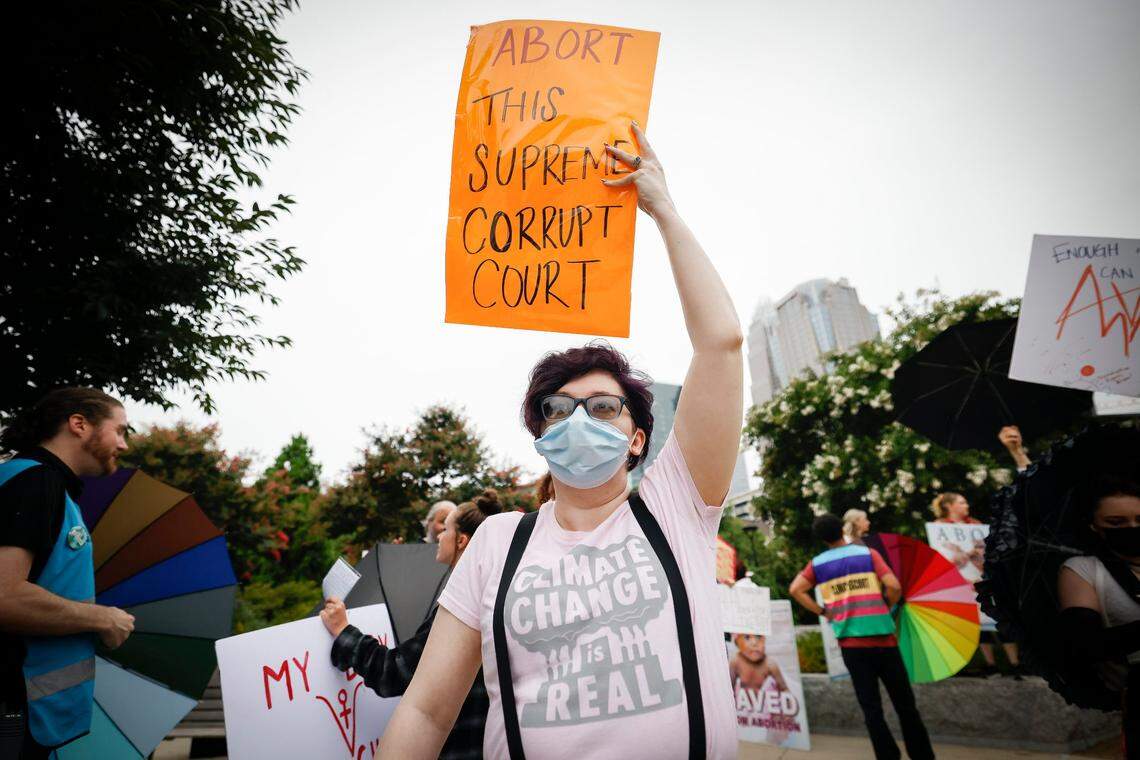
But last summer, the U.S. Supreme Court overturned Roe v. Wade. That let previously unconstitutional laws all around the country go into effect, including here in North Carolina.
And as the Supreme Court’s conservative majority has grown more aggressive in taking cases that could overturn longstanding precedents, some civil liberties activists are looking warily to North Carolina’s other unconstitutional laws still on the books to see what might be next.
North Carolina has unenforceable, unconstitutional laws, including a Jim Crow-era “literacy test,” and a ban on atheists holding public office. The state also unconstitutionally bans same-sex marriage and makes it a crime for unmarried couples to live together. Those laws, unless they’re repealed, could go back into place if the U.S. Supreme Court reverses key decisions.
“There is a concern that some of these laws could come back,” said Kristi Graunke, the top lawyer at the ACLU of North Carolina.
2,500 crimes
And while the American Civil Liberties Union leans left, it’s not the only group with concerns. The conservative John Locke Foundation has for years pushed for a massive undertaking to rewrite the state’s entire criminal code, and get rid of much of it in the process.
John Guze, the foundation’s senior fellow in legal studies and a longtime Durham attorney, said the state has more than 2,500 crimes on the books.
There are separate laws for stealing ginseng or for stealing a Port-A-Potty, he said — and until recently it was even automatically a crime to violate any rule passed by a state licensing board, no matter how obscure. Dentists, as one example, could have been arrested if a state regulator didn’t like their ads.
The unconstitutional civil laws on the books are another concern, Guze said, as are other laws that haven’t been ruled unconstitutional but are steeped in a racist history. He pointed to the state’s pistol permit requirements as one example. Opponents say the law, originally written in 1919, was created to give sheriffs a legal way to stop Black people from buying guns.
Republicans did vote to repeal the pistol permit law in 2021, but Democratic Gov. Roy Cooper vetoed it, writing that he credits the law with reducing homicides as well as suicides. The N&O reported at the time that the votes were along party lines. Guze, however, said he could see it gaining Democratic support in the future.
“It seems like really low-hanging fruit for everybody,” he said, adding that Republicans should support it for Second Amendment reasons, and Democrats should support it to undo a racist piece of the past.

Laws on voting, marriage, sex
Another Jim Crow relic that’s still on the books is the literacy test requirement — which voters and legislative leaders alike have declined to repeal multiple times since the civil rights movement, including as recently as 2021 in the legislature.
That bit of unconstitutional law is actually in the N.C. Constitution itself, as are other examples — like unconstitutional bans on same-sex marriage and a rule that anyone who doesn’t believe in “Almighty God” is banned from holding public office.
Same-sex marriage had been banned in state law for generations but after Republicans took control of the legislature in 2011, they wanted to make it harder for future politicians to legalize it, so they added a ban on gay marriage to the state constitution — an amendment voters approved with broad support in 2012. Three years later it would be made moot when the Supreme Court legalized gay marriage nationwide.
Another potentially unconstitutional law is one passed in the 1930s but apparently never used until 2022, which makes it a crime to portray politicians in a bad light.
It outlaws false statements about politicians and even some true statements. Democratic Attorney General Josh Stein was nearly charged with breaking that law last year, The N&O reported, over a 2020 campaign ad — but a federal court blocked the prosecution at the last minute, giving Stein at least a temporary win in his own lawsuit calling the law unconstitutional.
State law also makes it illegal for unmarried couples to live together, and for anyone — married or unmarried, gay or straight — to engage in oral or anal sex, among other bedroom activities.
North Carolinians were still being punished for violating both those laws until the early 2000s. The turning point was a 2004 U.S. Supreme Court case called Lawrence v. Texas, which ruled similar laws unconstitutional nationwide.
Now that court has undone Roe v. Wade, the Lawrence v. Texas precedent is one of several “erroneous decisions” the Supreme Court should revisit next, Justice Clarence Thomas wrote in a separate opinion in last year’s abortion case. He also named the Obergefell v. Hodges ruling that legalized gay marriage.
If that does happen, North Carolina’s laws on those subjects would likely spring back into place, just like the abortion rules did last year.
Policing the bedroom
North Carolina doesn’t have a ban specifically on gay sex. Instead, there’s a much broader ban on “crimes against nature.” It applies felony charges to a lengthy list of both common and uncommon sex acts — and applies to everyone, regardless of gender or orientation.
The vaguely written law gives judges and juries broad power to decide what coital acts should be punishable by jail time. Over the years, courts have interpreted the law to make it a crime to engage in oral sex, anal sex and more.
And it’s not just a product of its 19th century roots. Much of the caselaw expanding the list of banned sex acts is from the last 50 years, and some is even from the last 20 years, according to the North Carolina Criminal Law Blog.
Other similarly questionable laws in North Carolina ban unmarried people from living together, or even staying together overnight in a hotel.
Guze suggested that if North Carolina leaders don’t end up repealing or rewriting many of the state’s criminal laws, as he and others are pushing for, then another potential solution is to pass a new statewide rule that people can only be prosecuted if they knew they were breaking the law.
“Some will say ignorance of the law is no excuse, that just because you didn’t know something was a crime doesn’t matter, if you broke the law,” he said. “But I’d say that now, because we have so many crimes on the books, that doesn’t make as much sense anymore.”
Before federal judges made them stop, North Carolina cops arrested at least 25 people in the late 1990s and early 2000s for “living in sin” before marriage, London newspaper The Guardian reported. It had briefly become international news when Pender County Sheriff Carson Smith — now a Republican member of the N.C. House of Representatives — threatened to fire one of his employees unless she married her boyfriend or moved out.
She sued and got the law ruled unconstitutional in 2005, in a case based on the prior year’s Lawrence v. Texas ruling — the same ruling now in some conservatives’ crosshairs.
Democrats controlled the legislature at that time and wouldn’t repeal the law, despite one lawmaker filing a bill to do just that in 2007. It remains in place through the present day, with Republicans now in charge.
Graunke said state leaders allowing numerous unconstitutional laws — whether over voting rights, gay rights or other topics — to remain in place is concerning because they could always come back into use in the future, even if they’re currently unenforceable.
“There are some abhorrent laws on the books, and in our governing documents, that people would like to see taken out,” she said.
“And the fact that they remain on the books may speak volumes about our present,” she added.
For cheaters, the courts are doubly strict: Not only is adultery a crime, state law also allows spurned spouses to sue their alleged homewreckers — sometimes for millions of dollars, like in a recent Durham lawsuit — using a civil law called “alienation of affection.”
It stems from the outdated legal theory that women are the property of their husbands and, like other property, shouldn’t be stolen. North Carolina is one of only a few states that still has such a law. A few Democratic legislators sponsored bills to repeal it in 2021, but their proposals went nowhere in either chamber of the state legislature.
Another law, enforced as recently as 2018, prevents judges from giving domestic violence protections to some people in same-sex relationships. It was ruled unconstitutional in 2022 but, like many others, hasn’t been repealed and could go back into place if future court cases allow it.
And it’s not just the U.S. Supreme Court that could put some of these laws back into place. The N.C. Supreme Court has a new Republican majority, having flipped control from Democrats in the 2022 elections, who can now make changes to what’s considered unconstitutional or not.
In the 2022 case granting full domestic violence protections to LGBT people, The N&O reported, every Republican justice on the N.C. Supreme Court dissented. The 2020 N.C. Court of Appeals ruling in that same case also came down purely along party lines.
.JPG "RAL_122222-LITERACY-TEST-TEL-01 (1).JPG")
An unconstitutional constitution?
Recent court cases have explored the idea that parts of the North Carolina Constitution can themselves be unconstitutional — like a recent N.C. Supreme Court ruling that expressed doubt over the legitimacy of two 2018 constitutional amendments.
That case isn’t finished yet, The N&O reported last year.
But other parts of the state constitution are more clearly unconstitutional, like the literacy test requirement for voters.
Passed in 1899, it heralded the start of the Jim Crow era just months after the Wilmington Coup, in which a white supremacist militia supported by powerful state leaders overthrew the multi-racial city council and murdered numerous Black residents.
North Carolina election officials used those literacy test rules, for generations, to stop any Black people from voting. The state was finally forced to stop using them by the federal government, following the passage of the Voting Rights Act of 1965.
But voters chose in the 1970s to keep those racist rules in the N.C. Constitution, even if they’re unenforceable. They remain in place to this day.
Civil rights historian and UNC professor William Sturkey said an easy place for GOP leaders to start with racial reconciliation would be putting a constitutional amendment on the ballot to repeal the literacy test rules. It’s been over 50 years since the state last tried that and voters shot it down.
Doing so would teach people about history, he said, and could particularly inspire Black people by reminding them of what past generations overcame to win back the right to vote.
The fact that the racist law remains enshrined in the N.C. Constitution “symbolizes, basically, the lack of any regret for the structures that were in place for decades and decades,” Sturkey said. “And if you keep it, you’re legitimizing those white supremacists who don’t want Black people to vote.”
Several times in recent years, various lawmakers have proposed doing just that. The repeal idea has had some bipartisan support. But GOP leadership has consistently shot it down, often with no public explanation.
Proposed constitutional amendments to repeal the literacy test rules did pass the N.C. House of Representatives in 2013 and 2017. But the N.C. Senate never allowed a vote on either one, so voters never got the chance to weigh in, The Charlotte Observer reported.
Another attempt in 2019 went nowhere in either the House or the Senate. A 2021 proposal passed two House committees but never received another hearing, let alone a vote, in either chamber — despite having Republican Rep. Sarah Stevens, a top-ranking House member, as a main sponsor.
At the time Stevens acknowledged that getting rid of the literacy test rules is still a tough sell for many voters. She told fellow lawmakers at one meeting that “we will very much need all of your help on the ground” if the bill moved forward, which it did not.
Sturkey said literacy tests have long been popular in America, and not only due to overt racism. Many think it’s a good idea to limit voting to people who can read. But in reality, he said, the rules were always about racist control of the ballot box — with illiterate whites still allowed to vote, while at the same time local elections officials would use the rules to stop Black people from voting, even if they were highly educated.
“On the surface, many Black people might have even agreed with them in principle — ‘People should be informed’,” he said. “But where it really worked was at the local level, where the registrar could just look at someone and then decide to deny them the right to vote.”
Looking at modern politics, Sturkey said that while literacy tests aren’t an immediate threat to Black people’s voting rights, other new laws passed by the legislature share the same motivations.
He pointed to voter ID as one example. Republican lawmakers recently said they would pass another voter ID law this year, after the N.C. Supreme Court ruled in December that their 2018 voter ID law was unconstitutional due to “racially discriminatory intent.” A 2013 election and voter ID law was also struck down for intentionally targeting Black voters. Republicans say they are trying to improve confidence in elections, even though there is little evidence of in-person voter fraud.
“You might not be a member of the Klan,” Sturkey said, “but the effects on our society are going to be the same.”
This story was originally published January 27, 2023 at 6:00 AM with the headline "From Jim Crow to anti-gay laws, North Carolina has chosen to keep unconstitutional rules."