
Thousands of vacancies at NC DHHS lead to burnout for state workers still on the job
 "N.C. Department of Health and Human Services has a lot of staffing shortages, especially at state-run facilities like Central Regional Hospital in Butner, pictured here in an N&O file photo.")
A shortage of workers is putting extra pressure on those still on the job in North Carolina’s state-run mental health facilities.
As a result, employees are needed to work overtime. For some, it’s a way to add to their limited paychecks. For others, it’s another factor leading to burnout. Workers are leaving, and replacements are harder to recruit, for reasons that vary depending on who you ask. Some of it has to do with COVID-19, but workers said the pandemic has only exacerbated problems already there.
The Department of Health and Human Services has nearly 3,500 open positions among its 18,300 jobs. Most of those, nearly 2,300, are within its Division of State Operated Healthcare Facilities, which has 11,000 employees.
That division is in charge of 14 facilities that treat children and adults who have mental illness, developmental disabilities, substance use disorders and neuro-medical needs.
DHHS acknowledges significant staff shortages there, and is seeing an uptick agency-wide, too.
The most difficult positions to fill are health care positions like nurses, health care technicians, clinical social workers and psychiatrists, DHHS spokesperson Bailey Pennington said. There are also shortages in information technology, engineering and human resources.
‘Crucial’ situation
Sekia Royall is a cook at O’Berry Neuro-Medical Treatment Center in Goldsboro. She’s worked there three years.
“The situation is really crucial right now,” Royall told The News & Observer in an interview. In food service, she hasn’t had to work mandatory overtime, but has seen the impact of staff shortages in other areas.
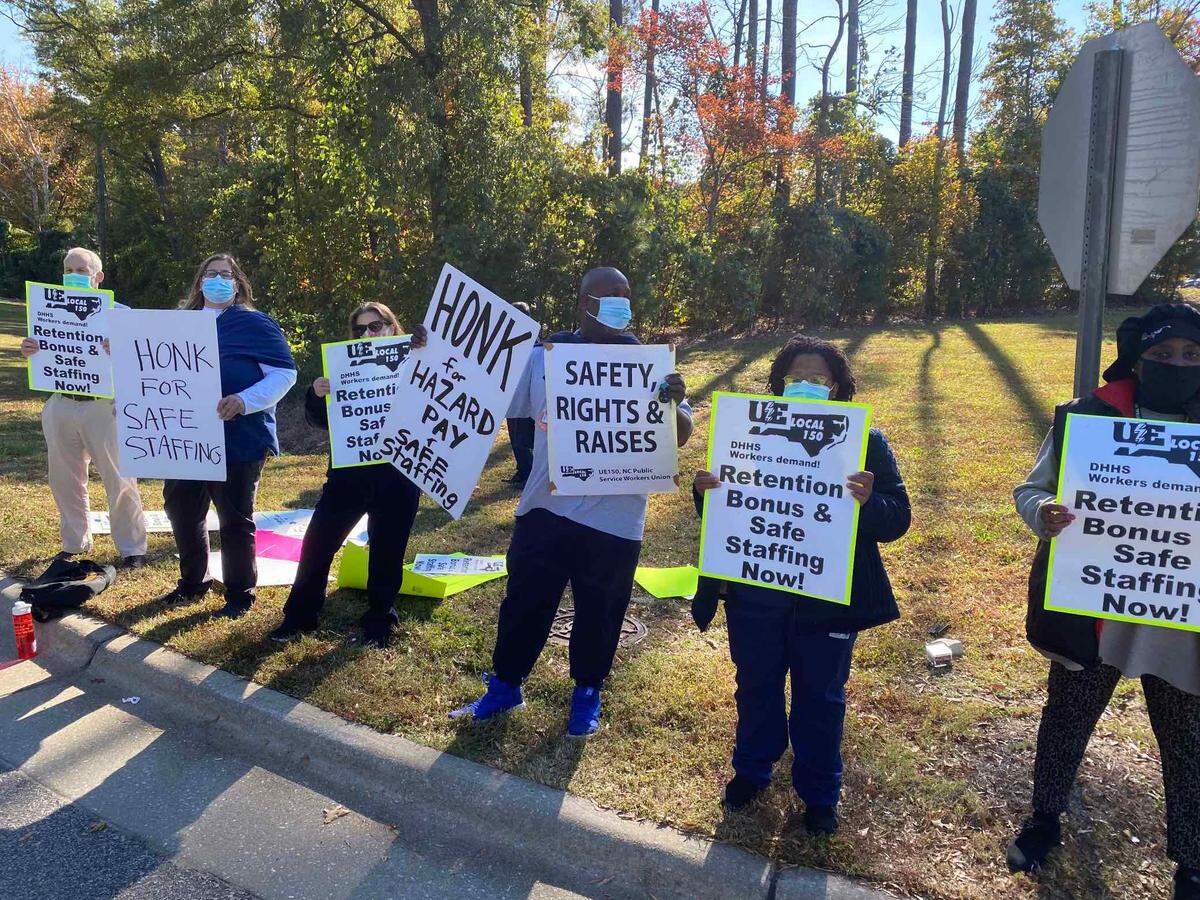
Royall is the statewide president of UE Local 150, a public-service workers union with members in about half of the state-operated facilities. Unions have very little power in North Carolina, which has the second-lowest membership rate in the country, after South Carolina. State law bans collective bargaining for public sector workers.
A lot of workers throughout the six DHHS facilities that have union members, Royall said, have left for various reasons ranging from COVID-19 cases or vaccine mandates to better positions or pay somewhere else. She said shortages at O’Berry mostly involve health care techs and housekeeping staff. Healthcare “techs” are certified nursing assistants, or CNAs. Royall said techs feel pressured to work longer hours.
A lot of overtime
At Central Regional Hospital in Butner, a “red dot” often means overtime whether you want it or not.
It’s not red, nor is it a dot, but it’s a reference to being on-call to work a double shift if necessary. Workers don’t get paid for those on-call hours if they aren’t needed, but still have to arrange child care or other outside-of-work schedules ahead of time just in case.
Pennington, the DHHS spokesperson, said that facilities prioritize patient safety and have “modified staffing patterns in order to increase scheduling efficiencies.” She said they also use temporary and contract staff.
A lot of pharmacy tech Jessica Gazso’s friends are “travelers,” those temporary staff contracted to fill shortages. Gazso works the overnight shift at Central Regional Hospital and is part of union leadership. She restocks the machines nurses use to dispense medication and enjoys her work. She only had to work the “red dot” extra shift once. Her manager in the pharmacy department is “the best,” she said, but managers in other areas affect morale.
Gazso, 38, said she sees nurses and CNAs leaving for better hours and better pay at new jobs. The staffing shortage makes it worse.
“It was kind of bad before the pandemic, then during the pandemic it was mandatory overtime, and they just got tired of it, so a lot of them left after Dec. 31 because for the bonus and raise, you had to stay until Dec. 31,” she said.
Royall said that federal COVID-19 relief bonuses and the 2.5% raises that state employees got in the state budget were appreciated, but don’t go far enough, especially given current inflation.
And the lack of raises is why some workers leave for more money in the private sector.
Money a big factor
What do the workers think would turn things around?
Royall said DHHS should be trying to figure out how to recruit more staff and provide incentives.
“Bringing up the staff is going to alleviate the stress and strain on these workers,” she said.
DHHS is a state agency under the executive branch. Its funding is part of the state budget, which is written and passed by the General Assembly and signed into law by the governor.
Staffing shortages aren’t unique to DHHS, but the department along with the Department of Public Safety have the worst shortages among state agencies.
Shortages in education, especially among substitute teachers, are also putting a strain on workers. In January, Gov. Roy Cooper offered state employees paid time off to serve as substitute teachers, and keep the substitute pay, too. Ardis Watkins, executive director of the State Employees Association of North Carolina, said last month that “staffing shortages at two of the largest departments (DPS and DHHS) are so severe we are not sure how many employees will be able to take him up on his offer.”
Royall said the staff who haven’t left are the most dedicated workers, those who have invested 20 years of their career and don’t want to start over somewhere new. DHHS officials should show appreciation for the staff they have left, she said.
Buba Sabally, a CNA at Central Regional Hospital, works overtime because he has bills to pay.
Starting pay for CNAs is $15 per hour. That’s about the average rate for health care workers who help patients with daily living activities, according to the U.S. Bureau of Labor Statistics.
Sabally has worked at Central Regional for five years, and at nearby Murdoch Developmental Center for three years before that. He works second shift, and sometimes third shift, which is overnight. Sometimes he works his usual 40 hours plus another 24 hours of overtime to help support his family.
He said the main reason co-workers have left is because of money. The January paychecks for state employees included retroactive raises and any bonuses not already paid out, but the February paychecks are back to normal. And the 2.5% raise isn’t very noticeable, workers say. Sabally has seen an increase in frustration and people quitting in the last three months to take jobs at UNC Rex or other hospitals.
Patient care
Dr. Rakesh Patel, an internal medicine physician at Central Regional Hospital, joined UE Local 150 primarily because he wanted to help patient care. He’s now president of the Butner Area chapter of the union.
Patients at the hospital are the “most vulnerable people you can think of,” he said, and range in age from 5 to 95. He said many patients are there for treatment for schizophrenia or bipolar disorder, and another group are “forensic” patients who have criminal charges against them.
Patel said the staffing shortage has become so critical that patients who should be accepted at the psychiatric hospitals are kept in medical hospitals because no beds are available. The shortages could eventually result in shutting down a unit, he said.
Patel blames handling of scheduling and that “red dot” overtime for the shortages, especially of nurses. He said the application process needs to be streamlined so they don’t lose candidates because it takes so long to be hired.
“I think a lot of people need to be fired,” he said. While there is a lot of finger-pointing about who is responsible for the problem, he said, there is not enough urgency.
“At the ground level, the morale is really low. Folks are all looking for another job. I’ve been asked to give references to a lot of people, because everyone’s looking,” Patel said.
Sabally, 52, is one of the employees who is sticking it out.
He loves his job because of the work he does helping people.
“We care for the patients, we feed them, bathe them, clean them up, put them in the bed, read to them, do some kind of fun game with them,” he said.
Originally from Zambia, he said he is living the American dream. He likes his colleagues, who are like a second family. He doesn’t want to leave his job, and he doesn’t want to start over somewhere else.
“If they increase the pay in most areas [of the] building, people will stay and do their jobs,” he said.
DHHS wants more competitive salaries, too.
“In order to best serve the people of North Carolina, it’s critically important that the Department has a team of quality employees,” Pennington, of DHHS, said in an email response to The N&O about staffing shortages. “Even before the pandemic began, the competitive market for hiring critical high-demand workers such as health care professionals, information technology, and engineering made it challenging to recruit and retain employees in these fields.”
“Unfortunately, that situation has been exacerbated by the pandemic. To effectively serve North Carolinians, we need the ability to offer more competitive salaries in a streamlined hiring process to the critical workers who are in high demand,” she said.
Pennington said recruitment has become one of the greatest challenges at DHHS over the past two years. “Additionally, more and more employees are deciding to retire, or they are seeking other opportunities that offer increased pay and better work-life balance,” she said.
For information about applying to work at N.C. DHHS, visit ncdhhs.gov.
For more North Carolina government and politics news, listen to the Under the Dome politics podcast from The News & Observer and the NC Insider. You can find it at link.chtbl.com/underthedomenc or wherever you get your podcasts.
This story was originally published February 8, 2022 at 11:30 AM with the headline "Thousands of vacancies at NC DHHS lead to burnout for state workers still on the job."
.jpg)