
Cooper will sign the NC budget. Why he says ‘the good outweighs the bad’
Update: The final budget vote was taken Thursday morning, with the House passing it 101-10. It now goes to the governor’s desk to sign.
North Carolina Gov. Roy Cooper announced Tuesday he will sign the state budget into law, which means the state will have its first comprehensive budget in three years.
The Republican-majority General Assembly negotiated with the Democratic governor ahead of releasing its compromise legislative budget, called the conference budget, on Monday, but did not reach a deal, so it had been unclear what Cooper would do.
Republicans have majorities in the House and Senate. They lack the three-fifths supermajorities required to override vetoes on their own, but top Republicans have expressed confidence in recent days that they have enough votes to override Cooper if he decided to veto the budget.
“I will sign this budget, because on balance the good outweighs the bad,” Cooper said, adding that it moves North Carolina forward in important ways, “many that are critical to our state’s progress as we are emerging from this pandemic.”
“While I believe that it is a budget of some missed opportunities and misguided policy, it is also a budget that we desperately need at this unique time in the history of our state,” Cooper said.
Cooper cites raises for state employees and tax relief for “everyday North Carolinians” among the reasons for supporting it.
He added the caveat that he is “clear-eyed there are ways we differ,” including that the budget does not include Medicaid expansion.
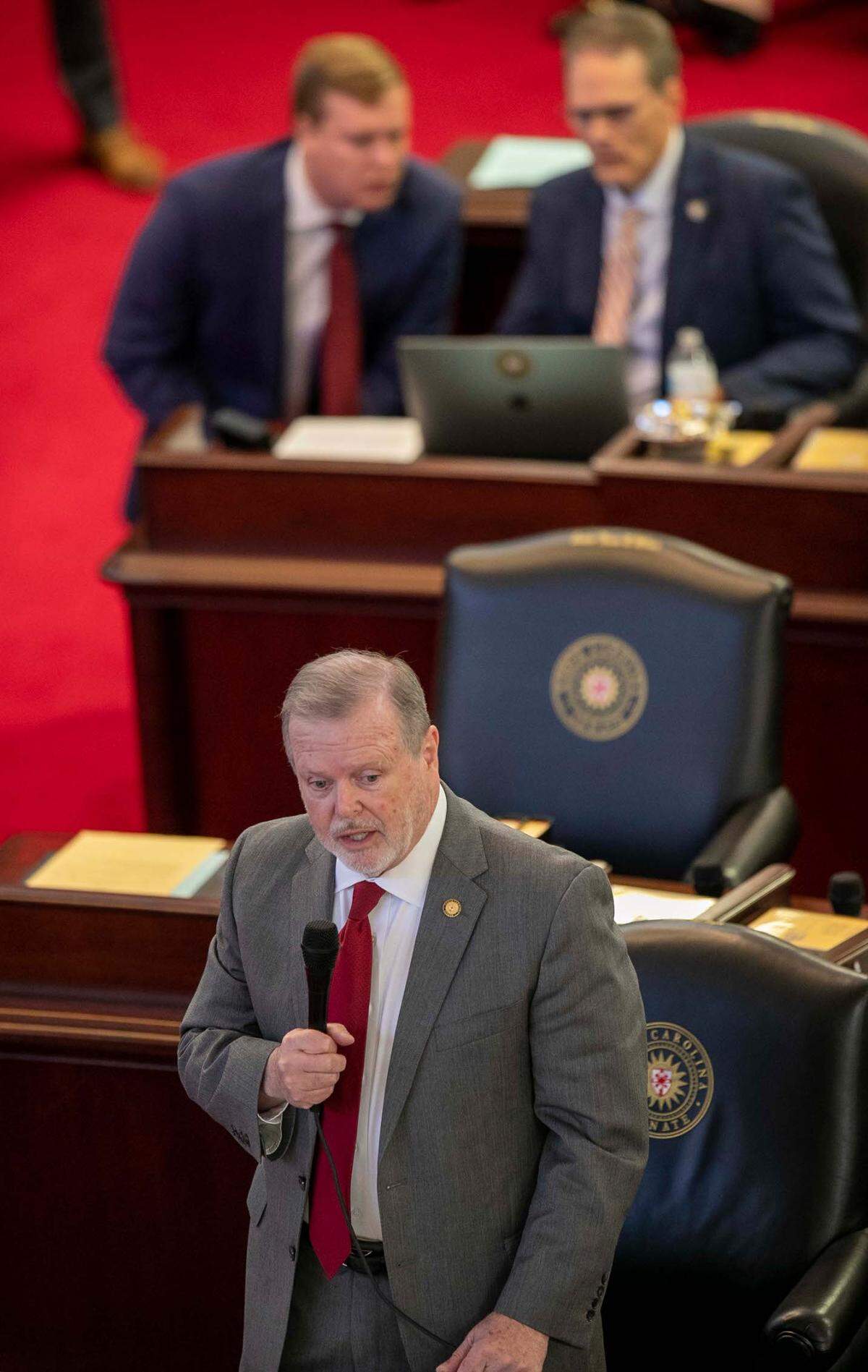
Senate leader Phil Berger, an Eden Republican, told reporters after the Senate tentatively approved the budget Tuesday that concessions made on the Senate Republican side in the budget include the higher raises than the original Senate plan as well as raising the minimum wage for non-certified school employees to $15 per hour within two years.
Senate vote
State senators voted 40 to 8 Tuesday in favor of the budget. Only Democrats voted ‘no,’ citing concerns about how additional education funding was steered away from Wake, Buncombe, Durham, Mecklenburg and Guilford counties.
The budget includes some Republican compromises with Democrats — both Cooper and the Democratic lawmakers who served on the budget conference committee that decided the final version of the budget. Those same Democrats voted for earlier budget proposals in both chambers, more than enough for overrides if they maintained support for the budget.
Sen. Don Davis, one of four Senate Democrats who worked closely with Republicans in budget negotiations, said the spending plan is important for the state.
“Perhaps this was the greatest time in the history of our state (to pass a budget) with navigating the pandemic and trying to figure out how to keep kids in school and keep them safe,” Davis said.
Cooper said that he thinks his veto would have been sustained in the Senate, but said it is time for the state to move ahead.
“Too many investments in this budget are overdue,” he said, including education funding for universities and community colleges, “particularly HBCUs.”
Another vote is expected in the Senate on Wednesday, with House votes on Wednesday and Thursday. Cooper could sign the budget into law as soon as Friday.
Sen. Kirk deViere, a Fayetteville Democrat who voted for the budget and served on the conference committee, said the goal had always been to find a way to a “compromise budget.”
“You’re never going to have a perfect budget. And I think this was an opportunity to move $52.9 billion out into North Carolina where it can do good work for its citizens,” he said.
Raises, tax cuts
On the Senate floor, head Republican budget writer Sen. Brent Jackson, a Sampson County Republican, said: “We’ve tried to cover as much as we could and touch every life in this state to make it better.”
Sen. Deanna Ballard, a Watauga County Republican, described the budget as “student centered, parent empowered” and “focused on funding students, not systems.”
And Democratic Sen. Jeff Jackson, who is running for U.S. Senate, voted for the budget, saying there were enough “major concessions” for him to support it.
”It was a cumulative thing. It was going over the numbers, seeing how they moved in our direction in category after category,” Jackson told The N&O. He said the biggest problem with the budget was the lack of Medicaid expansion, but said he thought lawmakers “took a small step” in appointing a study committee to look at the issue.
The budget includes an average of 5% raises over two years for teachers and state employees.
Ardis Watkins, the executive director of the State Employees Association of North Carolina, told The N&O that while SEANC hoped for higher raises to keep state government competitive, they are pleased with the bonuses in the budget. She said SEANC lobbied hard for retirees, who will get a bonus.
The budget also contains tax cuts for individuals and corporations. Cooper told reporters that “there are many years to fight for a fairer tax system in our state that gives tax cuts to lower-income and middle-income families.”
But Sen. Wiley Nickel, a Cary Democrat running for Congress, opposed the budget, citing the phasing out of the corporate income tax.
“North Carolina already has the lowest corporate income taxes in the South but has failed to invest in our teachers and our public schools. Corporations need to pay their fair share so we can invest in a world-class public education system,” Nickel said in an emailed statement.
Court fights ahead
The budget limits the length of states of emergency issued by the governor to 30 days without agreement from the rest of the Council of State, which is currently majority-Republican, and 60 days without agreement from the legislature.
The governor had vetoed a bill that would have put stricter limits on his emergency powers, starting as soon as this year. The budget also contains a provision about those powers, but Cooper told reporters the start date of 2023 gives time to prepare for changes. Cooper noted that he has repeatedly said he doesn’t want to make changes to emergency powers during the pandemic.
Cooper said the budget includes a policy provision that is a “direct attack” on the constitutional authority of the attorney general — likely a reference to limitations on legal settlements like one that was reached ahead of the 2020 election extending absentee ballot deadlines — and that he thinks that will be resolved in the courts.
Also subject to court resolution, he said: education funding that he wants boosted to comply with a court ruling in the Leandro case that called for hundreds of millions of dollars more in spending on schools.
During the Senate debate on Tuesday, which started after Cooper’s announcement, Senate Minority Leader Dan Blue, a Wake County Democrat, said: “This is the reality of compromise in government, and I accept that.”
“We could do better than this but a lot has been accomplished in this budget by the end of the day,” Blue said on the Senate floor. “This budget is a lot better than the budget we sent over to the House several months ago.”
But Blue said Republicans “surgically” targeted districts of Democrats in the budget.
“I want to point out something that really irks me and it oughta irk you: The treatment that you intentionally decided to impose on Wake County in this budget,” in addition to Buncombe, Mecklenburg, Durham and Guilford counties, Blue said. “In this bill you switched from the Leandro formula and came up with another formula simply to get these five counties and that’s unfair. And that’s why I can’t vote for this.”
Sen. Natasha Marcus, a Democrat representing Mecklenburg County, also voted no on the budget, saying she needed to “stand up for what’s good for Mecklenburg and CMS schools.”
“I know the governor is going to sign this budget,” Marcus said. “It’s probably the best thing for the state overall. But I wanted to be on record as a ‘no’ to stand up for some of the things that got left out that should have been in there, and some of the things that are in there that should not be.”
For more North Carolina government and politics news, listen to the Under the Dome politics podcast from The News & Observer and the NC Insider. You can find it at link.chtbl.com/underthedomenc or wherever you get your podcasts.
This story was originally published November 16, 2021 at 12:03 PM with the headline "Cooper will sign the NC budget. Why he says ‘the good outweighs the bad’."
.jpg)