NC lawmakers file their official redistricting plans, giving GOP a solid edge
The public has already seen a handful of potential redistricting maps — which could be used in every North Carolina election from 2022 to 2030 — but on Friday a top redistricting official filed the official bills for maps that whittled down the various options to just one map.
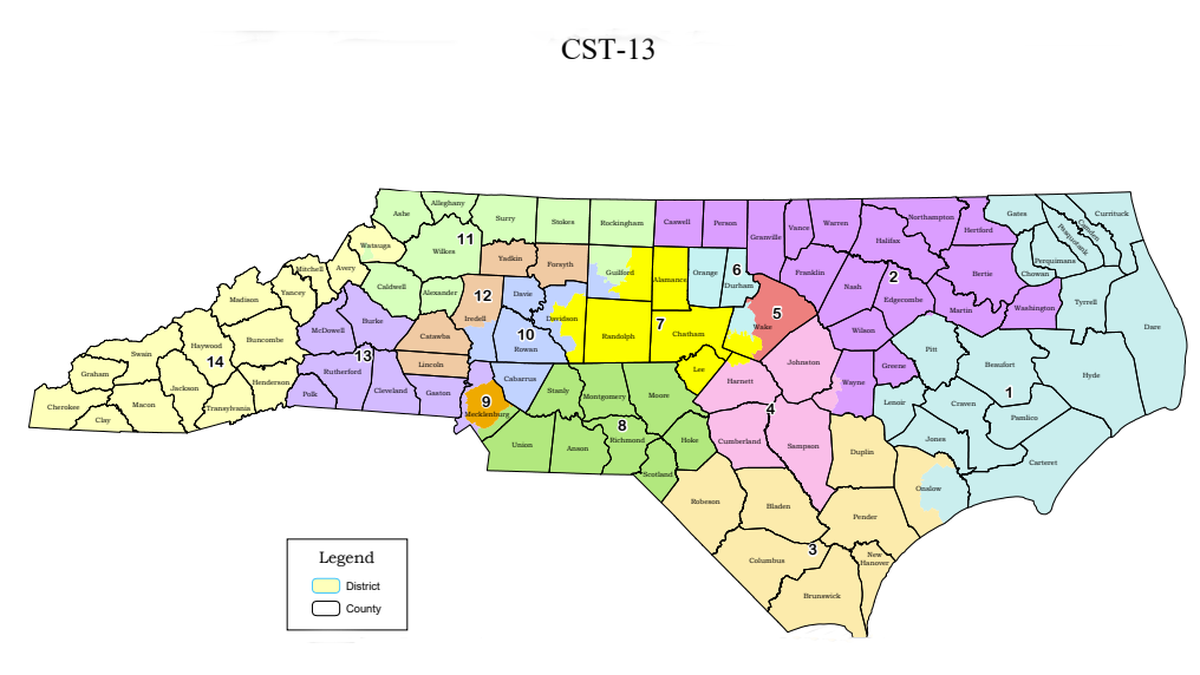
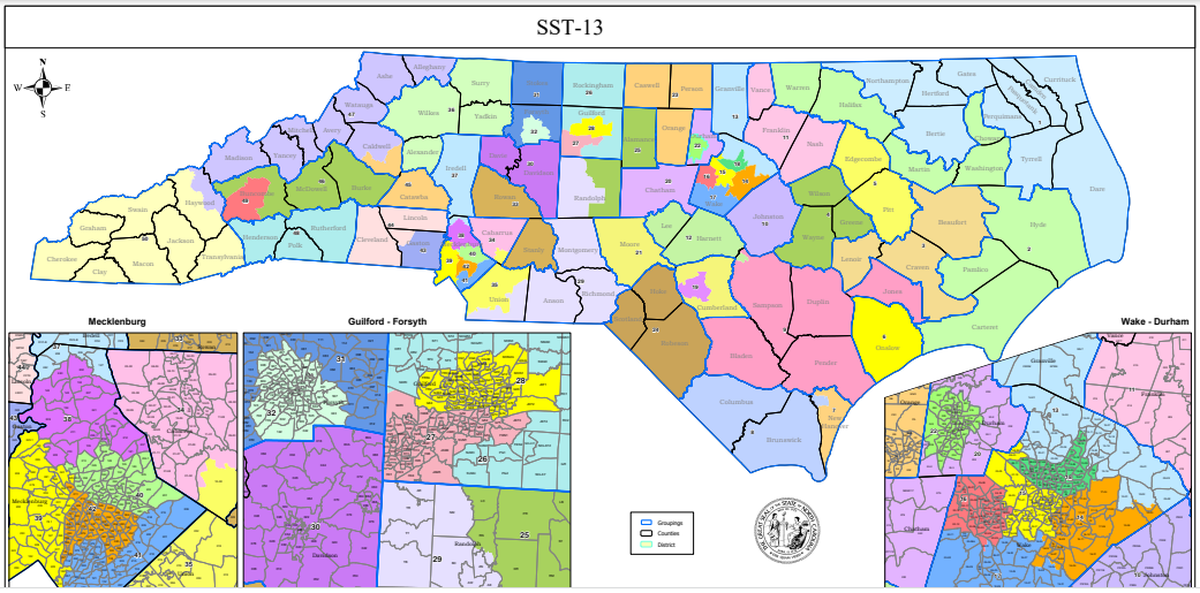
Republican Sen. Ralph Hise filed two bills Friday: One for the map that will determine the 50 seats that make up the N.C. Senate, and the other for North Carolina’s 14 seats in the U.S. House of Representatives.
The map for the 120 N.C. House seats should at least be up by Monday, according to a meeting agenda on the legislature’s website, but it could be posted before then, too. The House could also offer a competing version of a congressional map, different from the bill Hise filed Friday.
GOP leaders previously put out half a dozen different draft maps for the congressional map, each of which was different in some ways but all of which would likely lead to strong Republican majorities in the state’s congressional delegation for years to come.
Democratic politicians have criticized those draft maps as being heavily gerrymandered — comments echoed by several dozen speakers at public hearings the legislature held last week after posting those drafts for the public to review.
The statewide vote is split almost evenly — in the 2020 presidential race, Republican Donald Trump won just under 50% of the vote and Democrat Joe Biden won just under 49% — but all of the congressional maps that GOP leaders have floated would likely give their party nine, 10 or even 11 of the state’s 14 congressional seats.
The map Hise filed Friday was not one of the ones that had previously been shown to the public before the public hearings, although it does appear to be almost identical to one of the maps that was.
An analysis of the new map by the website Dave’s Redistricting App, using election data from the 2016 and 2020 elections, shows that the map would likely produce a 10-4 split in favor of Republicans if North Carolina’s voting patterns remain largely the same. The map would have eight safe Republican seats, three safe Democratic seats and three competitive seats; two would lean right and one would lean left.
It also has an incumbent-free district in the area between Charlotte and Asheville — a common feature in many GOP proposals, which The News & Observer previously reported has led to widespread speculation that it’s intended as a seat drawn for House Speaker Tim Moore to run for congress.
It wasn’t immediately clear if the new version posted Friday had similar underlying statistics.
See the maps
The following is Hise’s congressional map, officially called CST-13:
The following is Hise’s N.C. Senate map, officially called SST-13:
Gerrymandering lawsuit filed
Around an hour after the maps were filed Friday, the NAACP and the anti-gerrymandering government watchdog group Common Cause held a press conference announcing they had just filed a lawsuit asking the courts to intervene in the process, even before the legislature can vote on any maps.
The last time Republican lawmakers drew new maps after the census, in 2011, those maps were struck down as unconstitutional racial gerrymandering. The maps that replaced them were struck down as unconstitutional partisan gerrymandering.
Those legal battles took nearly the entire decade. In the end North Carolina’s 2012, 2014, 2016 and 2018 elections were all held using unconstitutional maps. The challengers want to avoid something similar this decade, hence the lawsuit before any maps even pass into law.
“North Carolina cannot handle another decade of unconstitutional maps,” said Allison Riggs, the co-executive director of Durham-based Southern Coalition for Social Justice. “The harm that that does to our democracy is one that we’ve been feeling the ramifications of for 10 years. It’s too much, and we’re going to start fighting back today.”
Riggs has led anti-gerrymandering lawsuits here in the past and is one of the attorneys now representing the NAACP and Common Cause — which was the group behind 2019’s successful gerrymandering lawsuits.
The lawsuit doesn’t target the specific maps filed Friday, but rather the process in general.
Republican lawmakers have said they did not use any racial or political data in drawing the maps, and some Democrats have questioned the decision not to use racial data. They say it will harm the ability of Black voters in North Carolina to elect politicians who will represent them.
The lawsuit asks that a judge stop the legislature from enacting any maps right now, and delay the 2022 primary elections so that there’s enough time to start the redistricting process over this fall under new rules.
Hise said the Southern Coalition for Social Justice “sued us previously because we used race, and now they’re suing us because we didn’t use race. The only constant here is finding any excuse to sue to gain partisan advantage, no matter how contradictory, and they’re doing it before the maps have even been considered by a legislative committee.”
What’s next?
The House and Senate redistricting committees both plan to meet Monday, the Senate at 9 a.m. and the House at 2 p.m.
The public will be able to attend, but it’s unlikely that they will be able to comment. Members of the committees will be able to discuss the maps and propose potential tweaks for the committee to consider.
It’s possible the committees might also decide to go ahead and vote on Monday. Or a vote may come later in the week. It’s unlikely to stretch too long, though, since leaders have long said they want to be finished by early November since candidate filing for the 2022 elections is in early December.
Once the committees pass the maps they will go to the full House and Senate for approval, where the Republican majorities in both chambers are likely to pass whatever maps come out of the committees.
And that will be the end of the process. Unlike with most bills in North Carolina, the governor is banned from vetoing redistricting maps. So unlike with the state budget or other high-profile issues, Democrats have very little leverage on redistricting since Democratic Gov. Roy Cooper can’t threaten a veto to force Republicans to negotiate with his party’s lawmakers.
This story was originally published October 29, 2021 at 4:14 PM with the headline "NC lawmakers file their official redistricting plans, giving GOP a solid edge."