
COVID is surging in NC. Here’s what emergency powers leaders can use to slow spread.
For now, Gov. Roy Cooper has not imposed a statewide mask mandate as coronavirus cases and hospitalizations swell due to the highly transmissible delta variant.
Yet Cooper is far from the only elected official in North Carolina who can wield sweeping emergency powers to get the pandemic under control.
The issue has taken on additional urgency during the pandemic and the emergence of the delta variant. Some places, including Durham County and the City of Durham, have imposed new mask mandates while others, like Charlotte, still have not.
A recent COVID-19 executive order from Cooper, in underlined wording, says that “local governments can impose greater restrictions.”
”Over the course of the COVID-19 emergency in North Carolina, COVID-19 outbreaks have occurred, at different times, in urban and rural areas; in coastal areas, the Piedmont, and the mountains; and in a variety of employment and living settings,” Executive Order No. 224, which spans the rest of the month, reads.
“Counties and cities may deem it necessary to adopt ordinances and issue state of emergency declarations which impose restrictions or prohibitions to the extent authorized under North Carolina law, such as on the activity of people and businesses,” the order continues.
These are the same parameters that have long been available to North Carolina municipalities during the pandemic. That helps explain why a patchwork of mask-wearing rules have emerged in some, but not all, parts of the state lately.
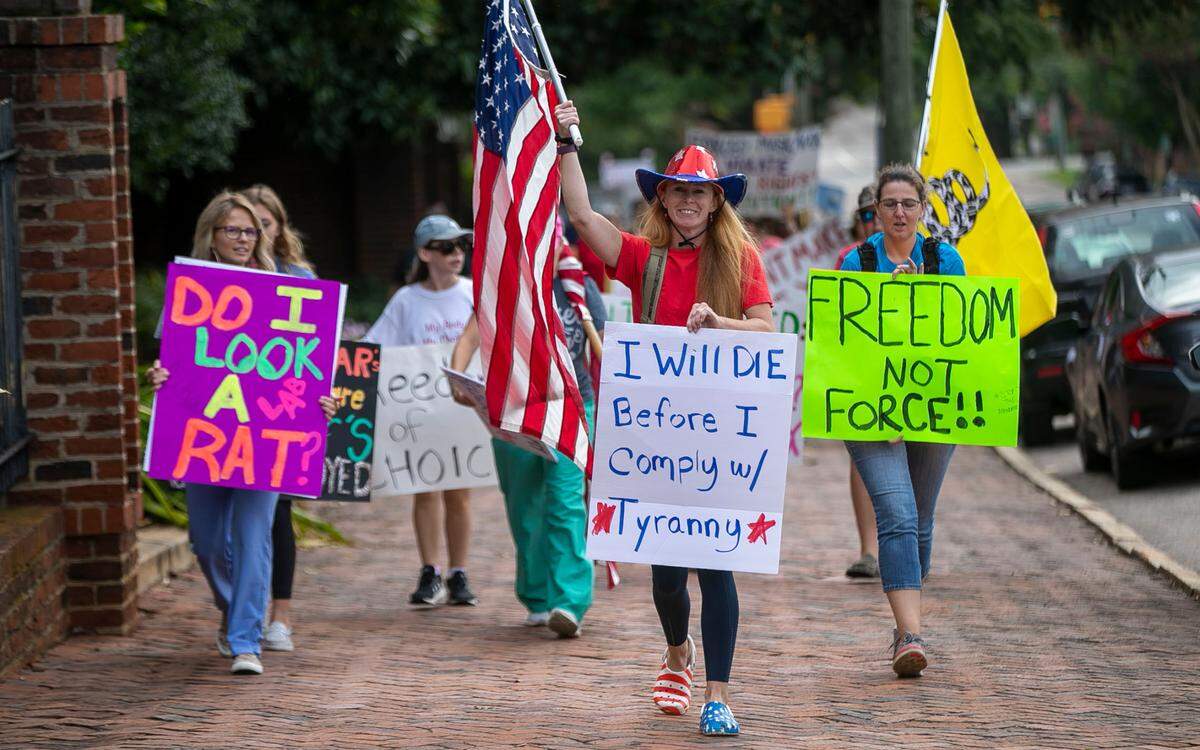
New NC mask rules
Durham County’s indoor mask mandate for everyone over age 5, for example, went into effect Monday afternoon. In Watauga County, Boone’s state of emergency declaration will require masks for residents over age 2, started Tuesday night. And Tuesday, Orange County in the Triangle announced everyone over the age of 2 will need to wear masks indoors starting Wednesday. The order was extended indefinitely throughout the county to Chapel Hill, Carrboro and Hillsborough.
In Charlotte though, Mayor Vi Lyles on Tuesday morning said she does not have the power to “mandate a mask requirement for the city.” She deferred the possibility of coronavirus restrictions to Mecklenburg County Public Health Director Gibbie Harris.
Hours later on Tuesday, Lyles issued a statement trying to clarify her authority, without specifying what exactly her role as mayor allows her to do amid the latest COVID surge.
Meanwhile, Norma Houston, an emergency management law expert at UNC’s School of Government, wrote a blog post at the start of the pandemic about what regulations local authorities can pursue under a local state of emergency. (Houston is now chief of staff for UNC President Peter Hans.)
“A local health director’s authority may not be sufficient to fully respond to the COVID-19 threat,” Houston wrote. “Local health directors’ orders are typically addressed to specific individuals or properties, while the authorities of cities and counties under a local state of emergency are broader.”
Last summer, when Mecklenburg County was pursuing a countywide late-night alcohol curfew, Houston told the Observer that individual mayors of towns and cities could move forward with their own stipulations in an emergency order.
Mayors can amend existing emergency declarations, without declaring or re-declaring new emergencies for their individual towns or cities, Houston said.
Emergency powers
Here is a recap of emergency powers, as the delta variant forces North Carolina officials to rethink coronavirus safety precautions.
▪ Emergency powers are not unlimited, the Observer reported in July 2020. As Houston wrote in her post, there must be a “factual basis” for imposing restrictions or prohibition. They must be used “only to the extent that the restrictions or prohibitions are reasonably related to the threat posed.”
When it comes to COVID-19, Houston said it is important that local officials deliberate with local and state health leaders. The goal, Houston writes, is to “determine whether emergency restrictions and prohibitions they are considering are supported by credible facts and serve a valid public health purpose in addressing the threat.”
▪ City or county officials can declare a local state of emergency, and the exact personnel should be outlined in a municipality’s local emergency ordinance, Houston wrote. The mayor or county commissioners’ chairman could have this authority, for example.
▪ Cities and counties can restrict “the movements of people in public” places under a local state of emergency, according to Houston. That includes ordering curfews or evacuations.
▪ Under a local state of emergency, cities and counties could restrict “the operation of offices, business establishments, and other places to or from which people may travel or at which they may congregate,” Houston writes.
▪ Municipalities can also place limits on the “possession, transportation, sale, purchase and consumption of alcoholic beverages.” Similar regulations apply to gasoline and dangerous weapons or substances, according to Houston.
More broadly, according to Houston, local authority can regulate additional activities that “may be reasonable necessary to maintain order and protect lives or property during the state of emergency.
This story was originally published August 10, 2021 at 6:24 PM with the headline "COVID is surging in NC. Here’s what emergency powers leaders can use to slow spread.."