
As NC legislature debates Critical Race Theory, Black lawmakers sit on one side of the aisle
As the North Carolina state legislature debates Critical Race Theory, all of the Black lawmakers are sitting on one side of the aisle.
The legislature overall mirrors the state’s African American demographics, but there are no African Americans among House Republicans or Senate Republicans. All are Democrats.
Republicans have a majority in both House and Senate, so they always have enough votes to pass legislation along party lines if all GOP lawmakers support it. This week the Senate revived a bill with Critical Race Theory and how to teach about race at the center.
African American lawmakers have been among the bill’s most vocal critics.
“I’m still trying to understand why we’re here,” said Sen. Don Davis, a Pitt County Democrat who is African American, in a committee hearing Wednesday.
Sen. Jay Chaudhuri of Raleigh, who is the Senate Democratic whip and Indian-American, likened an “unfounded fear of Critical Race Theory” to tactics used during the Red Scare.
Sen. Joyce Waddell, a Mecklenburg County Democrat who is African American, said the legislation uses a “fear-based approach to limit teachers’ ability to assess the reality of racism in the United States.”
Asked during a news conference about the bill coming from a caucus with no Black members, Republican Senate leader Phil Berger said: “The most vocal proponent [of the legislation] is the lieutenant governor.”
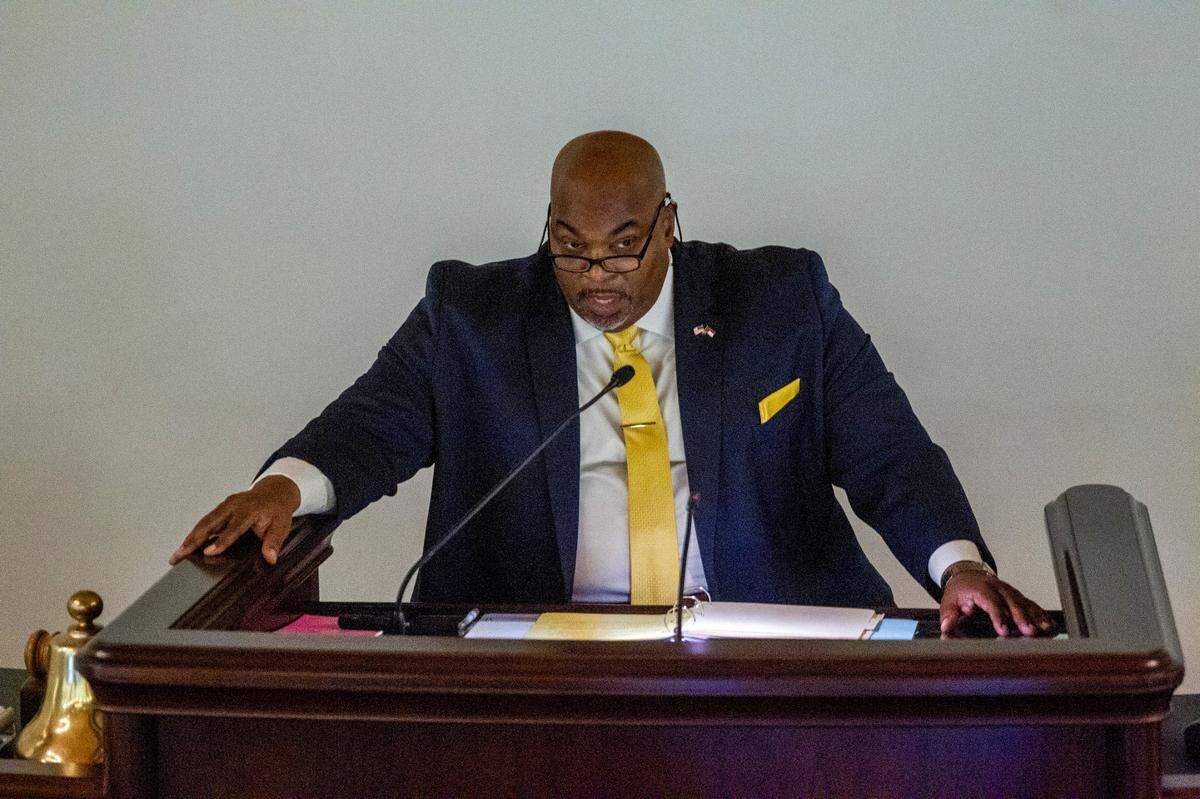
Lt. Gov. Mark Robinson is the state’s first African American lieutenant governor, making history with his election in the fall of 2020. Robinson is also a Republican. As lieutenant governor, he is the president of the Senate, which means he presides over session and would vote in the case of a tie.
Robinson spoke later that day in the education committee discussing the bill. He said he’d heard that a student wanting to do a project on Robinson’s historic achievement was rejected. Robinson thinks it is because of his politics. The lieutenant governor said he will release data from his office’s task force next week about parent and teacher complaints of “indoctrination” in schools.
Robinson has said previously that the U.S. system of government “is not systematically racist. ... In fact, it is not racist at all.”
House Speaker Tim Moore, a Kings Mountain Republican who is white, told The N&O this week that he wished the House GOP caucus had African American representatives as well as more women. He said they’ve done outreach and some candidates didn’t win. He hopes that will change.
Critical Race Theory
Regarding the anti-Critical Race Theory bill and education, Moore said that teachers should teach and not “try to indoctrinate the kids.”
“Our history has some very, very ugly, nasty chapters. Slavery is a stain on this nation. It continues to be. There are still lasting, lingering effects of racism. Absolutely is. But that does not mean for a moment that America is a racist nation,” Moore said.
Critical Race Theory, according to the UNC-Chapel Hill history department, is a “scholarly framework that describes how race, class, gender, and sexuality organize American life.”
This view holds that systemic racism has been and continues to be a part of the nation’s history.
Republican lawmakers have filed bills in state legislatures and in Congress targeting Critical Race Theory.
North Carolina school districts have denied they’re teaching Critical Race Theory. Berger said that while schools may not be teaching about the doctrine, they’re teaching in it. Conservatives have complained that schools are teaching about white privilege and shaming white students.
The Senate bill forbids public schools from “promoting certain discriminatory concepts” such as that particular privileges should be ascribed to a race or sex or that people solely due to their race or sex should feel guilt, anguish or discomfort.
When the House passed its own version of the bill, several African American representatives spoke against it.
Rep. James Gailliard, a Nash County Democrat, talked about growing up biracial and said House Bill 324 would hide the nation’s injustices.
“This is an act to ensure discrimination, fanaticism, bigotry,” Gailliard said during a May committee meeting. “This is really a ‘don’t hurt my feelings’ bill. ‘Don’t tell me the truth about our history because it may hurt my feelings.’” He went on to call the bill one of hatred, classism, privilege and fragility.
What are North Carolina’s demographics?
North Carolina has 10.4 million residents. More than a fifth — 22% of North Carolinians — are Black or African American, according to the U.S. Census.
There are 12 African American state senators in North Carolina, out of a total of 50 senators. That’s 24%, slightly higher than the state’s demographics. All are Democrats.
House members include 24 who are African American, which is 20%, slightly less than the state’s population. All are Democrats.
Of the 50 members in the Senate, 16 are women — 10 Democrats and six Republicans. That is less than a third, though women are slightly more than half of the North Carolina population.
In the House, 29 representatives out of 120 are women — 21 Democrats and eight Republicans. That’s just 24% women.
All three branches of government are led by white men — Berger, Moore, Gov. Roy Cooper and Chief Justice Paul Newby.
For more North Carolina government and politics news, listen to the Under the Dome politics podcast from The News & Observer and the NC Insider. You can find it at link.chtbl.com/underthedomenc or wherever you get your podcasts.
This story was originally published July 16, 2021 at 5:45 AM with the headline "As NC legislature debates Critical Race Theory, Black lawmakers sit on one side of the aisle."
.jpg)