
A disturbance in the force: Cooper, lawmakers are getting along. What it means for NC.
North Carolina’s last budget battle between Democratic Gov. Roy Cooper and the Republican leadership of the General Assembly was an old-fashioned political fight with a side of biscuits. In the end, nobody got what they wanted.
Not the governor. Not lawmakers. Not teachers. Not tens of thousands of state employees.
Something is different this time.
While not exactly best friends now, the political rivals are getting along a lot better. And the future of North Carolina lies, as it has the past four years, in their hands.
So far this year, Cooper, Senate leader Phil Berger and House Speaker Tim Moore have appeared together on the lawn of the Executive Mansion to announce Apple would bring an East Coast campus to North Carolina. They’ve appeared together within sight of the Legislative Building to announce a back-to-school deal. They even appeared in the same public service announcement about getting vaccinated.
Political science professor Christopher Cooper said one reason for them getting along lately is simply “pragmatism.”
“Both sides know almost nothing of substance is going to come out of this session. It’s divided government without a veto-proof majority. There’s really no point arguing publicly, adding vitriol, adding distrust in government, because we know ... the final score,” said Cooper, who is a professor and department head of Political Science and Public Affairs at Western Carolina University in Cullowhee.
What happened last time
In the long summer of 2019 budget drama, the two sides exchanged public letters and had point-counterpoint press conferences. At one point, Moore and Berger brought Bojangles’ to the old State Capitol for a meeting.
But even biscuits couldn’t resolve their differences. The rest played out the way state politics of opposing parties does: the Republican-majority House and Senate sent the Democratic governor a budget. Cooper vetoed it. The House overrode it in dramatic fashion. The Senate did not.
In the end, teachers did not get raises. Medicaid was not expanded. A new state budget was not passed.
What was at stake then is what is at stake now: North Carolinians and how they live and work. The difference now: the Old North State is emerging from a pandemic and is in solid economic standing. The state’s revenue forecast includes a $4 billion surplus.
All three men were in power the last long legislative session, and all three won reelection. North Carolinians are waiting to see how — if — they’ll agree on a plan to spend taxpayer money over the next two years.
“We’re doing things to help move us forward,” Moore said in an interview with The News & Observer. “Announcements like Apple are not an accident.”
Teacher raises, Medicaid expansion redux?
The final nail in the 2019 budget coffin came in January 2020, when a one-day session resulted in one more dispute. Cooper vetoed a bill that would have given teachers an average 3.9% raise, calling it “paltry.”
Tamika Walker Kelly, president of the North Carolina Association of Educators, said that was the right move. The absolute minimum raise for educators should be 5%, she told The N&O in a phone interview on Monday. What teachers marched for in May 2019 are still priorities in May 2021. That includes raises, restoring master’s degree pay and a $15 minimum wage for noncertified school personnel, she said.
“We, of course, have seen the spirit of bipartisanship come through the General Assembly and their relationship with the governor,” she said. “We are hopeful that lends itself to passing a budget that supports education and fully funds it. So educators are watching discussions very closely.”
“Good education policy is good policy, it doesn’t matter which party it comes from,” Kelly said.
State leaders are awaiting details on how they can spend federal money coming from the Biden administration’s American Rescue Plan for more coronavirus-related relief.
Soon after the coronavirus pandemic arrived in North Carolina in March 2020, Cooper closed schools, many of which stayed mostly remote-only for a year. As the state grappled with COVID-19, federal relief came in waves.
Leaders seemed to make nice with each other at first. Round one of coronavirus relief spending came through a bipartisan House committee process. Moore and Berger joined Cooper at a press conference when they signed the relief package in summer 2020.
But lawmakers don’t agree on a lot of policy, and rifts reemerged. At one House floor session in 2020, Democratic Rep. Robert Reives remarked: “COVID kumbaya is over.”
Reives is now the Democratic minority leader. He said things have changed a lot this session.
What he sees now is “a sea change.”
Reives credits Moore with setting a different tone in the House.
“The school bill to me was a perfect example of where we are this year,” Reives said, in terms of Republicans and Democrats getting along. After weeks of disagreement on how and when to tell schools to offer full-time, in-person instruction, Reives joined his Republican counterparts and Cooper for the announcement at a news conference on Bicentennial Plaza.
But schools reopening was something all parties wanted to see happen. On Medicaid, Republican Senate leadership does not want the expansion Cooper wants.
On Medicaid expansion, if the two parties can figure out something, great, and if they can’t, then they can’t, Reives said.
Moore said they should be able to agree on a roughly $26 billion state budget as long as there’s no single-issue sticking point — like Medicaid expansion.
“Just as there were not votes [for expansion] last year, there are not now,” Moore said. “There are many, many ways to improve access to health care. Medicaid is not the end-all, be-all, to access to health care.”
In interviews this year with The N&O and others, in his inaugural address and again a week ago on the front lawn of the mansion, Cooper has a common refrain. After the 2020 election, he didn’t get rid of the Republican-controlled legislature and they didn’t get rid of the Democratic governor. Voters chose to keep a divided government.
So all three of them — Cooper, Berger and Moore — owe North Carolinians a consensus, the governor has said.
Cooper spoke directly to lawmakers during his State of the State address in April in the House chambers.
“To the legislators in the room: We’ve agreed before; let’s find ways to do it again, and keep moving our state forward. Let’s agree to listen more to each other and act in good faith to get things done. We’re already making progress on that,” he said.
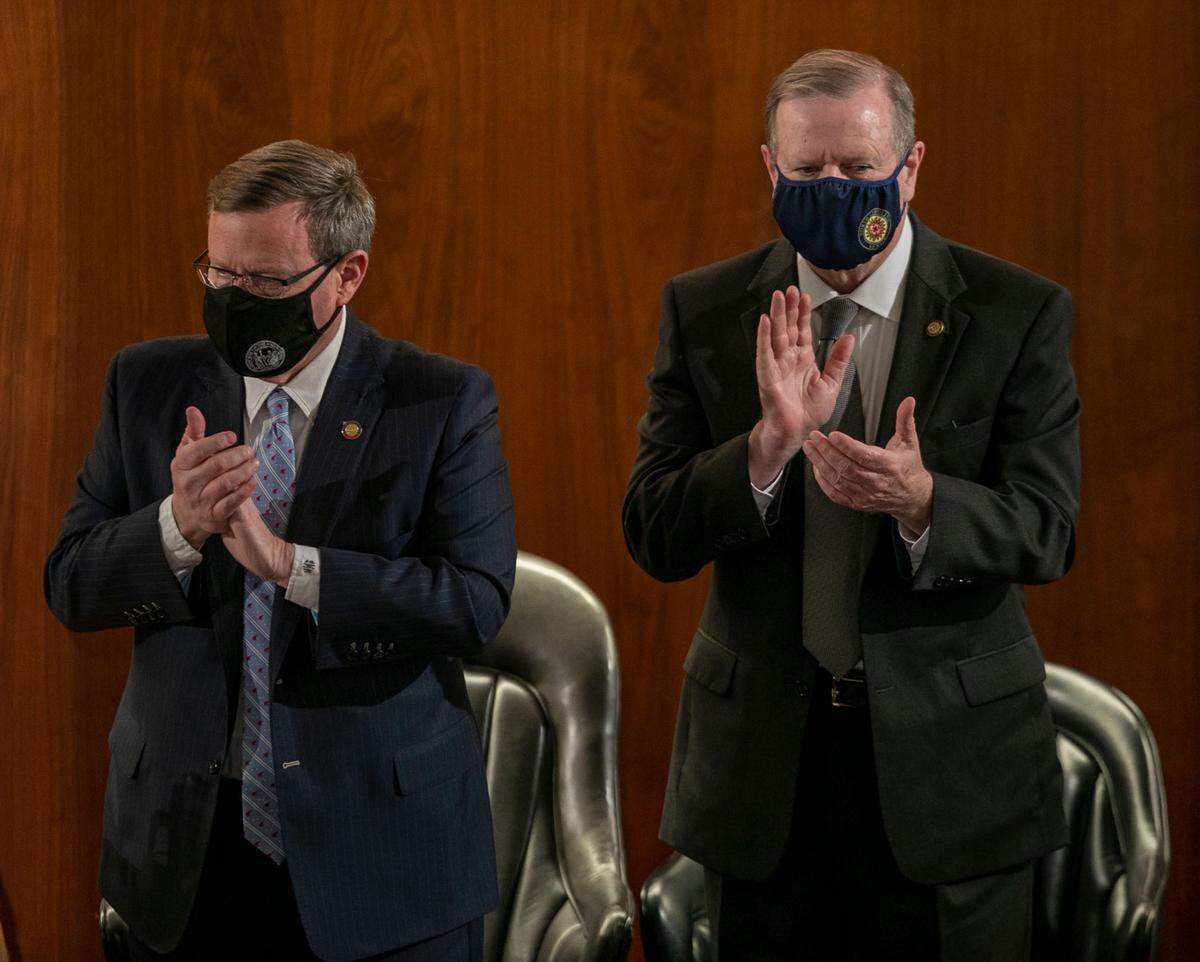
Berger, an Eden Republican, said he can’t point to a particular conversation they had post-election about all of them being reelected to lead a divided government.
“At least for me, it appears to be just a realization that there are things that would have been better if we’d been able to get through to a budget,” he told The N&O on the Senate floor after a recent session.
“However, I also think that probably the most important part of it is — you know we were talking before, and the challenge that we had is that we had a single issue that was determined to be the thing that must happen before we get all sorts of other things done,” Berger said about Medicaid expansion.
What helped was Cooper indicating that wouldn’t be his position this time, Berger said. Plus they are talking more this time around.
“I’ll give him credit for actually initiating calls to me that had not been done prior as regularly as they are now. And so it’s not unusual for my cell phone to ring and he’s on the other end of the line. I think he would concede that it’s not unusual for his cell phone to ring and I’m on the other end of the line,” Berger said.
“I think we all hope that we’re able to find common ground. I’m convinced that as long as Medicaid is not something that will cause the entire process to stop and fall apart, that we’ll be able to get to an agreement,” he said.
Moore told The N&O that there is something else at play, too.
Unlike the federal government, if the state does not pass a budget, there is no government shutdown. Instead, the operating budget for the previous year just rolls over. That’s what happened in 2019. The old budget rolled over, and several “mini” budgets were also passed.
“Look at it this way: The governor put very little input in this budget we’re operating under now,” Moore said. That budget is from 2017-2018, in the era when Republicans had a veto-proof supermajority and regularly blocked Cooper’s vetoes of their bills.
Cooper is now in a situation, Moore said, of signing a budget into law they’re all proud of.
“We’ve done that before,” Moore said, like COVID-19 relief and a summer learning program passed in the past year. By the next two-year budget in 2023, the balance of power may shift back to a Republican supermajority, he said.
Moore described his relationship with the governor this past year as “good.”
“There are some differences. The differences are, for example on emergency powers, with a lot of the shutdown regulations, though the governor is moving more and more to open things up, which is something we’ve been pushing for in the General Assembly,” he said.
The House and the Senate have each passed their own version of a bill curtailing the governor’s powers to issue long-term executive orders during an emergency. Votes have fallen along party lines.
Where things stand now
Cooper’s budget proposal has been out for two months. The negotiating now is going on behind closed doors between the House and the Senate. Berger told reporters last week that the House wants to spend more than the Senate does, and once they agree on a final overall number, they’ll sort out details like the amount of raises for state employees, including teachers. An agreement could be reached within a week, with the first round of the budget votes a few weeks after that.
“I don’t think [Gov. Cooper] wants to be known as the governor who doesn’t have a budget, twice,” said Cooper, the political science professor. He said that the governor had to put Medicaid expansion in his budget proposal, which isn’t a radical position.
“It’s a capital ‘D’ Democratic budget, but a mainstream one. A joke in North Carolina forever is that the governor’s budget is valuable only in that it’s a good doorstop,” he said. While heavy, it has no force of law, and just establishes an initial bargaining position, he said.
The new budget year starts July 1.
For more North Carolina government and politics news, listen to the Under the Dome politics podcast from The News & Observer and the NC Insider. You can find it on Pandora, Spotify. Apple Podcasts. Stitcher. iHeartRadio. Amazon Music, Megaphone or wherever you get your podcasts.
This story was originally published May 4, 2021 at 4:13 PM with the headline "A disturbance in the force: Cooper, lawmakers are getting along. What it means for NC.."