
In tight NC presidential race, Black voters could make the difference
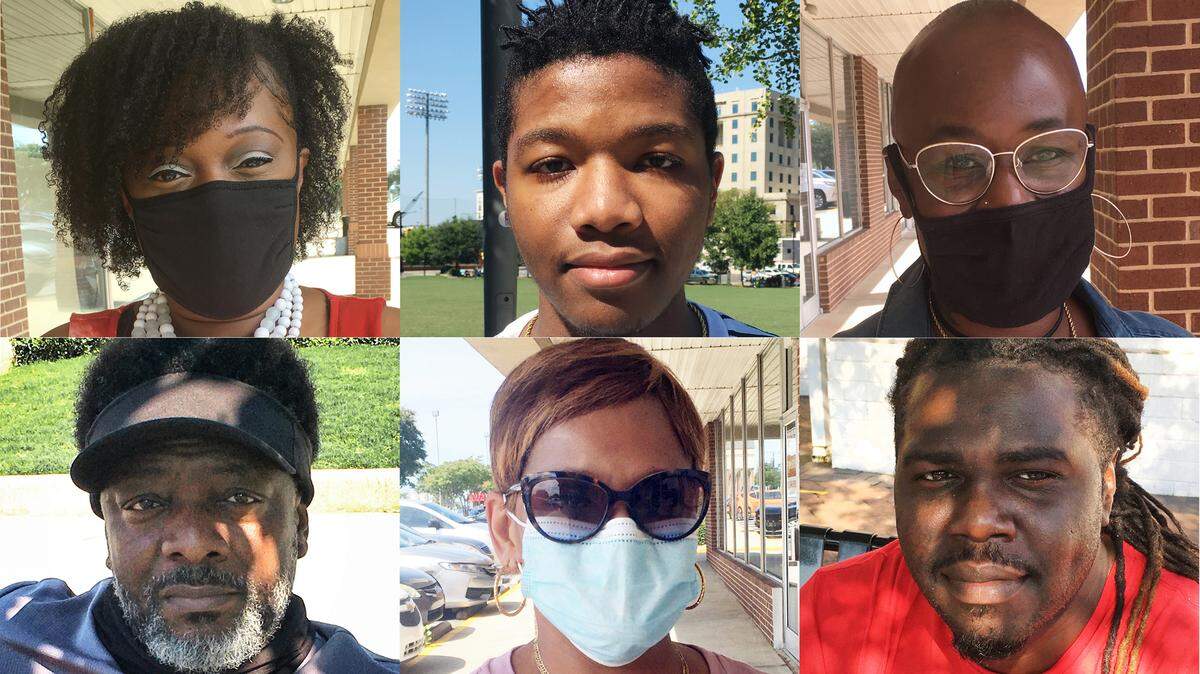
Who wins North Carolina’s 15 electoral votes — Republican Donald Trump or Democrat Joe Biden — may well hinge on African-Americans like Eileen Skinner and Derek Partee.
Skinner, 61, of Charlotte, still isn’t sure she’ll vote this year. “I’ve lost a lot of faith in politics,” said the customer service representative for a big retail company.
But if she does cast a ballot, she said it’ll be more a vote against President Trump than for former Vice President Biden. “I don’t care for his politics or his verbiage,” Skinner said of Trump. “I’m embarrassed to have him as president.”
Partee of Huntersville voted for Trump in 2016. “He was a New Yorker,” explained Partee, 68, who moved to North Carolina after working in law enforcement in his native New York.
But, four years later, Partee said it’s “up in the air” who he’ll vote for this time. As a Republican, he still considers himself a “party man.” But Trump’s record and rhetoric in office have disappointed him. “He’s not addressing the Black community,” Partee said. “And there’s no diversity in the Trump administration.”
With polls suggesting a possible nail-biter in North Carolina, the two presidential campaigns are both making pitches to Black voters. The state has a greater percentage of African-Americans — nearly 23 percent — than any of the other five most hotly contested battleground states.
Black voters in North Carolina and elsewhere traditionally side overwhelmingly with Democratic candidates, but Trump made inroads four years ago. Nationally, 13 percent of Black men voted for Trump in 2016; only 4 percent of Black women did, according to exit polls.
With the campaign in the home stretch, both sides are ginning up their courtship of North Carolina’s African-American community this week. The Trump campaign is stressing the president’s record on signing bills launching criminal justice reform and funneling more money to historically black colleges and universities. The Biden campaign is also focusing on Trump’s record — namely, his mishandling of the COVID-19 virus, which has disproportionately hit people of color.
On Tuesday, the Biden campaign in the state hosted a virtual vote-by-mail rally headlined by Stacey Abrams, the Black Democratic activist from Georgia who came close to winning that state’s governor’s race in 2018.
Also Tuesday, the Trump campaign launched a radio ad in 11 “urban” markets, including Charlotte and Raleigh, featuring former NFL star Herschel Walker. The 1982 Heisman Trophy winner was one of several African-Americans who promoted Trump’s re-election during speeches at the recent Republican National Convention.
‘Huge turnout’
The Biden campaign is hoping to whip up the kind of massive turnout among Black voters that helped Barack Obama in 2008 become the first Democratic presidential candidate since Jimmy Carter in 1976 to carry the Tar Heel State. And the Democrats are banking as much or more on Black voters’ antipathy toward Trump as on any enthusiasm for Biden, Obama’s vice president, and his running mate, Sen. Kamala Harris, the first Black woman to run on a major party ticket.
“The Democrats not only want the level of Black turnout they saw in 2008, they must have it if they’re going to carry North Carolina. That’s key,” said Kerry Haynie, a professor of political science and African and African-American Studies at Duke University.
Haynie and Michael Bitzer, a political scientist at Catawba College, agreed that the Biden-Harris campaign will also need to put up a fierce fight for suburban voters if they hope to reclaim the state.
Still, said Bitzer, Biden’s need to turn out more African-Americans is a given: “It’s incumbent on the Biden campaign to speak to, energize and mobilize that key constituency.”
N.C. Democratic leaders have had their eye on one number: 169,800 Black Democrats who voted in the state in 2012 did not vote in 2016, when Trump beat Democrat Hillary Clinton in the state by about 4 percent.
Black Democratic women like U.S. Rep. Alma Adams, D-N.C., of Charlotte are expected to take a leading role in boosting turnout by urging early voting and having answers ready on how to vote by mail. Last Friday, North Carolina became the first state to begin sending out requested absentee ballots.
And on Thursday morning, Adams and a caravan of supporters and other elected officials are planning to show up at the Mecklenburg County Board of Elections to turn in their absentee ballots and be among “the first people in the state, if not the country, to vote for Joe Biden,” said Adams spokesman Sam Spencer.
Adams told the Observer that she plans to work with Black churches and other groups to get out the vote, whether in-person or by mail.
“I do think it’s absolutely critical that we have a huge turnout,” she said. “We don’t need to have any questions about whether or not Biden-Harris takes this election. But we have so many people concerned that their votes be counted. ... So we are encouraging people to get the absentee ballot and vote early. I think that will alleviate some of the stress.”
The Biden campaign is running ads in the state tailored to Black voters, including one featuring Adrianna Williams, a student at Duke University who co-chairs Black Students for Biden, and another with N.C. Rep. — and Rocky Mount pastor —James Gailliard.
It’s clear that N.C. Democrats and the Biden campaign hope to make the election a referendum on Trump, with Exhibit A being his handling of the pandemic and its effects on the African-American community.
“President Trump’s mismanagement of the COVID-19 pandemic has disproportionately devastated Black North Carolinians and his divisive rhetoric has made all our communities less safe,” L.T. McCrimmon, state director of the Biden campaign said in a statement. “The choice for Black voters in the state, especially Black women, couldn’t be clearer, and we are working tirelessly to ensure they understand what’s at stake for their families and future, the tremendous power they have, and their options to vote in this election.”
In the weeks ahead, Adams and others expect visits from the two candidates and at least virtual appearances by Obama and former First Lady Michelle Obama. Both campaigned in the state for Clinton in 2016.
Also look for the campaign to make hay of Harris’s ties to historically black colleges and universities. There are 11 of them in North Carolina, including Johnson C. Smith in Charlotte, Shaw in Raleigh and North Carolina Central in Durham.
Harris attended Howard University in Washington, and belongs to the Alpha Kappa Alpha sorority, whose colors are pink and green and whose well-organized members will likely sign up en masse as volunteers.
“You will see a lot of pink and green in North Carolina between now and November,” said Duke University professor Haynie. “It’s extremely important to have Harris on the ticket as they try to build enthusiasm and get out the (African-American vote).”
‘Kept his promises’
While N.C. Democrats wait for visits from Biden and Harris, Trump and Vice President Mike Pence have each made three stops in the state in as many weeks. Then there are the recent campaign events in North Carolina featuring members of the Trump family.
The reason for so much attention: North Carolina is a must-win state for Trump. No Republican has won the White House while losing North Carolina since Dwight Eisenhower in 1956.
In recent years, it’s also become a state where the victory margins are thin. Obama won in 2008 by 0.32 percent. Four years later, Republican Mitt Romney edged Obama by about 2 percent. And while Trump’s 2016 margin of 3.67 percent was less of a squeaker, it also was a far cry from the years when Republicans easily carried the state — George W. Bush by 13 percent in 2004.
The lesson is that every vote counts in North Carolina. “This year, the presidential race in North Carolina is going to be determined by 2 percent or less,” predicted Donald Bryson, president and CEO of the conservative-leaning Civitas Institute in Raleigh, which conducts the Civitas Poll.
Nobody expects the Trump campaign to win anywhere near a majority of African-American voters in North Carolina. But if the president can peel away an additional 5 percent of those voters, “it would literally be impossible for Biden to win” the state, said Clarence Henderson, a civil rights pioneer from High Point who is advising the Trump campaign in the state.
Henderson was another of the African-American speakers at last month’s Republican National Convention.
He said his job is to spread the word, via radio ads, Facebook and Twitter posts, op-ed pieces and virtual gatherings, about what President Trump has done for the African-American community.
Here’s how Paris Dennard, who directs the Trump campaign’s outreach to Black voters, put that pitch in a statement:
“President Trump has kept his promises to the Black community, including delivering permanent annual funding for HBCU’s like North Carolina A&T State University, over 250 North Carolina opportunity zones, criminal justice reform, record-low unemployment, reduced prescription drug prices, and progress on school choice. “
In February, the campaign announced it would open 15 “Black Voices for Trump” field offices around the country, including three in North Carolina. The one in Greensboro did open, but Dennard said Gov. Roy Cooper’s “draconian COVID-19 restrictions” prevented the opening of the field offices planned for Charlotte and Raleigh.
The campaign had an in-person “Black Voices for Trump” event in Raleigh in January featuring Henderson and Diamond and Silk, two African-American women who hail from Fayetteville and appeared with Trump at rallies during the 2016 campaign.
In the radio ad that launched Tuesday, former gridiron great Walker says that Trump “keeps right on fighting to improve the lives of Black Americans. He works night and day. He never stops. He leaves nothing on the field.”
In a Civitas Poll in August, taken before Biden chose Harris to be his running mate, Trump was supported by 5.7 percent of African-American voters. Biden was the choice of 80.5 percent, with 9.8 percent undecided.
In an earlier July poll by Public Policy Polling, a Democratic-leaning firm based in Raleigh, Black voters broke down this way: Biden, 91 percent; Trump, 4 percent; and 5 percent undecided.
‘Show some empathy’
Over the Labor Day weekend, the Observer spoke with 12 African American voters from the Charlotte area.
Some gave Trump credit for signing the criminal justice and HBCUs legislation and for low unemployment pre-pandemic.
But there was no support for re-electing him.
Their biggest objection to Trump: He has divided the country, rather than trying to unite it.
“When he says he’s for law and order, he means ‘Fight, fight,’” said W. Miller, a retired Vietnam vet from Charlotte.
Added Raymond Moore, 55, who fought on the front lines during his 30 years in the Marines: “He doesn’t care about law and order. How many people around him are now in jail?”
Miller, Moore and others said they also believed claims, made by anonymous sources in a recent Atlantic magazine article, that Trump has referred to U.S. soldiers who served and died as “suckers” and “losers.”
Kelvin Parsons, 55, a salesman who served 10 years in the U.S. Marine Corps, said he believes the article because of how Trump publicly denigrated then-U.S. Sen. John McCain because he had been captured during the Vietnam War.
“That’s his pattern,” Parsons said. “I’m disappointed, but not surprised.”
Even voters who don’t fully support Biden were not ready to vote for Trump.
Tasha Bias, 30, a Charlotte-Mecklenburg police officer and member of the National Guard, said Biden needed to outspoken in distancing himself from those who say they want to “defund the police.” She said Trump’s stance supporting the police is closer to her view.
“It’s about holding people accountable,” she said. “It’s not a police issue, it’s a people issue.”
Does that mean she might consider casting her ballot for Trump?
No, she said. “I don’t really believe anything that comes out of his mouth.”
And though Pamela Clay said Trump’s embrace of school choice could help some African-American children, she also said the president could not understand those who have been poor and oppressed. “Not just that,” she added, “he doesn’t have the desire to understand.”
In the interviews, issues regarding Trump’s character came up more often than his handling of the pandemic.
“I definitely do not want Trump to be re-elected,” said Katrina Lawson, 43, a sixth-grade teacher in Charlotte. “He’s rude, disrespectful. He should be upholding his role as president. Show some empathy.”
Oronde Nelson, 19, a student at Central Piedmont Community College, said neither Biden nor Harris would have been his choice to lead the Democratic ticket. He cited Biden’s sponsorship of the 1994 crime bill and Harris’s past as a prosecutor.
But he plans to vote for them. “I don’t really think Trump is fit for for the job,” Nelson said. “He’s not doing anything to help anybody but himself.”
Others said they liked Biden because he seemed committed to doing what Trump won’t or can’t: Bring the country together.
Said Toi Bias, 35, Tasha’s husband who does IT work for an Internet provider: “At least he has a track record of being more bipartisan. I think that’s what we need.”
Francesca Chambers of McClatchy’s Washington bureau contributed to this story.
This story was originally published September 9, 2020 at 6:00 AM with the headline "In tight NC presidential race, Black voters could make the difference."