Fact check: ICE says North Carolina jails won’t hand over dangerous inmates
Editor’s note: This article marks the launch of our new fact-checking project. Read more about the project here.
The issue: With an increasing number of cities or counties refusing to cooperate with ICE, the agency is highlighting some of the inmates who have been released from jails without being turned over for potential deportation. Some have gone on to commit major crimes. In North Carolina, ICE also is raising concerns about the status of people currently in jail, including suspects who haven’t been released and some who aren’t eligible for release.
Why we’re checking this: With a new ICE website focusing on North Carolina jails, and with congressional testimony claiming that murderers are being released into communities, we wanted to dig into details. Specifically, are murderers or murder suspects being released despite ICE detainers?
What you need to know: In November 2018, North Carolina voters elected black sheriffs in each of the state’s seven most populous counties. The sheriffs won election, in part, because of their opposition to hardline immigration policies.
Republican state lawmakers passed legislation to force sheriffs to comply, but Gov. Roy Cooper vetoed the bill.
The sheriffs are refusing to comply with requests — called detainers — from Immigration and Customs Enforcement to hold unauthorized immigrants in their custody for up to 48 hours after they’ve completed their sentences or posted bond, so federal agents can pick them up for deportation.
Wake County Sheriff Gerald Baker has said ICE is responsible for immigration enforcement and the agency should not ask the sheriff’s deputies to do it, the N&O previously reported. Baker also defended the practice of not agreeing to ICE detainers because he said it leads to greater cooperation from the Latino community.
Critics of the sheriffs compare them to “sanctuary cities,” which typically describes jurisdictions that limit work with immigration enforcement officials. The agency says the number of “sanctuary jurisdictions” nationally has risen from 40 in 2009 to more than 580 in May 2018.
During a Senate committee hearing in October, Timothy Robbins, ICE’s acting executive director for enforcement removal operations, said the “sanctuary” policies are a threat to public safety.
“Are sanctuary cities releasing violent murderers?” asked Sen. Ted Cruz, a Texas Republican.
“Yes,” Robbins replied.
ICE says it requested 160,000 detainers in fiscal year 2019.
According to data ICE provided to WBTV, the agency prepared 2,975 detainers for detention facilities in North Carolina. ICE said 489 were lifted due to being “declined by law enforcement agency,” in the 2019 fiscal year as of Aug. 17. It is not clear if all of these inmates were released or if they were subsequently arrested by ICE.
The News & Observer made several requests for additional data, but ICE has not provided it. ICE did not respond to requests to identify the two people charged in homicide cases, and the N&O wasn’t able to identify them, determine if they were charged with murder or another crime, or find out what happened in their cases.
We did find a recent release from jail involving someone convicted in a drunken driving death in Mecklenburg County. Earlier this month, ICE announced it had arrested a Mexican citizen after he was convicted of felony death by motor vehicle, sentenced to time served and then released despite an ICE detainer. Jose Barajas-Diaz had been free for a week when he was arrested by ICE, according to the agency.
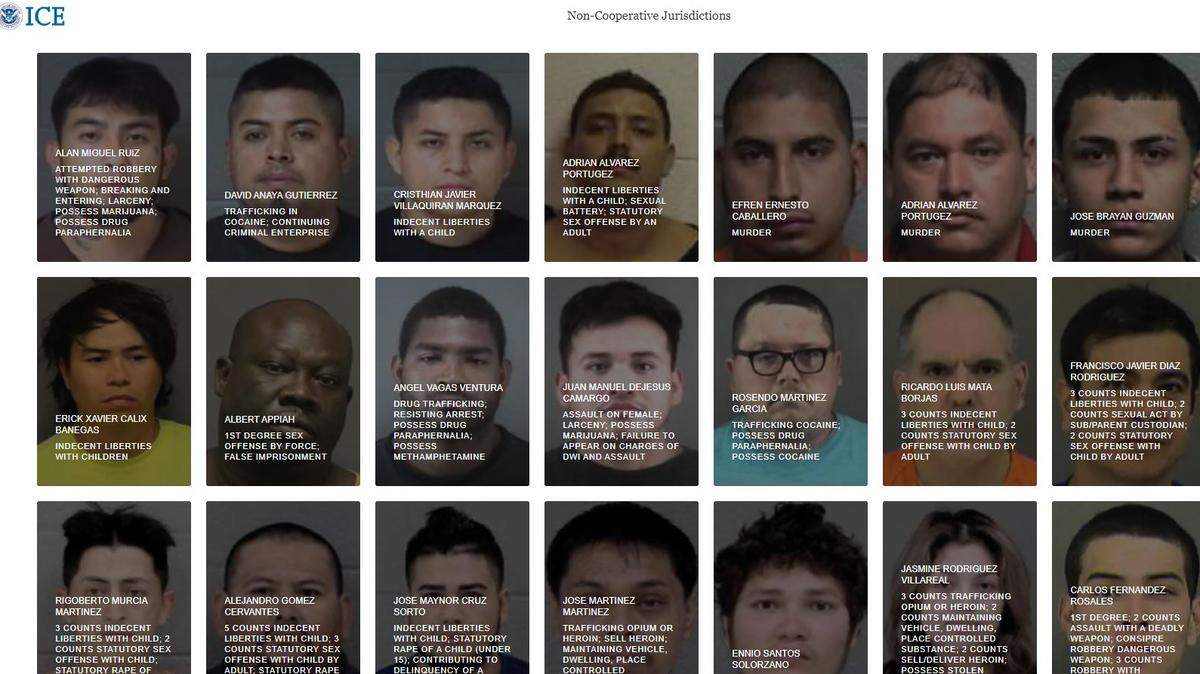
Now ICE has created a website about what it calls “non-cooperative jurisdictions” in North Carolina, containing the names and photos of 25 inmates being jailed in Buncombe, Durham, Forsyth, Guilford, Mecklenburg and Wake counties. Four are facing murder charges (three in Durham County and one in Mecklenburg County).
We checked on the status of the four murder suspects on the ICE website to see if they may be released. We found that two of the suspects are not eligible for release and two others have been in jail for more than three years with hefty bonds:
▪ Eliseo Verver Gonzalez was charged with murder in the death of a Durham teen who was strangled in January 2016. Gonzalez has been in the Durham County jail since November 2016, a span of more than 1,000 days. There is a $500,000 bond for his release.
▪ Efren Ernesto Caballero-Martinez was charged with murder in a Durham stabbing case in February 2016. Caballero-Martinez is facing four charges: assault on a female, first degree battery, murder and attempted murder. He has a $750,000 bond and has been in jail since Feb. 14, 2016, more than 1,300 days.
▪ Jose Brayan Guzman faces murder charges related to the death of his girlfriend in August. Guzman was arrested in Louisiana. He is being held without bond on the murder charge, according to the Durham County jail roster. He also faces a larceny of a motor vehicle charge. He has been in jail since Oct. 3.
▪ Ennio Santos-Solorzano was charged in the stabbing death of his roommate in East Charlotte. He faces a first-degree murder charge. He has been held since August. He is being held without bond.
ICE, according to its website, has requested detainers on all four inmates.
Bonds are not set by local sheriffs. They are set by the courts.
“If anybody meets the legal conditions set by the court for release, then we will release them barring any kind of criminal warrants, outstanding criminal warrants from any agency — be it the Durham police department or the FBI,” said AnnMarie Breen, a public information specialist with the Durham County Sheriff’s Office. She added that ICE detainers “are not criminal warrants. There is no probable cause behind those.”
Some courts have found that ICE detainers violate people’s constitutional rights. Hans Linnartz, an immigration attorney who taught immigration law at Duke University for 10 years, said North Carolina courts haven’t ruled on it, but other courts have found that ICE detainers “simply don’t satisfy the requirements of proving a person needs to be deprived of his or her liberty.”
“They are asking for a second bite at the apple based on the belief that the person is a worse offender because he or she might not be lawfully present,” Linnartz said. “Immigration status, even if established, really isn’t a proxy for law breaking or law keeping and it almost never has any relevance to the charge for what the person was first put into jail — driving without a license or murder. It’s almost always unrelated to that.”
A 2019 study released by the Trump Administration’s Justice Department found that non-citizens, who make up 7% of the population, accounted for 15% of all federal arrests in 2018. Two studies released in recent years, one by the libertarian Cato Institute and another in the journal Criminology, found that unauthorized immigrants commit far fewer crimes than U.S. citizens.
Around the country, ICE has publicized the cases of people accused or convicted of serious crimes before their release, along with examples of other people who were released and later arrested for serious crimes:
▪ A Jamaican citizen in New York who was released despite a detainer while charges of attempted murder were pending.
▪ A Maryland case in which two teens and suspected MS-13 gang members were charged with attempted murder, released despite detainers, then arrested on murder charges stemming from the case.
▪ Six cases over the last five years in the Pacific Northwest, laid out in an ICE news release, in which local authorities didn’t honor detainer requests and the former inmates were later arrested and charged with violent crimes, including four murder cases.
BEHIND THE STORY
MOREOur process
We check claims that are widely shared or published; are about a topic of concern to many of our readers; can be proven or disproven through facts; and could cause people to act or vote in a certain way. This topic met all the criteria.
Send comments and suggested fact-checks using this form.
Find out more about our process here. And as always, we abide by our newsroom’s ethical guidelines.
Our sources. Here’s where we found information and research on this topic:
Lawfare on immigration detainers
Interview with Sen. Thom Tillis on Oct. 30
ICE website on “non-cooperative jurisdictions”
Senate Judiciary Committee hearing on Oct. 22
ICE data for North Carolina in the 2019 fiscal year
This story was produced by The News & Observer Fact-Checking Project, which shares fact-checks with newsrooms statewide. It was edited by Politics Editor Jordan Schrader and Managing Editor Jane Elizabeth. Submit a suggestion for a fact check, or a comment or suggestion about our fact-checking, at bit.ly/nandofactcheck.
This story was originally published November 21, 2019 at 5:00 AM with the headline "Fact check: ICE says North Carolina jails won’t hand over dangerous inmates."