‘Long’-fingered creature found lurking near trail in China. It’s a new species

As night seeped across the mountains of southern China, a “long”-fingered creature moved through the leaves near a trail and tucked itself under a rock. But its hiding place wasn’t quite hidden enough.
Visiting scientists found the “brassy” animal — and discovered a new species.
A team of researchers hiked along a mountain trail in Guizhou Province in April as part of a wildlife survey focused on amphibians and reptiles, according to a study published Nov. 3 in the peer-reviewed journal ZooKeys.
During their visit, researchers found several unfamiliar-looking lizards moving along the ground or hiding, the study said. Intrigued, scientists took a closer look at the animals, analyzed their DNA and quickly realized they’d discovered a new species: Scincella tenuistriata, or the narrow-striped ground skink.
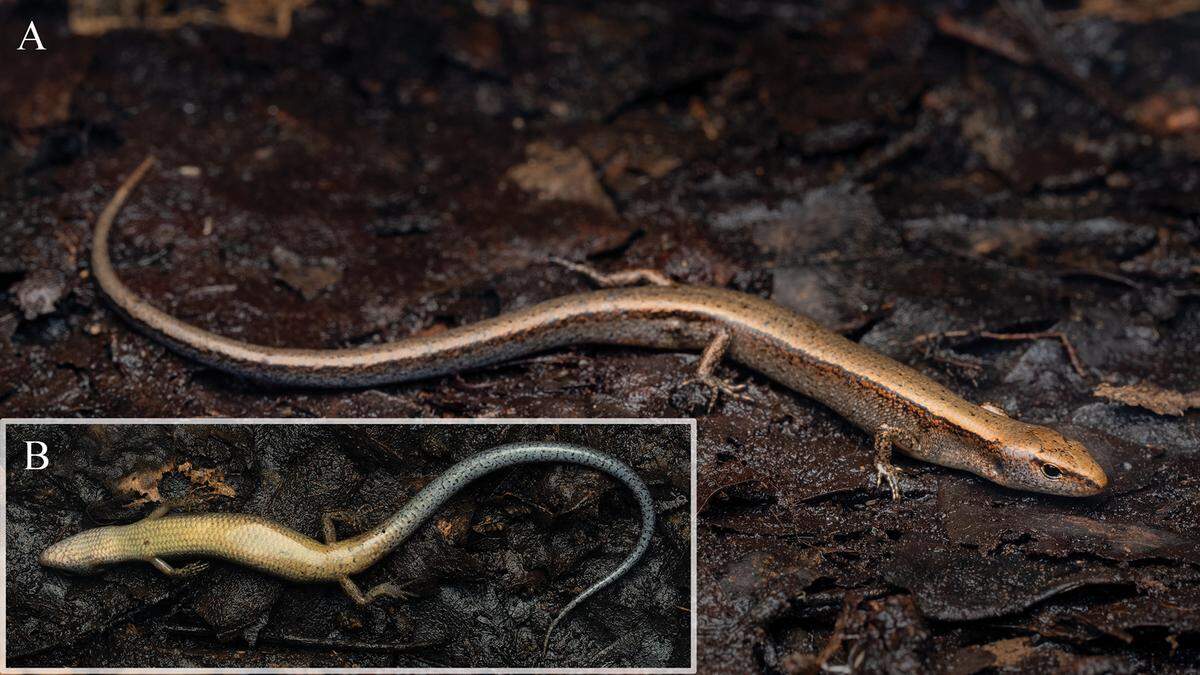
Narrow-striped ground skinks are considered “medium”-sized, reaching just over 4 inches in length, the study said. They have “large” eyes with a transparent “window”-like disc in their lower eyelids. Their tails are “long,” and their limbs are “short” with “long and slender” fingers and toes ending in a “clearly visible, slightly curved claw.”
Photos show the “brassy” coloring of the new species and its yellow belly. Researchers said they named the new species after the Latin words for “narrow” and “striped” because of its distinctive coloring.
Narrow-striped ground skinks were found “under leaf litter and beneath rocks along a shaded mountain trail” at an elevation of about 6,100 feet, the study said.
“The skinks were noticeably more active during daylight hours, particularly in the morning and late afternoon, when they were frequently observed actively moving across the forest floor,” researchers said. “At night, individuals retreated beneath cover objects and could only be located through careful searching.”
So far, narrow-striped ground skinks have only been found at one site in Guizhou Province of southern China, the study said. Because of this, the new species has “potential vulnerability to habitat disturbance,” and researchers suggested “future surveys in adjacent montane areas … to clarify its conservation status.”
The new species was identified by its body size, body proportions, finger and toe shape, scale pattern, coloring and other subtle physical features, the study said. DNA analysis found the new species had at least about 9% genetic divergence from related species.
The research team included Yuhao Xu, Zhonghao Gong, Tan Van Nguyen, Jundong Deng, Andrey Bragin, Shiyang Weng, Tierui Zhang, Nikolay Poyarkov and Lifang Peng.
This story was originally published November 5, 2025 at 12:19 PM with the headline "‘Long’-fingered creature found lurking near trail in China. It’s a new species."