
‘Serrated blade’ stuck in rock on UK beach is ancient sea creature tooth, experts say
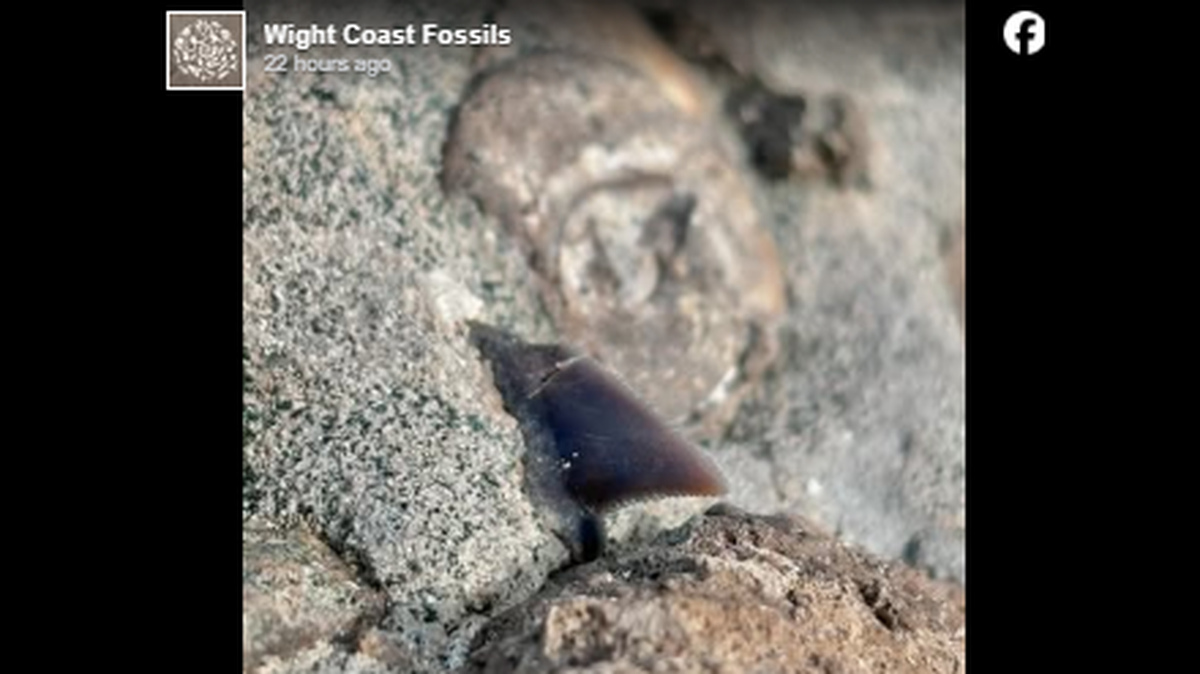
A “serrated blade” found sticking from a rock in the United Kingdom has been identified as a “nearly perfect” prehistoric shark tooth, experts say.
It belonged to a Squalicorax falcatus shark, which prowled the ocean 90 to 100 million years ago, according to Wight Coast Fossils on the Isle of Wight.
That’s tens of millions of years older than the better known — and monstrously large — megalodon shark.
Fossil hunters discovered the tooth “eroding” from a block of sandstone on the fossil-rich island’s southern coast, Wight Coast Fossils told McClatchy News.
“Colloquially known as the ‘crow shark,’ Squalicorax was a widespread and common shark in the oceans of the late Cretaceous,” the company said in a Jan. 14 Facebook post.
“Reaching body lengths of up to (9.8 feet), Squalicorax falcatus was a medium-sized pelagic and coastal predator, well-adapted for hunting and scavenging.”
The tooth was taken off the beach still encased in rock, then carefully extracted for inclusion in the Theo Vickers collection, officials said. It’s small, measuring at less than a half an inch tall, making it all the more miraculous the tooth survived intact.
Squalicorax had a body similar to modern grey sharks, Fossilera reports, but with the “can-opener” shaped teeth of tiger sharks.
The species met its demise during the Cretaceous-Tertiary extinction event (known as the KT extinction) that also wiped out the dinosaurs, experts say.
“A meteorite big enough to be called a small asteroid hit Earth precisely at the time of the K-T extinction,” according to a report by the University of California Museum of Paleontology.
“Almost all the large vertebrates on Earth, on land, at sea, and in the air (all dinosaurs, plesiosaurs, mosasaurs, and pterosaurs) suddenly became extinct. ... At the same time, most plankton and many tropical invertebrates, especially reef-dwellers, became extinct, and many land plants were severely affected.”
Squalicorax shark fossils have been found in Europe, North America, Africa and Asia, but they are a rare find on the Isle of Wight, Wight Coast Fossils said.
The buying and selling of their teeth is a thriving market on the internet.
This story was originally published January 15, 2025 at 1:54 PM with the headline "‘Serrated blade’ stuck in rock on UK beach is ancient sea creature tooth, experts say."