
A man was hunting bear. Watch as a bear climbs into the stand with him.
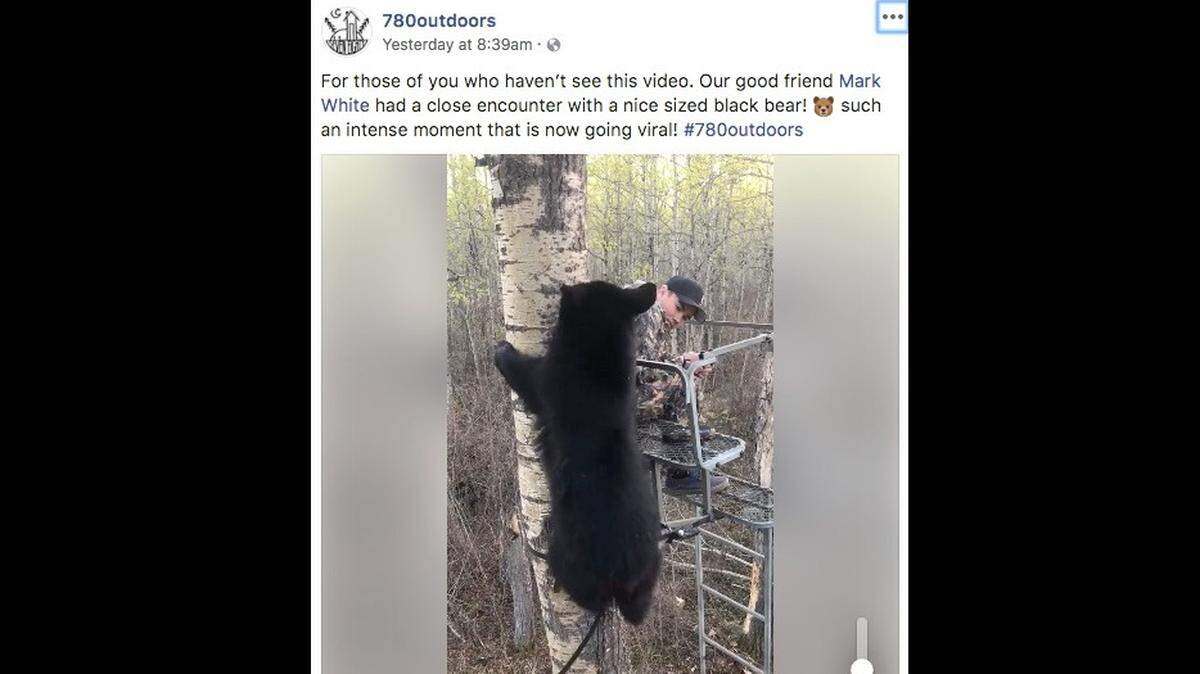
Davin Grunow was hunting bear in Bonnyville in Alberta, Canada, when suddenly he was no longer alone in his tree stand.
A black bear cub climbed the tree Grunow was perched in, and fellow hunter Mark White caught it on video.
The video, captured during a hunting excursion May 11, was posted to the 780outdoors Facebook page on May 15 and had been shared more than 32,000 times by the next day, with more than 6,300 reactions.
White said he and Grunow were out hunting black bears. But it's illegal to hunt sows (adult female bears) and cubs.
This cub was chased up Grunow's tree by an aggressive boar (adult male bear), White said.
In the 54-second video, the cub scoots up the tree, seems to hesitate briefly when it sees Grunow, then continues up.
The curious cub takes a look around from his new vantage point, then gets curious about Grunow.
The bear cub leans toward Grunow and it looks like it may even have touched him.
White makes soft noises and snaps off camera to distract the bear from Grunow. The bear turns around almost immediately and looks directly at White and his camera.
The cub then quickly loses interest in Grunow and ambles slowly down the tree.
And this isn't the first time White has seen this happen. Just not quite this close.
Summer — particularly July and August — is when bears are on the move, according to wildlife officials. Mature males seek females during this breeding period and mother bears drive off juvenile males who must seek their own territory.
Years ago, sightings would have been rarer throughout North Carolina.
Before Europeans colonized the New World, black bears lived in all forested regions of North America and were abundant in the area that would one day become North Carolina, according to the North Carolian Wildlife Resources Commission.
But like mountain lions and gray wolves, black bears often were killed by early settlers. By the early 1900s, black bears were found only in the most remote mountains and coastal swamps of the state, fleeing the more heavily populated Piedmont region.
Deforestation from development, over-hunting and diseases contributed to the black bear decline.
But conservation efforts have been successful and the black bear has made a remarkable comeback in population and in range in the last 30 to 40 years. As of the early 2000s, according to the wildlife commission, about 11,000 bears made their homes in North Carolina, occupying about 50 percent of the state’s total land area. From a coastal bear population of a little more than 2,000 bears in 1980, the eastern North Carolina bear population steadily has grown to about 10,000 in about 2008.
This story was originally published May 16, 2018 at 2:42 PM with the headline "A man was hunting bear. Watch as a bear climbs into the stand with him.."