
Colorful creatures found in Alabama river turn out to be ‘imperiled’ new species

“Brilliantly” colored fish caught in streams in Alabama have been identified as two new species — but they’re at the “highest risk of extinction,” researchers said.
The new fish, the Gurley darter and Birmingham darter, were discovered in creeks of the Black Warrior River system outside the Birmingham metro area, according to a study published April 23 in the Royal Society journal.
These fish, also known as Etheostoma gurleyense and Etheostoma birminghamense, join the ranks of two other new species of darters found in the same river system and recently described in the journal Zootaxa, McClatchy News previously reported.
“The Birmingham, Alabama, metropolitan area harbors an exceptional diversity of imperiled species of freshwater fishes,” researchers wrote.
The new snubnose fish and the existing species they were confused for share common ancestry dating back 5 million years ago, researchers said.
DNA testing revealed the new species are genetically distinct.
“We use 21st century methods to delimit species as evolutionarily distinct units with distinctive morphology,” said lead author Chase Brownstein, a graduate student at Yale University’s Department of Ecology and Evolutionary Biology. “A combination of methods is now the gold standard for describing species, and can be super effective (as we have shown) for efficient description when taxa are clearly imperiled.”
With these conservation concerns in mind, the researchers have published their findings in short-form. Brownstein compared this strategy to the format sometimes used in the early stages of discoveries in paleontology.
Both new darter fish are relatively small, with the largest specimens measuring just over 2 inches long.
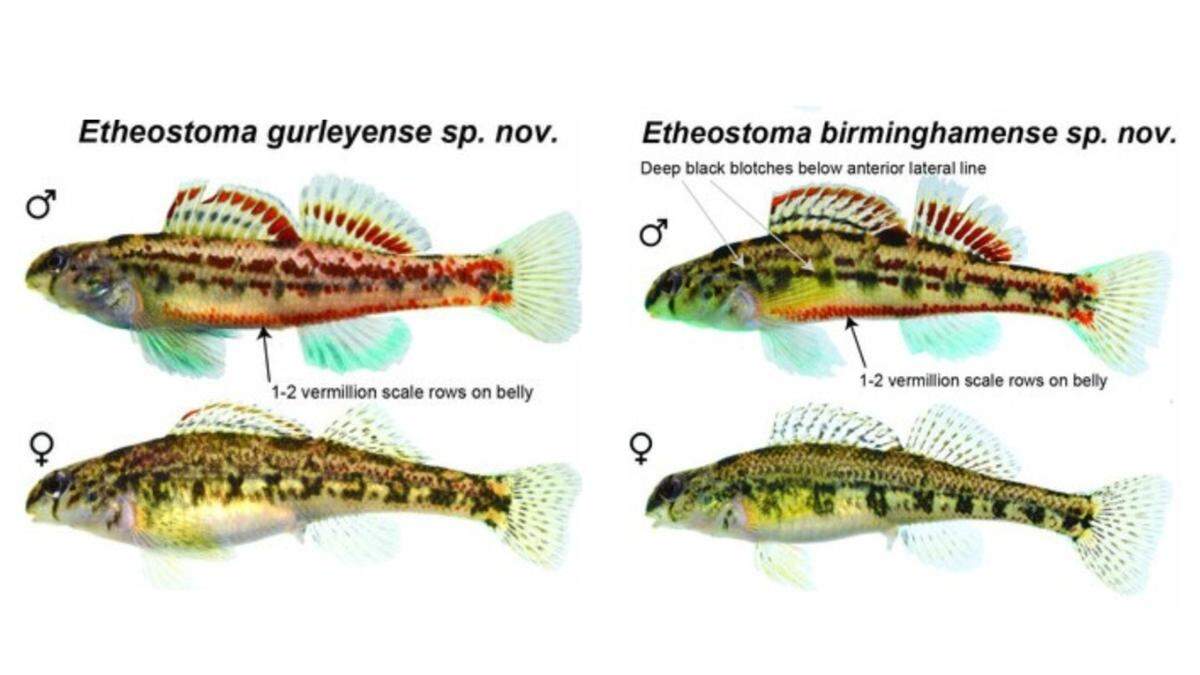
Male Birmingham darters and Gurley darters each have one to two rows of “vermilion” red scales on their bellies, in addition to turquoise-hued fins underneath and multicolored fins on top of their bodies, photos show. Females tend to be less colorful.
The Birmingham darter differs from other related fish in that it has long, black blotches on its side.
The authors say both new species are extremely restricted in their ranges and thus vulnerable to extinction.
“The primary threats include water quality degradation from urban and industrial pollution, sedimentation from agricultural runoff, urban development and strip mining for coal,” researchers wrote.
The Gurley darter’s range is so small, found only in a 6-mile-long stretch of its namesake creek, that the authors say one toxic spill could wipe the population out entirely.
And within the Birmingham darter’s habitat, more than half of the land has been developed, and it’s already disappeared from one area where it used to be documented, according to researchers.
The description of these new species, and discovering how rare they are, plays an important role in conservation efforts, the study says.
“The preservation of the millions of years of evolutionary history embodied in these snubnose darters — and the broader, species-rich southeastern North American biodiversity hotspot — fundamentally depends on rigorous approaches to integrative species discovery and delimitation,” the authors wrote.
This story was originally published April 24, 2025 at 4:55 PM with the headline "Colorful creatures found in Alabama river turn out to be ‘imperiled’ new species."