7,000-year-old hunting kit gives ‘snapshots’ of ancient human life in Texas, experts say
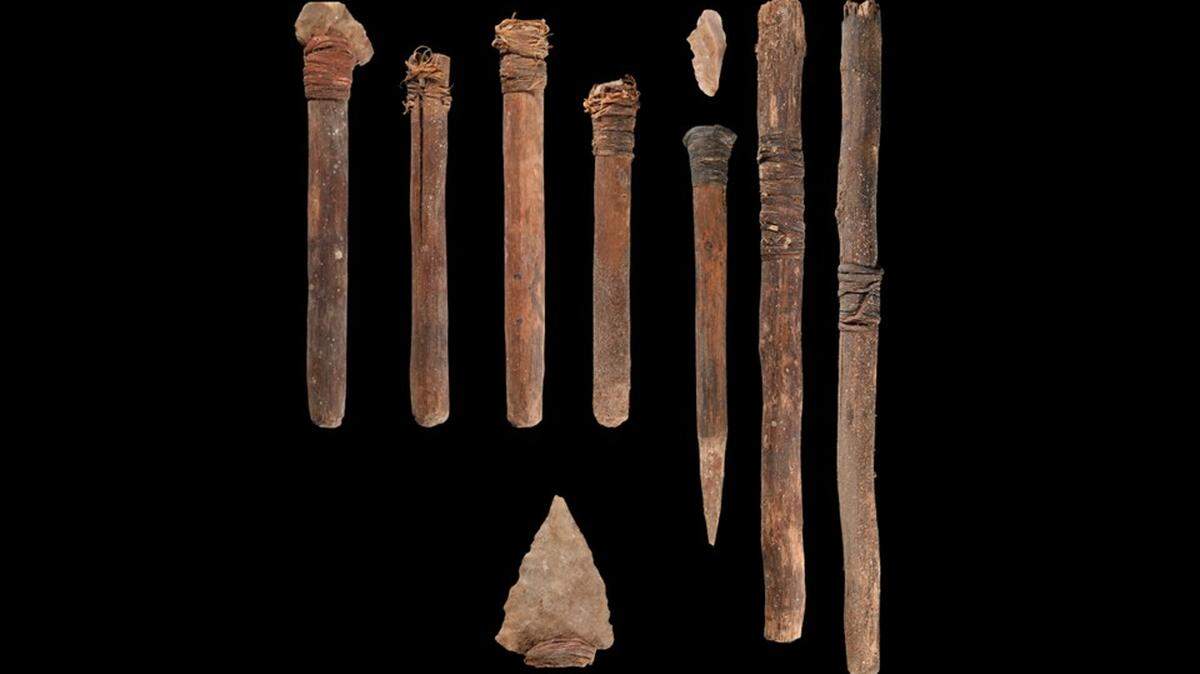
An ancient human’s hunting kit castoffs found in modern-day Big Bend National Park can help reveal how people lived in the region 7,000 years ago, according to Texas Parks and Wildlife.
A boomerang, stone dart components and a spear-throwing device called an atlatl used by ancient humans almost everywhere in the world were found at the West Texas site, along with a folded pronghorn hide that still bore hair. Texas Parks and Wildlife said it might be “the oldest example of an intact full weapon system in North America.”
Bryon Schroeder, director of the Center for Big Bend Studies, said the kit found in the San Esteban Rockshelter was in remarkably good condition for a relic, giving researchers insights into the owner’s life.
“A person came to the back of the cave and went through their hunting gear piece by piece: ‘This is good. This is not good. I need to remake this leather pouch a little bit.’ And then they went on their way,” Schroeder told the agency’s magazine. “But that one small act is going to have profound implications in understanding a wide range of topics, including the environment.”
He said since the wood survived, it can be analyzed to find out what was growing in the area and how long hunters spent working on their tools.
“We get these incredible snapshots of life, vignettes of how they lived, what the environment was and how they responded to it,” he said.
In an interview with McClatchy News, Schroeder said another site had evidence that indigenous Clovis people lived in modern-day Big Bend as long as 13,000 years ago.
“We have also found multiple sites associated with mammoth(s), and we are in the process of dating those and hope to understand if those were killed by humans in the coming months,” Schroeder said.
How they hunted
Devin Pettigrew, a weapons expert who assisted with the research, said the atlatls and boomerangs are common ancient weapons. Atlatls consisted of handheld, grooved lengths of wood that held spears and allowed for better accuracy, while most boomerangs were only made to travel one direction.
“Atlatls have been found on every continent except Africa and Antarctica, and boomerangs, every continent but Antarctica,” he told McClatchy News. “These are very common ancient thrown projectiles that are hard to pin to any early time period because of their perishable nature.”
A roughly 20,000-year-old mammoth ivory boomerang has been seen in Poland. Ancient Egyptians and Celts used them, and more recently ethnographically by people in Africa, Australia, and the Americas, among other places. The most common type of boomerang is non-returning and made for combat and hunting, like the one found in the cave.
“It is important because it tells us about cultural connections, ecology, and people’s lives,” Pettigrew said.
He said the earliest evidence of atlatls comes from 20,000 years ago in Europe, compared to 70,000 years ago for the bow. But it’s hard to confirm the accuracy of those dates given how many weapons may have been simply destroyed over time and never seen.
“Most scholars think the earliest Paleo-Indigenous people to come into the Americas had atlatls and used them to hunt megafauna like mammoths,” Pettigrew said. “This was the predominant piercing projectile weapon until around 2,000 years ago when societies were becoming more settled, larger and complex, the bow finally supplanted the atlatl in most, but definitely not all roles.”
Schroeder said their Odyssey fieldwork is still ongoing, and more is slated for June 2025.
This story was originally published April 1, 2025 at 10:52 AM with the headline "7,000-year-old hunting kit gives ‘snapshots’ of ancient human life in Texas, experts say."