
Blood-covered snow found at remote Alaska lake ignites grisly debate over ‘kill site’
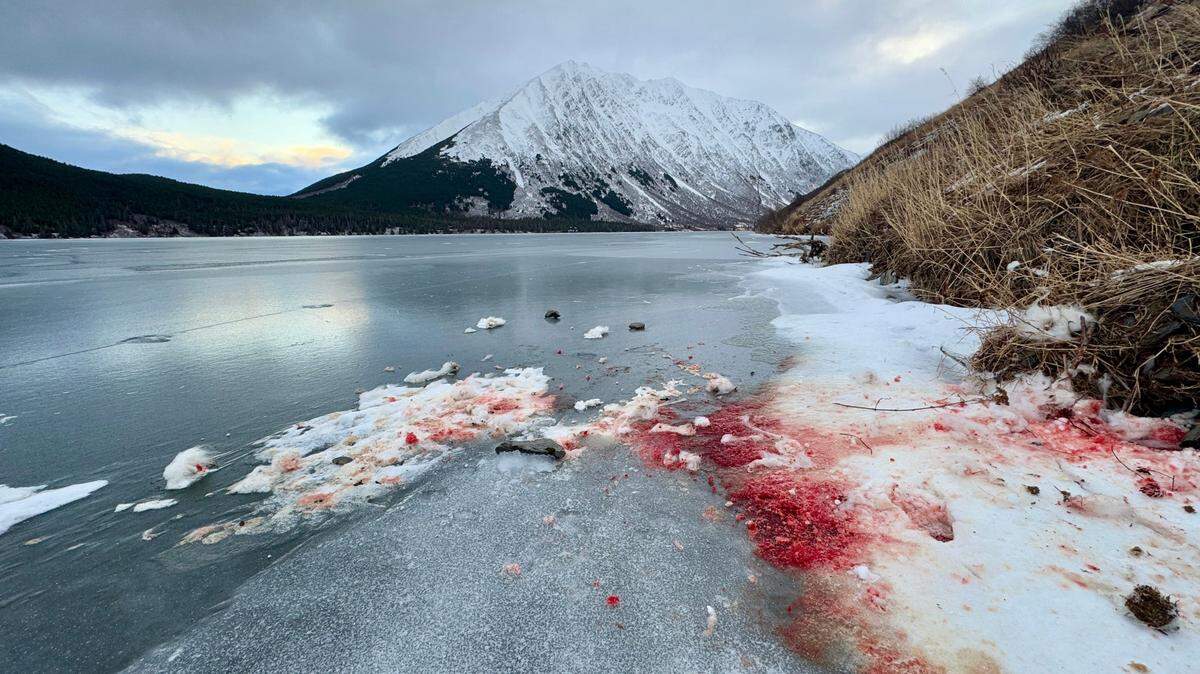
A mysterious discovery of blood-splattered snow along a lake in Alaska’s Kenai Peninsula is fueling a grisly social media debate over what got killed — and what did the killing.
No carcass was found at the scene ... and no bones ... and no internal organs.
Author and educator Luc Mehl stumbled onto the “kill site” after hiking 3 miles to go “wild ice skating” on Crescent Lake, despite wind gusts of 30 mph. The lake is about a 105-mile drive south from Anchorage.
“Hunters and outdoors folks ... what is going on here?” Mehl asked in a Dec. 21 Facebook post. “I didn’t see any sign of dragging or transport. It’s a big wide open lake (frozen) and I expect I’d be able to track a drag trail or see debris nearby.”
In addition to finding blood, Mehl found white fur and what appeared to be “large brown scat that looks mostly to be grasses.”
However, commenters on his post noted that poop might be what’s left of the victim’s stomach ... or intestine contents.
Some have suggested a carcass was likely hidden under the surface of the frozen lake.
“If a hoofed animal ends up in an icy lake, they usually cannot get up or out without help,” Leza Ball posted on Facebook. “Who knows how (long) it could have been there. Birds of prey ate it?”
“Only bears eat the bones or... hungry wolves,” Ara Howard wrote.
“I don’t think it can be a bear! They are hibernating,” Fer Ah said.
“I mistakenly skied through a wolf kill site up the snow river last year. River otters were the prey, and there were caches of bones hidden under the trees,” Lesley Seale posted.
The debate continues but Mehl says commenters seem convinced the victim was a goat, and perhaps only a fraction of it was brought to the lake by scavengers.
There are occasions when animals sit too long in the lake, and get frozen to the top of it, he says.
“Earlier this winter, same lake, we saw a loon that was stranded on the ice,” Mehl told McClatchy News via email. “No open water for it to fly from. And it looked injured, probably from having partially frozen into the ice the night before. It was doomed.”
This story was originally published December 26, 2024 at 9:15 AM with the headline "Blood-covered snow found at remote Alaska lake ignites grisly debate over ‘kill site’."