
Odd asteroid as big as Empire State Building passes Earth. Here’s why NASA tracked it
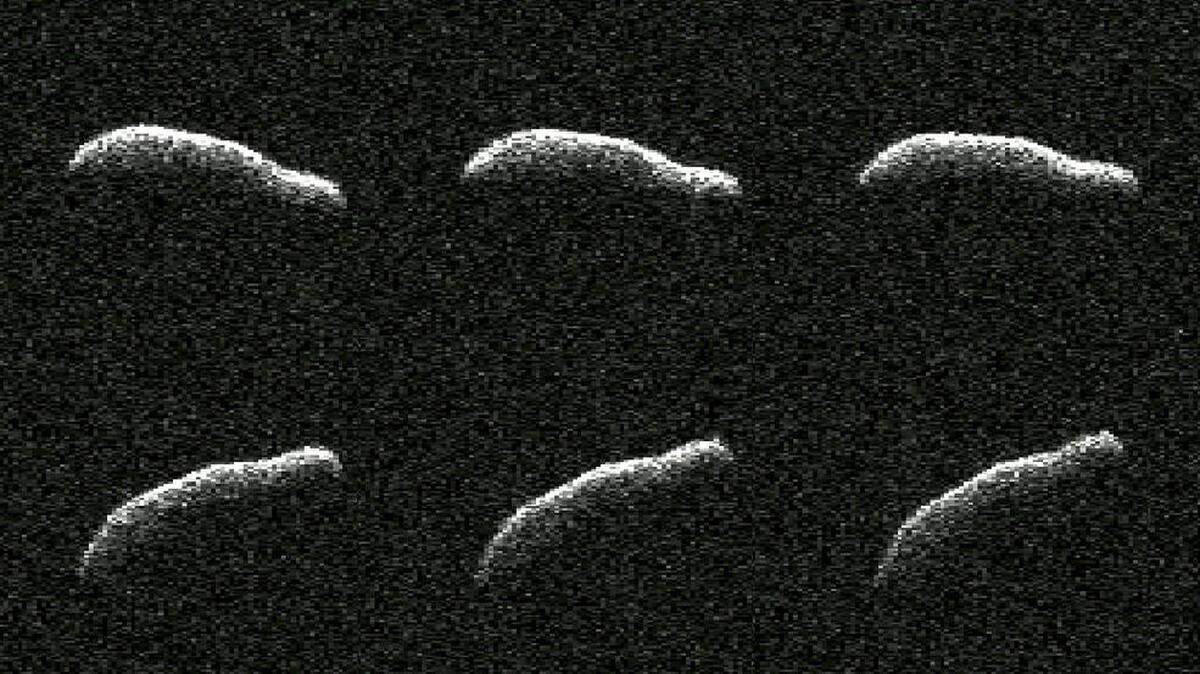
An oddly elongated asteroid soared by Earth the first week of February, and planetary radar revealed it was about the size of the Empire State Building, NASA says.
The asteroid, named 2011 AG5, was closely tracked because some scientists feared it might eventually pose a threat to Earth, officials said.
On Feb. 3, it passed at a very safe distance of 1.1 million miles, but future tracks will likely be closer, NASA says.
“Shortly after its discovery, 2011 AG5 became a poster-child asteroid when our analysis showed it had a small chance of a future impact,” according to Paul Chodas, director of NASA’s Center for Near-Earth Object Studies.
“Continued observations of this object ruled out any chance of impact, and these new ranging measurements by the planetary radar team will further refine exactly where it will be far into the future.”
NASA reports it has so far found 1,040 near-Earth objects and 2011 AG5, discovered in 2011, “is one of the most elongated.”
Among the observations made by radar during its recent passing:
- It’s 1,600 feet long and about 500 feet wide — “dimensions comparable to the Empire State Building.”
- The surface has “subtle dark and lighter regions that may indicate small-scale surface features a few dozen meters across.”
- If seen by the human eye, it would resemble charcoal.
- It’s slowly rotating, taking about 9 hours to make a complete spin.
Scientists say they also got a better understanding of the asteroid’s orbit: It circles the sun every 621 days.
That means its next “close encounter with Earth” won’t come until 2040. The asteroid is expected to “safely pass our planet at a distance of about 670,000 miles.” That’s about three times the distance between the Earth and the moon, officials said.
This story was originally published February 20, 2023 at 9:50 AM with the headline "Odd asteroid as big as Empire State Building passes Earth. Here’s why NASA tracked it."