
NASA technology reveals the most miserable spot to be in a big city on a hot day
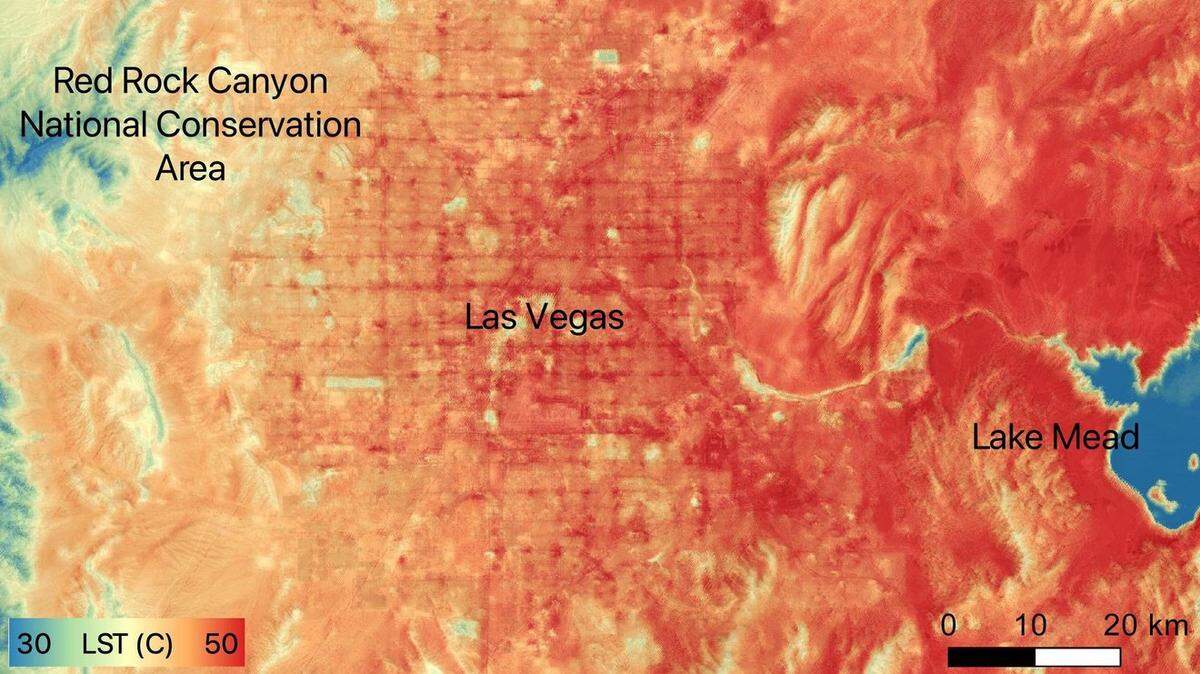
Driving in summer heat has long been a source of misery for Americans, and NASA space station technology has confirmed our dread is justified.
Using Las Vegas as a test subject, the space agency found the most miserable place to be on a hot day is a city street during evening rush hour.
The data was collected around 5:23 p.m. on June 10, when Vegas hit “a record daily high” of 109 degrees Fahrenheit.
“Within the city, the hottest surfaces were the streets. ... Pavement temperatures exceeded 122 F (50 C), while the exteriors of downtown buildings were a few degrees cooler than paved surfaces,” NASA reported.
“Suburban neighborhoods averaged about 14 F (8 C) cooler than pavement, and green spaces such as golf courses were 23 F (13 C) cooler.”
To put 122 degrees in perspective, human skin starts to blister when exposed to temperatures of 120 degrees, with second degree burns at 8 minutes and third degree burns at 10 minutes, according to Antiscald.com.
NASA tracked the heat with an Ecosystem Spaceborne Thermal Radiometer Experiment, which was launched into space in 2018 to measure the ability of plants “to adapt to a warming climate.” It has since proven useful in studying “other heat-related phenomena,” such as how heat can be absorbed and retained by things on Earth’s surface.
“Cities are usually warmer than open land because of human activities and the materials used for building. Streets are often the hottest part of the built environment due to asphalt paving,” NASA says.
“Dark-colored surfaces absorb more heat from the sun than lighter-colored ones; asphalt absorbs up to 95% of solar radiation and retains the heat for hours into the nighttime.”
The same NASA study found a particularly warm area east of Las Vegas, near Lake Mead. The terrain near the lake is home to “patches of dark-colored volcanic rock,” NASA said.
This story was originally published June 22, 2022 at 2:58 PM with the headline "NASA technology reveals the most miserable spot to be in a big city on a hot day."