
Rare ‘hole-punch clouds’ open up the skies of upper Midwest. But what are they?
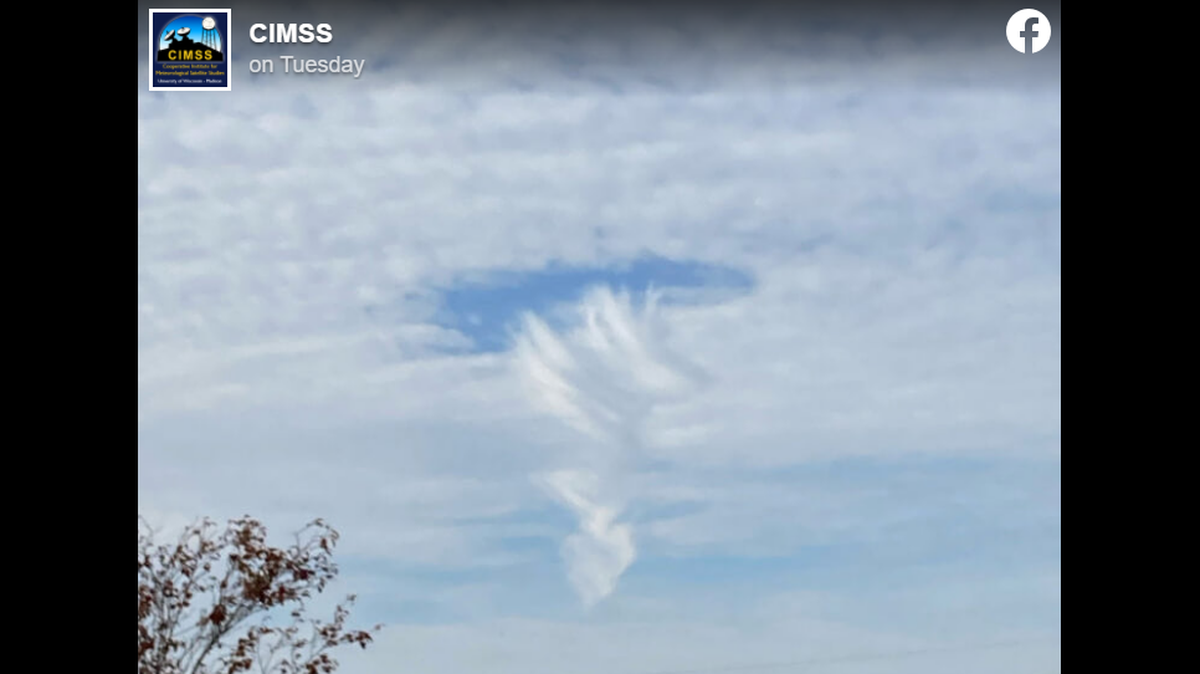
Mysterious clouds opened up the skies of the upper Midwest over the weekend, treating some who looked up to a rare view.
The “relatively rare phenomenon” of “hole-punch clouds” was visible in parts of Wisconsin, Illinois, Iowa, and Minnesota the morning of Sunday, Nov. 7, according to the Cooperative Institute for Meteorological Satellite Studies (CIMSS) at University of Wisconsin-Madison.
If you missed the opportunity to witness this atmospheric event, researcher Tim Wagner shared a photo of one the hole-punch clouds he photographed from Madison at about 11:20 a.m. Sunday. The picture also captured the ‘fallstreaks” associated with the rare cloud.
A storm spotter in Minnesota said she also spotted one of the hole-punch clouds on Sunday, sharing a photo of it on Twitter.
What are ‘hole-punch clouds’?
Hole-punch clouds, also known as fallstreak clouds, form “because of the unusual properties of cloud droplets,” according to a blog post from CIMSS regarding the “cool phenomenon.”
For this to happen, you need supercooled clouds. That’s the word for clouds made of liquid water that is below freezing. It’s important to know that while water typically freezes at 32 degrees Fahrenheit, the air temperature must be even colder to freeze curved droplets in the clouds, according to CIMSS. When it’s not freezing enough to form ice, you get those “supercooled clouds.”
“Another commonly-known fact about water is if the relative humidity of the air is less than 100%, liquid water will evaporate,” Wagner wrote in the blog post. “Again, that’s not necessarily true for cloud droplets. What is especially interesting is that the relative humidity required to support growth is bigger for a cloud droplet than it is for an ice crystal.”
And when you have both cloud droplets and ice crystals, he says the droplets will begin to evaporate as the crystals grow. That’s known as the Bergeron-Findeisen process, which is critical in forming precipitation.
Before cloud droplets and ice crystals can form, they need a nucleus (common ones include dust and pollen). However, ice crystals are “selective” and require a certain type of nucleus to form, making supercooled clouds “relatively common,” Wagner said.
Here’s what happened Sunday
The science described above helps explain what took place Sunday morning, when a large deck of clouds filled the sky, according to CIMSS. While the surface temperature was reaching 60 degrees, the clouds were high enough to be below freezing.
“Without a sufficient amount of ice nuclei present, they stayed in the liquid phase and were thus supercooled clouds,” Wagner wrote.
But then came the airplanes flying in and out of regional airports.
“The moisture-rich exhaust from the planes was deposited into the low-pressure wake behind the airplane, where it cooled very quickly and formed ice,” the blog post says. “Normally, this would form the classic contrails seen behind many aircraft in the sky. However, in this case the contrail served as a nucleation site within the supercooled cloud.”
Contrails are those long white streaks you’ll often see after a plane flies through the area.
On Sunday, though, “the droplets near the ice rapidly evaporated and the ice crystals generated by the airplanes grew even larger,” according to CIMSS. “In some cases, the crystals grew so large that they could no longer be supported aloft, and they started falling to the ground as snow.”
The crystals couldn’t reach the ground because it was too warm under the clouds, Wagner said, so the crystals either melted and evaporated or turned to vapor. That opened up the skies, creating hole-punch clouds.
“While the airplanes that created these structures have long since departed to other locations, their impact remained for some time,” he said.
This story was originally published November 10, 2021 at 5:37 PM with the headline "Rare ‘hole-punch clouds’ open up the skies of upper Midwest. But what are they?."