Plans inch forward for closing 2 Chapel Hill-Carrboro schools; 5 on the table
AI-generated summary reviewed by our newsroom.
- School board narrowed 64 criteria to just over a dozen and will finalize Mar 5.
- Staff will recommend closures, impacts and savings based on five suggested schools.
- District needs to find $3.6–8M in savings amid enrollment decline; decision due Jun 30.
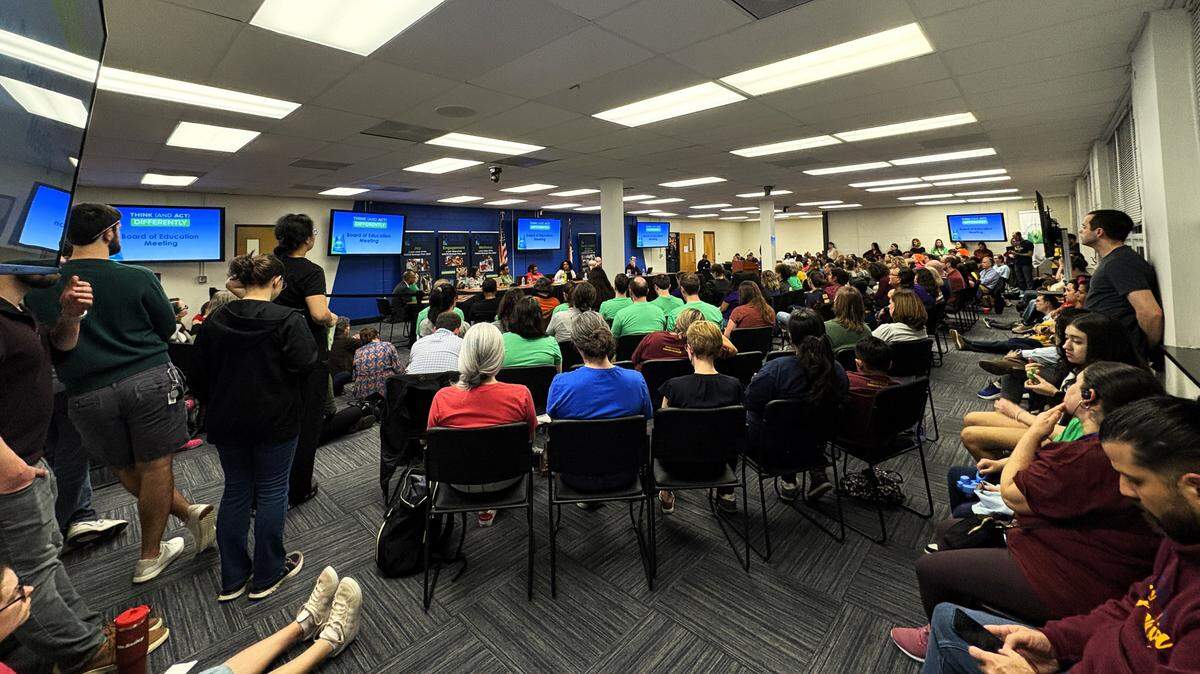
So many parents, teachers and children showed up for the Chapel Hill-Carrboro school board conversation about closing schools Thursday night that they filled the few hundred seats, lined the walls and found spots on the floor.
The board spent nearly two hours reviewing the reasons to close two schools and narrowed 64 proposed criteria to just over a dozen, but left the final list for its March 5 meeting.
There are five schools on the table: Estes Hills, Frank Porter Graham Bilingüe, Ephesus, Seawell and Glenwood.
Staff will bring back recommendations for which schools to close, along with the effect on students and staff, and how much money it could save. A decision is expected by June 4, following community input sessions and public hearings.
Board Chair Riza Jenkins said the decision needs to be purely financial — to address the district’s declining enrollment and budget pressures — and not about particular programs or schools.
But dozens of parents, some of whom waited until after midnight to speak, pleaded to save the district’s dual-language programs in Mandarin and Spanish and neighborhood schools where families still walk to class.
They understand the situation is dire, parents and staff said, but they also want more transparency about the process and a focus on expanding programs that bring more families to the district.
Taking too long to make a decision could cause more harm, several parents said, including Harsha Ganga, whose daughters attend Estes Hills and Phillips Middle School.
“You can’t run out the clock here. You have to rip the Band-Aid off and get the decision done and help us move forward … because I want us to thrive as a community,” he said. “The longer you delay, you’re ripping the community apart, and it’s not helping.”
Decision: Close schools or cut teachers, jobs
Waiting too long could also put 50 to 80 jobs at risk, Superintendent Rodney Trice said. The district needs to find $3.6 million to $8 million in savings over the next few years, at a time when declining enrollment is reducing the local and state dollars coming in.
That could affect teachers, teacher assistants, and support services, such as school counselors and psychologists, as well as central office staff, putting more workload on the schools, Chief Financial Officer Jonathan Scott said.
The district, on the other hand, could save $1.7 million a year by closing one school, plus $10 million to $15 million in maintenance costs, said Al Ciarochi, deputy superintendent for operations.
A June 30 decision would give staff and families a year to plan and set redistricting in motion, Trice said.
“I don’t know that we’ve done a great analysis, but we want as much time as we can give to the redistricting process. If we have to push that off another year, that has other ramifications for staffing that we have not done yet,” he said.
Closing schools wasn’t a bond issue
The countywide Woolpert report was not among the board’s chosen criteria, but Trice said its analysis of the age and condition of school buildings will be important. The report, which recommended school repairs, consolidation and closure, was used to market a $300 million school construction bond approved in 2024.
But the idea of closing Chapel Hill-Carrboro schools only came up last year, when officials realized elementary school enrollment and funding would continue to fall sharply. The Orange County commissioners, who control the bond money, have also voiced support for relying on the Woolpert recommendations.
Some parents said Thursday they wouldn’t have voted for the bond if they knew it meant their children’s schools might close. Others said they just want the board to be honest about what it plans to do.
Parent Mark Coupland said he was active in bond discussions in 2024, when the public “relied heavily on the board’s commitment.”
“I would ask the board to reiterate its commitment to the voters that you will work to deliver on the promises made as part of this bond that we voted for and approved,” he said. “I understand this isn’t an exact science ... but we as voters are relying on you to work toward making the board’s commitments to the voters a reality.”
Board member Meredith Ballew told the crowd that the district would face the same choices without the bond money.
“It’s very upsetting, and I know it’s upsetting for all of you, but I just wanted to say, from my perspective, that we’re trying to really think this through and decide what is the best decision for our district going forward,” she said.
Can smaller district offer more?
The five identified schools have strong public support, and Glenwood and Frank Porter Graham are popular magnet schools with Mandarin and Spanish immersion programs. Ephesus, Estes Hills and Seawell are walkable and near new housing.
Estes Hills and Seawell could see the largest drop in enrollment by 2035, CHCCS data shows.
The addition of Estes Hills and Frank Porter Graham to the list of potential closures on Feb. 5 was a surprise. Those schools, along with Carrboro Elementary, were supposed to be replaced over the next 10 years using $175 million in bond money.
Planning for a $53 million Carrboro Elementary is already underway, with a fall 2028 move-in date.
Some parents came with ideas for making a smaller district better. Audrey Shen, a mother of two Glenwood students, said the decisions “call for leadership, grounded in clarity, compassion and innovation.”
She suggested attracting more families with expanded dual-language programs, STEAM (science, technology, engineering, arts and math) classes, and investments in exceptional children’s programs.
“We need a broader, forward-looking strategy that secures the district’s long-term financial health,” Shen said.

Why is CHCCS seeing less enrollment, budget cuts?
- CHCCS has 1,545 fewer students than in 2020 and could lose 277 more next year, for 10,741 total students.
- Number fall sharply in elementary school, because families have other options, housing is expensive and birth rates are declining, experts have said.
- Enrollment declines cut funding, awarded on a per-student basis. Next year’s enrollment drop could cut about $2 million in state funding, officials said.
- Orange County is considering a change in funding local districts that could reduce the $64.8 million in current CHCCS local funding.
This story was originally published February 20, 2026 at 8:06 AM with the headline "Plans inch forward for closing 2 Chapel Hill-Carrboro schools; 5 on the table."