Lee Roberts takes oath as UNC chancellor. Building trust is still a work in progress.
Lee Roberts walked across the indoor breezeway of the UNC-Chapel Hill Alumni Center on Wednesday, strolling into the waiting area outside of the ballroom. He greeted the staff there, who were welcoming the guests attending the celebration inside.
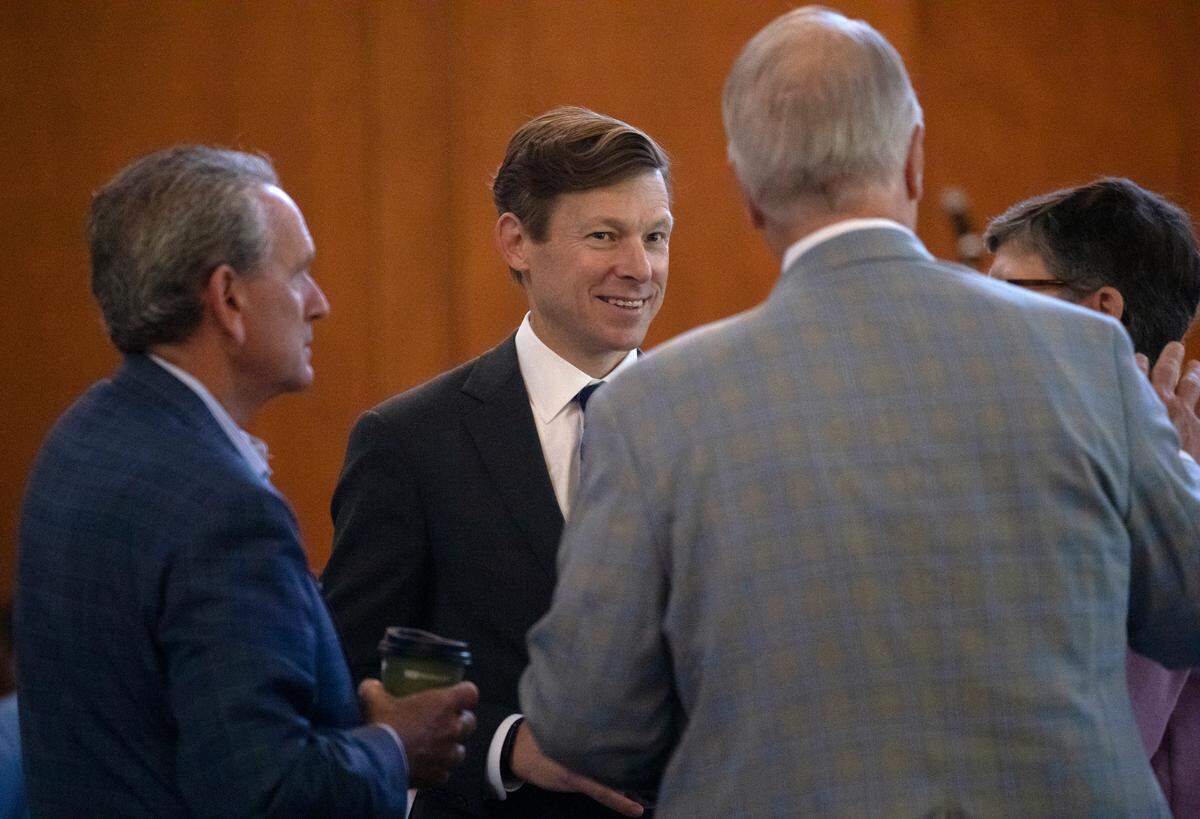
Moving into the ballroom, Roberts made rounds to several tables as guests ate a catered breakfast, shaking hands and sharing smiles. Then, as the program began, he stepped to the side of the stage at the front of the room and waited for his cue.
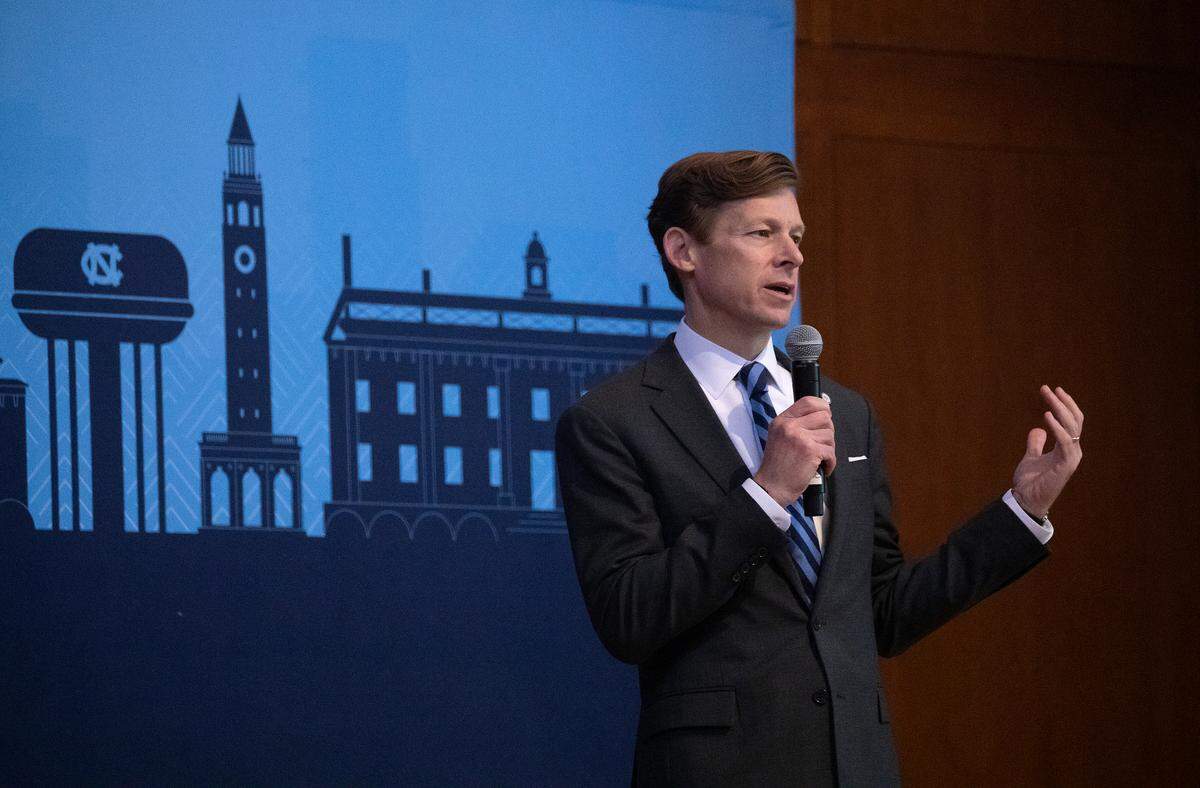
“‘I’ve heard it said before that you shouldn’t fall in love with an institution, because it can’t love back,” Roberts told the crowd. “I disagree. I think Carolina does love back the people who love it, and nobody loves it more than the people in this room.”
Like Roberts, the roughly 325 guests invited to Wednesday’s event are employees of the university. But unlike Roberts, they have been on the staff or faculty for decades — at least 25 years, and for two guests, as many as 55 years — and were at the event to be honored for the longevity of their service to the university. Combined, the guests have worked at the university for nearly 7,200 years.
Roberts has yet to cross the one-year mark.
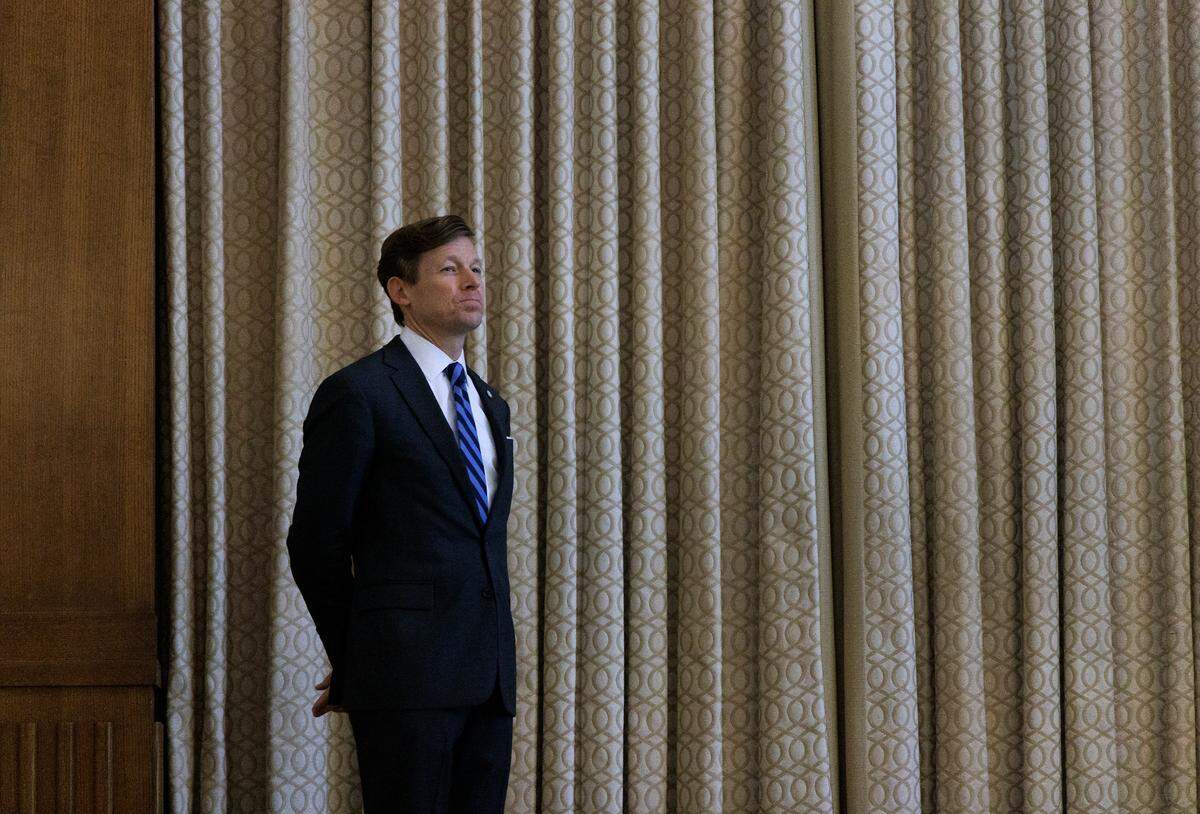
He was named UNC’s 13th chancellor in August after serving in the role on an interim basis for eight months. With a professional background in finance and private equity, and a less than two-year stint as the state budget director under former Republican Gov. Pat McCrory, he is still new to higher education administration.
His resume, including the support he has received from powerful Republican lawmakers, has left many skeptical of him.
Roberts understands the concerns. Though it has become more common for university administrators to come from outside of academia, Roberts is the first chancellor at UNC with such a background. He also remains a new face around campus, especially compared to his predecessor, Kevin Guskiewicz, who spent his entire academic career at UNC before becoming chancellor.
“One of the biggest challenges is just that people don’t know me,” Roberts said in an interview with The News & Observer. “How could they? I haven’t been here.”

In his still-new job, Roberts doesn’t attend events like Wednesday’s every day, telling The N&O that “there’s always more of that happening than you could possibly attend.” Still, he makes an effort to carve out time on his calendar to walk around campus, go into buildings he hasn’t been in before and talk to the university’s roughly 44,000 faculty, staff and students.
“You’re never going to meet everybody,” Roberts said. “But I think have a responsibility just to get out and about and meet as many people as possible, in as many different nooks and crannies of the university as possible.”
So far, that’s helped build trust and confidence among some people on campus.
But others aren’t yet convinced. On Tuesday, the senate of the Graduate and Professional Student Government passed votes of no-confidence in Roberts and the university’s provost and called for them to resign. The votes, while symbolic and still winding through the elected body’s legislative process, are a clear statement of opposition to Roberts, just two months into his role as chancellor.
Days after that vote, Roberts was installed as chancellor during a campus ceremony on Friday. Even after taking his oath of office, Roberts knows he still has work to do.
No-confidence vote ahead of installation
Tuesday’s no-confidence vote against Roberts, introduced by graduate senators Hashem Amireh and Nyssa Tucker and cosponsored by 10 additional senate members, passed with 33 senators voting for the measure and eight voting against. Eleven abstained.
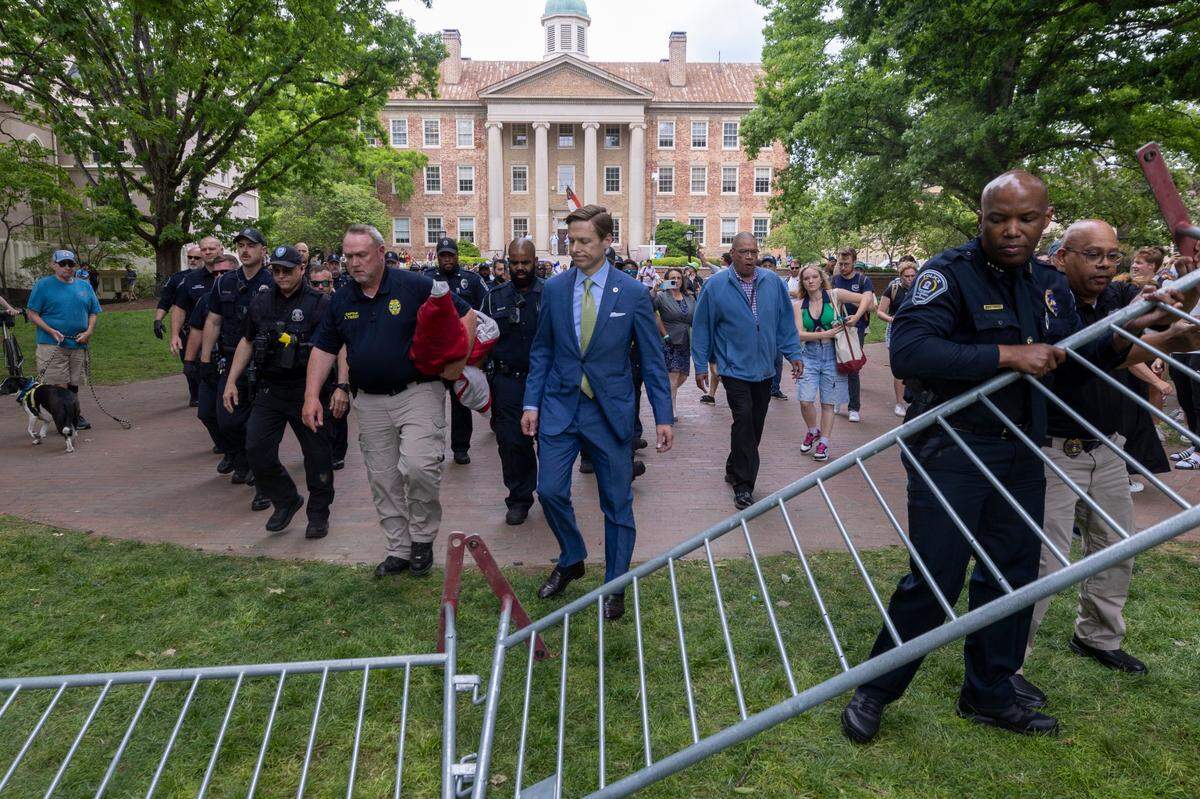
The resolution listed several grievances against Roberts and his leadership, including that he “lacks necessary qualifications” to be the chancellor of a major research university, given his non-academic background; that he “possesses deep ties to partisan actors” in state government; that the confidential search process used to select him was “was blatantly opaque” and did not include any graduate students on the committee; and that he “played a key role in UNC’s violent and wholly unwarranted brutalization of student activists” when police forcibly disbanded a four-day, pro-Palestinian tent encampment this spring.
Debate over the resolution against Roberts and the separate one against Provost Chris Clemens lasted more than an hour on Tuesday evening, with most senators speaking in support of the measures against the administrators. Some expressed concerns that approving the resolutions might fracture the group’s working relationships with Roberts and Clemens or hinder progress they hope to make on other issues facing graduate students.
Katie Heath, the Graduate and Professional Student Government president, did not support the resolutions. But she wrote in a letter following the vote that she respects “the senate’s voice.”
“As president, I have seen multiple actions taken by the UNC administration over the past year that have concerned me greatly. Additionally, given my role I have interacted with many individual administrators that have made continuous efforts to improve the lives of graduate and professional students,” Heath’s letter read. “While I have had the chance to enjoy these experiences, I know that many of my peers have had less than positive if not at times adversarial relationships with administrators across campus.”
The measures passing “just shows that grad students are frustrated and professional students are frustrated,” Amireh told The N&O.
Roberts was not present at Tuesday’s meeting.
“[I] obviously respect all student views, particularly those chosen as leaders by their peers,” he told The N&O Wednesday. “I do wish, candidly, that they had asked us to talk with them. The provost and I would have been delighted to go speak with them and hear their concerns and do our best to address them.”
Roberts said he and other university leaders will “continue to seek and value input from the GPSG and all other student leaders” despite the vote against him.
Being a listener
Roberts’ response to the no-confidence vote embodies what many who know him believe to be true: he is willing to listen.
McCrory, for whom Roberts served as state budget director, previously told The N&O that Roberts is “one of the best listeners” he’s ever known. Beth Moracco, the chair of the UNC faculty, described Roberts Wednesday as “exceedingly accessible.”
His efforts to listen often include offering meetings to those who are publicly critical of him and the university.
“I don’t know that I’ve ever met anyone quite so eager to listen while so many people tell him he’s wrong on any given subject,” UNC System President Peter Hans, who selected Roberts to be interim and permanent chancellor, said during Friday’s ceremony.
In April, when a student group hosted a “teach-in” critical of Roberts’ ties to state Republican leaders and the possibility of a ban on diversity, equity and inclusion in the UNC System, which would later pass, he showed up to the event — “not to try to challenge anybody, just to show that I was eager to have a dialogue,” Roberts said. In March, he invited a representative from the campus chapter of Students for Justice in Palestine to address the Board of Trustees and share the group’s demands for the university to divest from Israel.
When Sue Estroff, a professor in the School of Medicine who serves on the university’s Faculty Council, shared her thoughts on Roberts in news articles in the days leading up to him being named permanent chancellor, he emailed her to acknowledge her comments and asked for a meeting to hear more — an experience several faculty have had during Roberts’ short tenure.
“I’ve always thought that — and I don’t think it’s controversial — that you learn more by by listening than by talking. But that’s especially important in this role,” Roberts said. “There are so many different constituencies, so many different points of view. I have so much to learn, that I don’t think I’d be doing my job very well if I didn’t make it a priority to listen to as many people as possible.”
Estroff, who, like many other faculty, has been skeptical of Roberts, said she believes he has “done a really pretty good job of trying to overcome” the early perceptions many on campus had of him.
“His actions, to me, demonstrate that he knows that he needs to earn, and not just expect, people’s confidence and trust,” Estroff said.
But as the graduate students’ no-confidence vote showed Tuesday, there’s still more to be done.
“He has a lot of work to do if he wants to make friends with the students,” Estroff said.
Moracco, who meets with Roberts regularly in her role as faculty chair, said the true test of Roberts’ leadership will come not just from listening, but in how he uses the information and opinions he hears.
“It’s one thing to listen, and it’s another to ... consider that information or those data, and then what role that plays in the decision-making,” Moracco said.
After he finished his interview with The N&O on Wednesday, Roberts said, he was scheduled to meet with a student who was concerned about the increased security and surveillance measures on campus this week, which marked the one-year anniversary of the Hamas attack on Israel. Roberts defended the measures to The N&O and said he’d heard “a very wide range of views” on the matter throughout the week.
Four key focus areas
As he continues to listen to perspectives around campus — “I think you could be here for a long time and never stop learning about this university,” he said — Roberts is already putting his stamp on the university’s future.
Early on as interim chancellor, Roberts convened working groups to consider four key areas of focus as the university’s strategic plan nears its end. The groups were tasked with drafting proposals regarding enrollment, artificial intelligence, applied sciences and the university’s physical master plan, all of which were submitted in August and released publicly last month.
Roberts has made clear that the recommendations are just that, and that work remains to see any concrete changes implemented. But the proposals offer an early look at how the university could soon grow and change under his leadership.
“The hard work really starts now, now that we have the reports from the working groups and we need to move into execution and implementation,” he said.
Physically, the campus could see changes to its recreation facilities, which many see as outdated and too small to fit the needs of students, faculty and staff. Three major capital projects are underway or soon to begin, Roberts said, including one that will create a new research building and another that will redesign a key path from campus to Franklin Street.
“And then there’s the high profile discussion about where we’re going to be playing basketball in the future,” Roberts said, referencing the ongoing work to determine whether the Dean Smith Center will be renovated or replaced. (Asked if he had a preference about where the Tar Heels would play going forward, Roberts said his decision would be informed by a pending feasibility study.)
The university could also grow its enrollment, with that focus group suggesting the university raise its cap on the proportion of out-of-state students it can enroll and increase the overall student population by 5,000 undergraduates over the next five years. Such a change would require approval from the UNC System Board of Governors, which sets policy for all 16 public universities in the state.
If those additional students get to campus, they could have new majors to choose from, as the university also works to increase and bolster its offerings in engineering-related areas. As part of that effort, lawmakers in the state House of Representatives this summer proposed the university establish a School of Applied Science and Technology — a move the state Senate did not consider at the time, but which could offer a sign of what is to come.
Roberts said the level of state support and funding the university receives requires him to stay in regular communication with lawmakers and the Board of Governors.
“We, obviously, have an ongoing, in-depth dialogue with the [UNC] System office, with the Board of Governors, with the General Assembly, about our needs and our missions and how we can serve the state most effectively,” Roberts said, “and that’s part of my role.”
Being installed on University Day
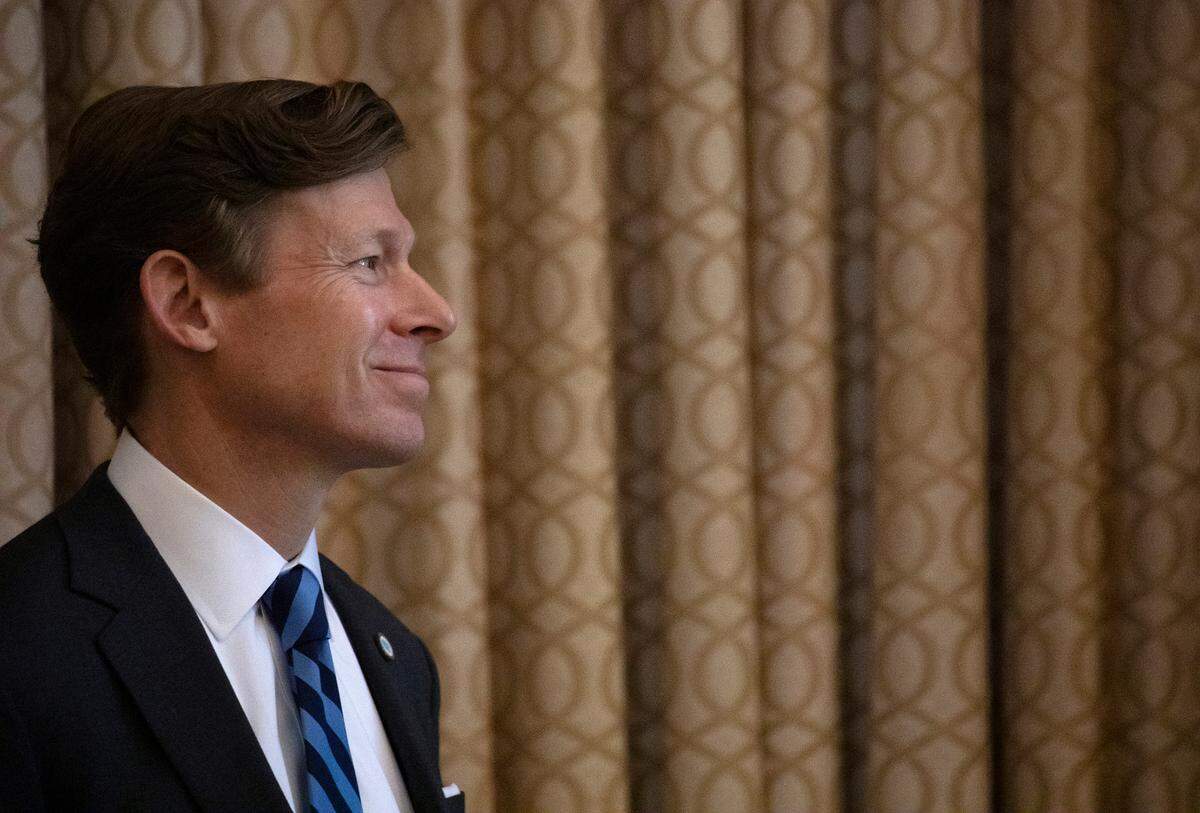
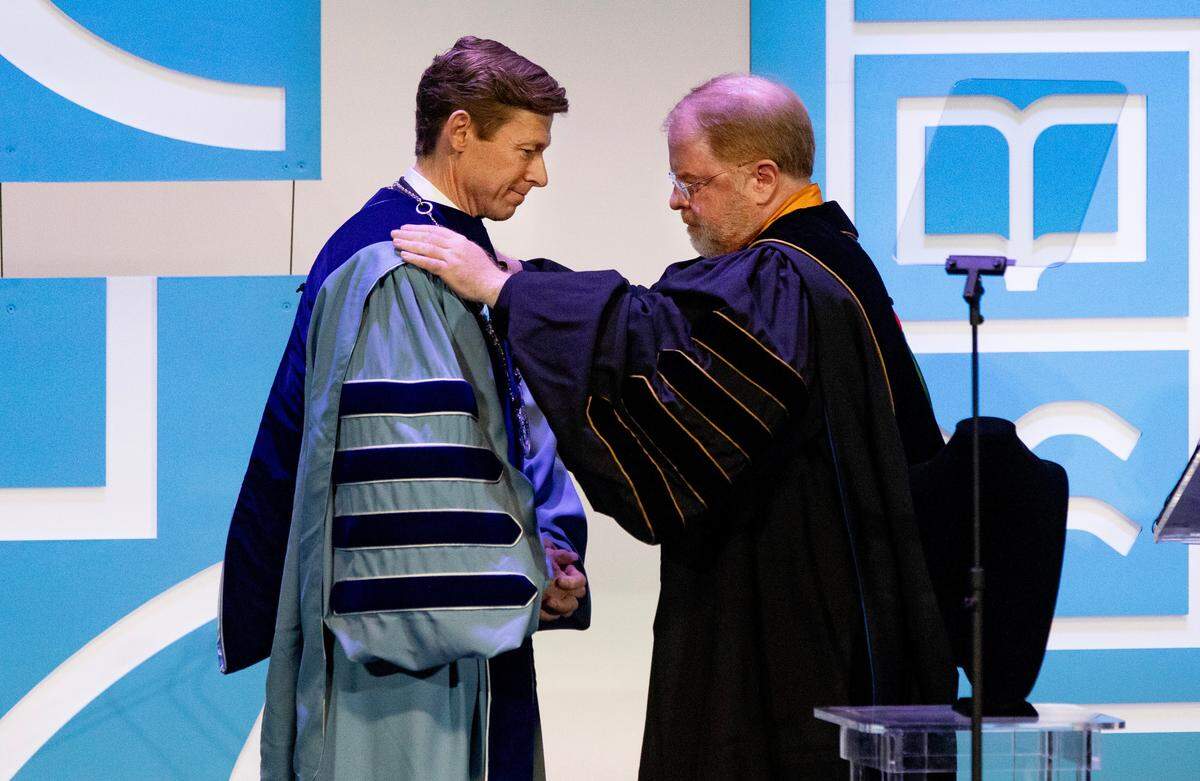
Though Roberts has been on the job as UNC’s 13th chancellor since August, he formally took the oath of office — administered by state Supreme Court Chief Justice Paul Newby — Friday, which marked this year’s celebration of University Day. The annual event that commemorates the day in 1793 that the cornerstone was laid at Old East, the university’s first building, and, since 1957, it has served as the official ceremony for new chancellors to be installed to their post.
The day, at times, has also become a more significant occasion. John F. Kennedy and Bill Clinton attended and spoke at the event during their respective presidencies, and it is also a tradition for North Carolina governors to speak at the event during their first term in office.
One of Roberts’ predecessors, Carol Folt, used the event to publicly apologize for the university’s role in the “profound injustices of slavery,” a move that came during the contentious and fraught battle over the fate of Silent Sam, the Confederate monument that stood on campus for more than a century.
Entering his chancellorship as the Israel-Hamas war continues to divide college campuses across the country, Roberts, too, will helm the university at a tense time. Roberts, sitting in his South Building office Wednesday, said he hoped to share the message Friday that it is also “a really exciting time.”
“I’m confident that everyone who’s ever sat in this office has faced significant challenges, but we’ve always overcome them and continued to grow and thrive and prosper,” Roberts said. “And I wouldn’t trade our challenges for those of any other university in America. We’re extraordinarily well-positioned, and the future for Carolina is brighter than it’s ever been.”
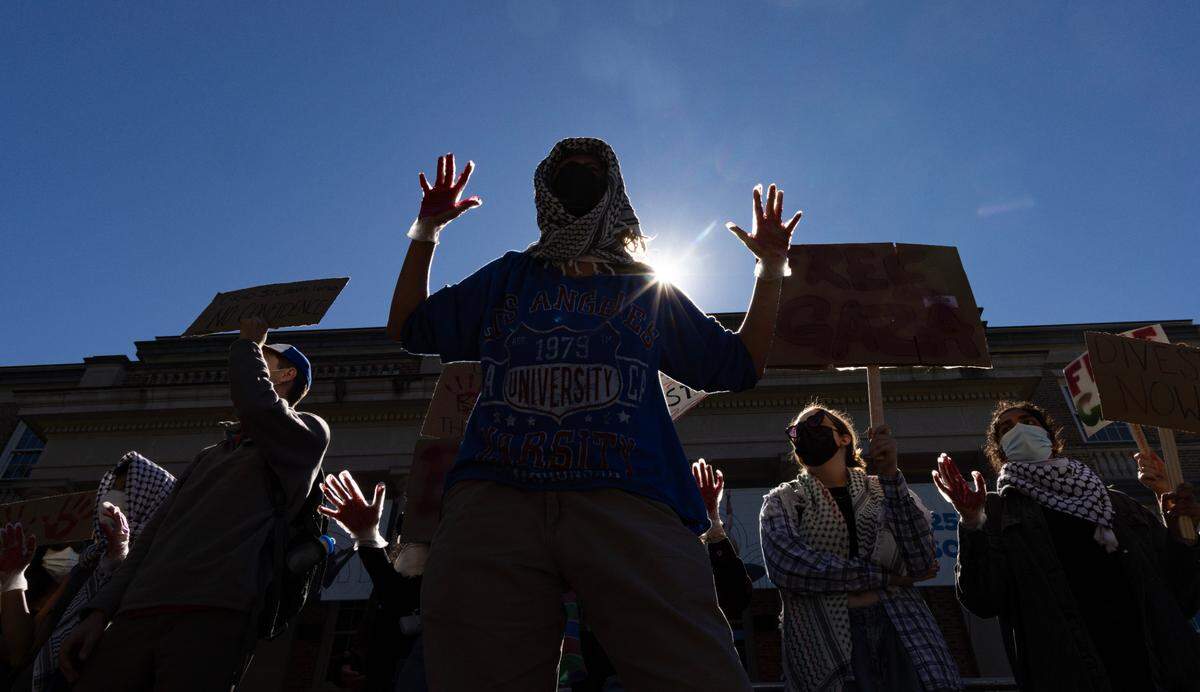
Friday’s ceremony brought another reminder of the challenges he will face. After he took his oath, roughly 20 pro-Palestinian protesters in the crowd at Memorial Hall stood up silently with their hands, painted red, in the air. They then left the auditorium to join roughly 50 other protesters outside the venue who were picketing the event.
This story was originally published October 11, 2024 at 9:21 AM with the headline "Lee Roberts takes oath as UNC chancellor. Building trust is still a work in progress.."