Johnston’s new school dress code is called ‘sexist’ and body shaming to female students
Student dress code changes that were supposed to make Johnston County schools less restrictive about clothing have instead drawn complaints that they are being unfairly enforced on female students.
This school year’s updated student dress code removed several examples of prohibited apparel and added wording that clothing must cover from upper chest to mid-thigh. But some families say schools are now embarrassing female students by publicly pulling them aside for measurement checks of their clothing.
“Teachers and staff and administrators are humiliating and body shaming our teenage girls by pulling them aside in front of all the school as they enter and lining them up in front of their peers to be judged,” said Courtney Altizer, a parent at Corinth-Holders High School.
“Teachers and staff are telling our female students that they look provocative and inappropriate, even being told to raise their arms over their heads to see if their shirt rides up.”
Altizer was among several parents and students who spoke at a recent school board meeting to urge the district to amend the dress code. Most of the complaints have come out of Corinth-Holders High, which has a mailing address in Wendell.
It’s not immediately clear whether the complaints, which have been rumbling as well through social media, will lead to changes. A school district spokesperson did not return The News & Observer’s request for comment.
What’s acceptable length for students’ shorts?
Johnston, North Carolina’s seventh-largest school district, has made multiple revisions to the dress code in recent years.
In 2019, the school board eliminated language that said shorts must be no higher than four inches above the top of the knee and that skirts and dresses must be no higher than three inches above. Instead, the dress code was revised to say shorts, skirts and dresses must be at least mid-thigh.
Then dress code underwent a major revision this year with the new wording that “student must wear clothing that covers their skin from upper chest to mid-thigh” with non-see-through fabric in front, the back and sides.
In addition, the updated policy says breasts, genitals and buttocks must be covered with non-see-through fabric.
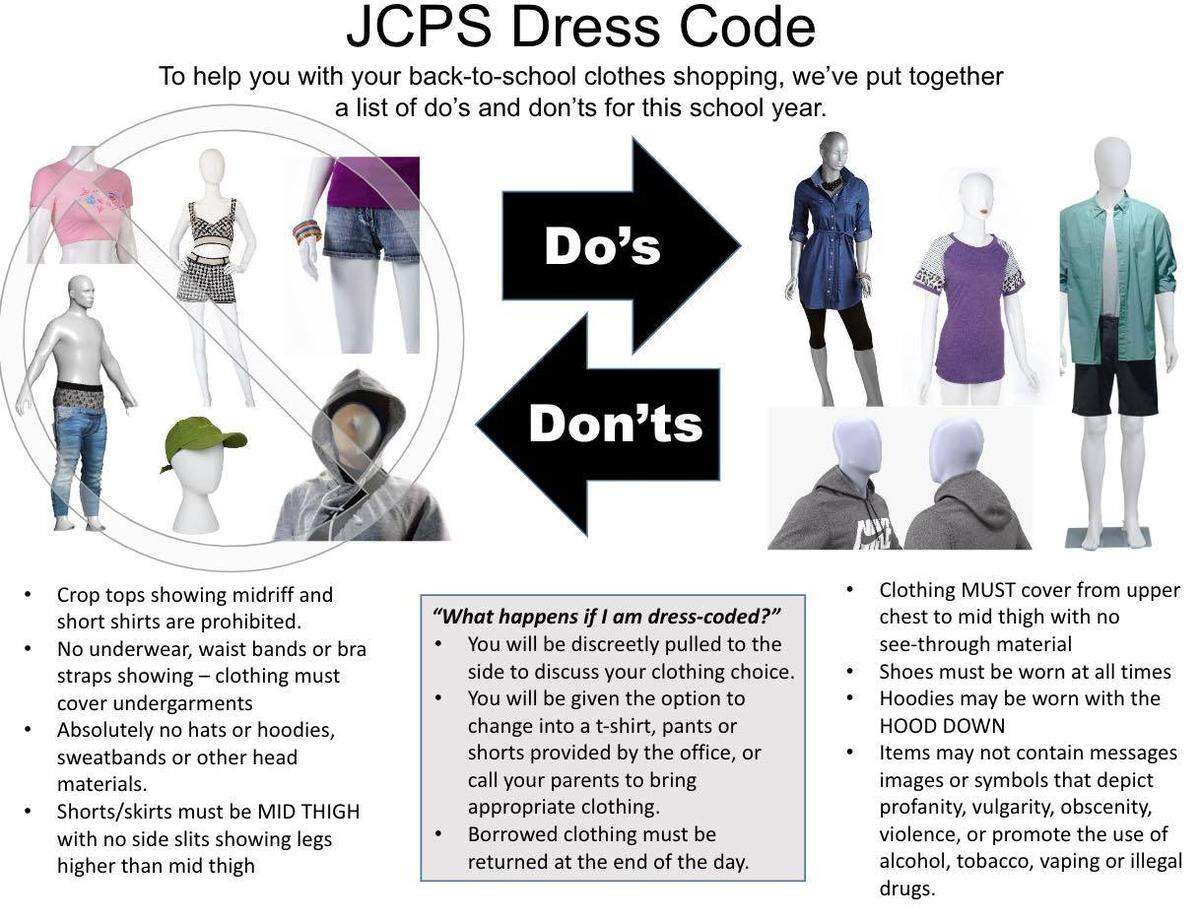
Clothing must also still cover undergarments, including waistbands and bra straps.
But specific wording banning tank tops, spaghetti straps, strapless shirts and leggings were dropped from the new policy.
Wake County had adopted much of the same language in 2019 to try to make its student dress code more gender neutral.
Is upper chest to mid-thigh clear language?
The amended Johnston dress code was approved on June 30 in a 5-2 vote, with board members Michelle Antoine and Ronald Johnson as the dissenters. Antoine said the new policy was a case of “dropping our standards” for students.
Antoine and Johnson also raised concerns that the dress code language would be too subjective.
“Look, there’s no real measure,” Antoine said. “A good measure would be like has a strap that covers a substantial portion of the shoulder or something like that.
“Something that is more measurable objectively by an administrator. I think we put our administrators in conflict with parents and students through this dress code.”
But other board members said the upper chest to mid-thigh requirement was clear.
“I would think upper chest to mid-thigh is pretty self explanatory for most average people,” said board member Kay Carroll. “You don’t have to drag out a ruler to determine somebody’s mid-thigh or chest.”
Girls ‘humiliated’ by new dress code
The hot weather at the start of the school year triggered a surge of dress code violations. Students have been pulled out of classes until they borrow clothing from the front office or have their parents bring a change of clothing to campus.
An online petition calling for a change in the “sexist dress code” has drawn more than 675 signatures.
“Boys are only being told to take their hats and hoods off yet girls get written up for showing a centimeter of skin,” according to the petition. “Suggestive clothing is subjective and practically all that can be worn now is basketball shorts, pants and teeshirts.”
While the intent of the new dress code was to be less strict, parent April Lee said many schools weren’t enforcing the prior code. Now that it’s being enforced, Lee said the dress code seems very restrictive and has led to “policing of girls’ bodies.”
“We don’t need to make our dress code more restrictive as long as breasts, butts and genitals aren’t hanging out of clothing,” Lee told the board. “We don’t need to target our girls. They don’t need to lose instructional time from their classes.”
Susan Locklear, a Corinth Holders parent, warned the board she’ll seek legal action if the dress coding continues. She said it’s shaming girls who’ve been model students up until now.
“These young ladies were publicly humiliated,” Locklear said. “The adults need to be held accountable for their actions and the emotional toll this sexism has taken on these students. Who’s going to apologize publicly to these young ladies and communicate the expectation of staff moving forward?”
Girls say dress code is ‘sexualizing’ them
Some female students voiced their frustration to the school board over how they say they feel they’re being objectified by the new dress code.
“Now I feel ashamed of my home,” said Cora Altizer, a Corinth Holders student, said of the school. “My home is now a place where sexualization and harassment are excused in the name of boys’ lack of self control.”
Grace Alzuauer, a Corinth Holder junior, told the board her teenage body should not be a problem to the learning environment.
“Growing up a woman is hard enough as is,” Alzhauer said. “But when adults 20 to 30 years older than you sexualize you for the way you dress or how your body looks, it further damages the growth of a young teenage girl’s mind.
“It leaves young women feeling discouraged, uncomfortable and dirty for doing something as easy as putting on an outfit that makes them feel confident and comfortable.”
Feds required Nash County to review dress code
The Johnston County complaints come the same week that the U.S. Department of Education’s Office for Civil Rights announced it had reached a settlement over its investigation into Nash County’s student dress code policy.
At the start of the 2022-23 school year, a person posted on Instagram that he might force one of the ninth-grade female students at Nash Central High School to have sex with him. Several other “inflammatory and inappropriate” posts were made on social media.
Amid the social media posts, the high school held a girls-only assembly to discuss the dress code The school did not hold one only for male students
After listening to a recording of the assembly, OCR said the school told the girls that they were “opening the door” to harassment with their manner of dress and then “wonder why they [boys] disrespect you.”
Under the settlement, Nash County agreed to take steps such as reviewing and, as necessary, revising its dress code to ensure it does not discriminate on the basis of sex.
“The nondiscrimination guarantee in Title IX promises that girls not be blamed for their own sexual harassment as well as that students will not be subjected to differential school rule enforcement based on sex stereotypes,” Assistant Secretary for Civil Rights Catherine E. Lhamon said in a news release.
“Consistent with that guarantee, Nash County Public Schools commits now to ensuring that all students can fully participate in school without discrimination based on sex.”
This story was originally published September 15, 2023 at 2:50 PM with the headline "Johnston’s new school dress code is called ‘sexist’ and body shaming to female students."