DHHS eases NC rules on missing school after COVID exposure, ends contact tracing rules
North Carolina health officials are changing COVID-19 guidelines to reduce the number of healthy students and teachers who are required to stay home after exposure to the virus.
New guidelines released Thursday as part of the NC Strong Schools Toolkit say individual contact tracing and exclusion from school of asymptomatic people after an identified COVID-19 exposure is no longer recommended statewide in K-12 schools.
The toolkit from the state Department of Health and Human Services recommends that schools no longer require students and school employees to stay home after an exposure unless they’ve tested positive or show symptoms.
“Our goal has always been to keep kids in the classroom, “ DHHS Secretary Kody Kinsley said in an interview Thursday. “We’re constantly evolving our guidance in the Strong Schools Toolkit to be responsive to the latest science.”
With widespread access to the COVID-19 vaccine now available, Kinsley said the updates to the guidance are the right decision to make at this moment. The changes won’t go into effect until Feb. 21.
What the guidelines say on masks
The changes come the same day that N.C. House Speaker Tim Moore sent a letter to Gov. Roy Cooper and Kinsley urging them to change DHHS guidelines that he said disrupt school and hinder student achievement..
“Please repeal the guidelines that force healthy kids to stay home and effectively mandate masks in schools,” Moore wrote in his letter.
Moore had cited how governors in several states announced this week that they’re lifting their statewide school mask mandates. North Carolina doesn’t have a statewide school mask mandate, but Moore said that DHHS guidelines were leading most school districts to keep requiring face masks.
Currently, 79 of the state’s 115 school districts require face masks.
Kinsley said the changes had been days in the making and were not in response to Moore’s letter.
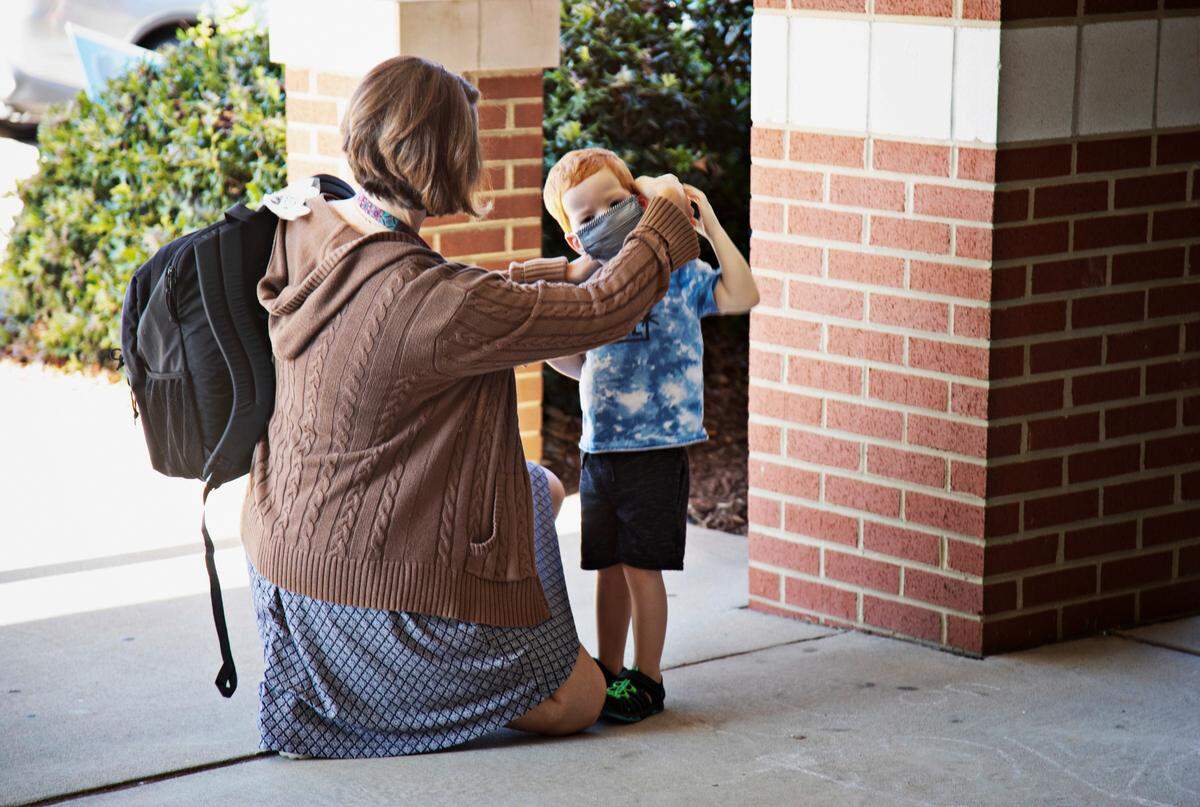
DHHS now says schools should require people ages 2 and up to wear face masks in areas where there is high or substantial transmission of COVID-19, as defined by the Centers for Disease Control and Prevention. All 100 counties currently have high or substantial transmission.
It’s a slight wording change from prior recommendations that schools only consider making masks optional when they’re in an area with low or moderate COVID-19 transmission.
“Vaccines are the most important tool first, and second masking is important and a proven strategy of reducing the spread of COVID-19 and keeping kids in the classroom,” Kinsley said. “While community transmission is high, (masking) should stay in effect.”
Contact tracing no longer recommended for schools
The end to contact tracing comes after school districts have complained about the extra work it’s placed on them to identify people who’ve been potentially exposed to the virus at school.
The Union County school board, which has had a mask-optional policy all school year, voted last week to end all contact tracing and quarantine requirements. Union County, southeast of Charlotte, is hoping other districts will follow its lead on the issue.
DHHS had threatened legal action against Union County when it tried something similar earlier in the school year. But on Thursday, DHHS said contact tracing in schools has become less effective as a means of reducing spread of the virus.
“There are more effective tools to limit the spread of COVID-19 and reduce the risk to COVID-19 than contact tracing,” Kinsley said. “This (omicron) variant spreads rapidly. The incubation period is short. There is more of a period of time when asymptomatic spread potential is possible.”
Keeping healthy students in school
One of the complaints about the prior DHHS guidance is that it led to healthy students missing too many days of school because they were identified as potentially exposed to the virus.
“At the time, those were the right steps based on the information we had,” Kinsley said. “As we learned more about the variant, we are remaining nimble and we are all continuing to push forward to live with this virus.”
DHHS has been lowering the quarantine requirements over time. Kinsley said that exclusion from school has always been the last resort and that excluding asymptomatic people is not an operationally effective means of reducing virus spread.
This story was originally published February 10, 2022 at 3:52 PM with the headline "DHHS eases NC rules on missing school after COVID exposure, ends contact tracing rules."