NC schools appeal court order blocking $1.7 billion transfer of funds for education
The North Carolina Supreme Court could decide whether the courts have the right to order the state to fund a $1.7 billion plan to support public schools.
Last month, a three-judge state Court of Appeals panel blocked enforcement of Superior Court Judge David Lee’s order requiring $1.7 billion to be transferred from the state treasury to fund the Leandro school action plan. On Wednesday, two appeals were filed by different groups of plaintiffs asking the state Supreme Court to overturn the appellate panel’s order or at least review the case.
“The children of North Carolina have waited long enough for vindication of their constitutional right to the opportunity for a sound basic education and deserve no less,” Melanie Dubis, the lead attorney representing school districts suing the state, said in their appeal.
The Supreme Court needs to intervene because “a defiant General Assembly” won’t correct the constitutional violations, according to the appeal from Elizabeth Haddix and David Hinojosa of the Lawyers’ Committee For Civil Rights Under The Law. They’re representing the Charlotte-Mecklenburg Branch of the NAACP in the lawsuit.
The appeals hit at the question of what power the courts have to require the state to live up to its constitutional obligation to provide students with the opportunity to receive a sound basic education. Leaders of the Republican-controlled General Assembly argue that only the legislature has the constitutional authority to appropriate state money.
The Supreme Court has a 4-3 Democratic majority. If the high court allows the transfer, it would create a showdown with GOP legislative leaders who’ve been critical of both Lee and the Leandro plan.
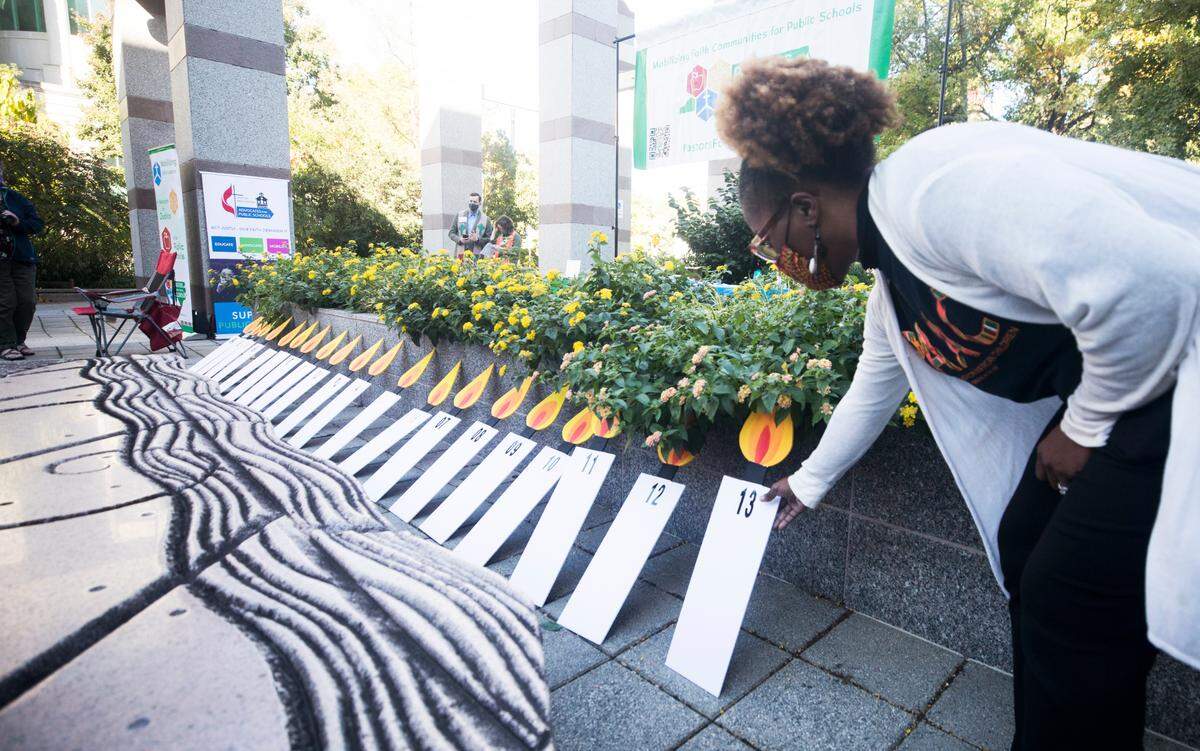
Providing a sound basic education
The appeals are the latest chapter in the long-running Leandro school funding case.
The Leandro court case was initially filed in 1994 by low-wealth school districts to get more state funding.
Over the years, the state Supreme Court has ruled that the state Constitution guarantees every child “an opportunity to receive a sound basic education” and that the state was failing to meet that obligation. Lee, a retired Union County judge and registered Democrat, was assigned the case by the Supreme Court in 2016.
In his Nov. 10 court order, Lee wrote that the courts had waited long enough for state lawmakers to act. He ordered the state treasurer, state controller and state budget director to transfer $1.7 billion to fund the next two years of a multi-year action plan developed by an education consultant.
The consultant’s plan includes things such as pay raises for principals and teachers, hiring more teacher assistants, increased funding for low-wealth school systems and expansion of the state’s Pre-K program.
Linda Combs, who was nominated to state controller by former Republican Gov. Pat McCrory, appealed Lee’s order to the Court of Appeals.
On Nov. 30, the two Republican justices on a three-judge appellate panel issued an order declaring that Lee had exceeded his authority to require the transfer of funds. John Arrowood, the Democratic member of the panel dissented, saying only an order temporarily blocking Lee’s decision while the case is appealed should have been granted.
Timing of appellate order questioned
In the appeals, plaintiffs questioned the process used by the panel to issue the order.
Combs filed her petition on Nov. 24, the day before Thanksgiving. Under normal procedure, Dubis said the parties would have been given until Dec. 7 to give responses.
But the panel shortened the time to respond to Nov. 30, the last day before a new panel of judges would have been appointed. The plaintiffs say there was no need for the panel to act so quickly because Lee had stayed his order to Dec. 10.
“State constitutional issues should not be resolved in hasty gamesmanship by judges apparently bent to decide issues in secret without ample notice to litigants or the public,” Dubis wrote in the appeal. “Such procedural irregularities undermine the public confidence in our judiciary system and should not — indeed cannot— be tolerated when the fundamental, constitutional rights of our State’s children are involved.”
Haddix and Hinojosa accused the majority members of the appellate panel of flouting the rules and procedures to ensure they would hear the case. They and Dubis also say that allowing the appellate decision to stand will weaken the ability of the courts to respond to constitutional violations by the legislature.
“Allowing the decision below to stand will encourage future politically motivated flouting of litigants’ procedural rights and undermine the people’s faith in the fairness of the State’s judiciary,” Haddix and Hinojosa write.
GOP leaders appeal funding order
Last week, Senate leader Phil Berger and House Speaker Tim Moore filed paperwork to intervene in the lawsuit and to appeal Lee’s order.
The recently approved state budget funds about half of the first two years of the Leandro plan, according to the Public School Forum of North Carolina. Both GOP lawmakers say that Lee’s order challenges the state budget and the General Assembly’s authority .
“The Court’s Order seeks to direct State officials to pay money from the State treasury in a manner contrary to appropriations made in the State Budget,” Berger and Moore say in their court filing. “In doing so, the Order contravenes the doctrine of Separation of Powers reflected in Article I, Section 6 of the State Constitution.”
At this critical point in the lawsuit’s history, the plaintiffs say the Supreme Court needs to intervene again.
“Right now, thousands of at-risk children are being denied the opportunity to avail themselves of their fundamental constitutional right to a sound basic education,” Dubis writes. “Immediate and final adjudication by this Court is necessary to prevent further and irreparable harm to these children.”
This story was originally published December 15, 2021 at 6:49 PM with the headline "NC schools appeal court order blocking $1.7 billion transfer of funds for education."