The Leandro case explained: What to know about NC’s historic school funding dispute
Here are the basics of what you need to know about North Carolina’s Leandro school funding case.
What is the Leandro case?
The Leandro case started in 1994, when school districts in five low-wealth North Carolina counties (Hoke, Halifax, Robeson, Vance and Cumberland) and families sued the state, claiming that children were not receiving the same level of educational opportunities as students in higher-income counties.
In 1997, the state Supreme Court agreed, and ruled that the North Carolina Constitution guarantees every child in the state “an opportunity receive a sound basic education.” The court said that the state was failing to meet that standard.
In 2004, the state Supreme Court said the state’s efforts to provide a “sound basic education” to poor children were inadequate.
Who is the Leandro case named for?
The case is named after Robb Leandro, a student from Raeford, in Hoke County.
Leandro was in 8th grade when the lawsuit was filed. Because he was a minor at the time, his mother, Kathy, filed the suit on his behalf. The Leandro family was the lead plaintiff in the original lawsuit.
Leandro went on to study at Duke University for his undergraduate degree, where he played football for four years. He graduated in 2001. Leandro received his law degree from Vanderbilt University in 2006, and is now a partner at Parker Poe, a regional law firm in the Southeast that represented the plaintiffs in the original Leandro lawsuit. He works in the firm’s Raleigh office and specializes in health care law.
Why is Leandro back in the news?
Because the courts — along with educational coalitions, N.C. Gov. Roy Cooper and N.C. Democrats — say the state is still not doing enough to uphold the Leandro ruling. They say that a new plan, developed by educational consultants, would help provide better educational opportunities for students.
▪ In a January 2020 court order, State Superior Court Judge David Lee, who took over the Leandro case in 2016 when Judge Howard Manning retired, said the state is further behind in providing a “sound basic education” than it was even in the 1990s, and that the state must “work expeditiously and without delay to take all necessary actions.”
▪ In 2021, a proposed budget by Gov. Cooper, along with House Bill 946 filed by Democratic lawmakers, would fund the first two years of an action plan to improve education opportunities for children in low-wealth districts.
▪ In June 2021, Judge Lee signed a court order approving a 7-year plan agreed to by the State Board of Education, the Cooper Administration and the Leandro plaintiffs that calls for at least $5.6 billion in new education funding through 2028 (the $1.7 billion at issue right now would fund the first two years of this $5.6 billion plan).
▪ In September 2021, Lee gave state lawmakers a deadline to either fund the Leandro plan or he’d intervene. Similar legal action has been used by courts in other states to increase public education funding.
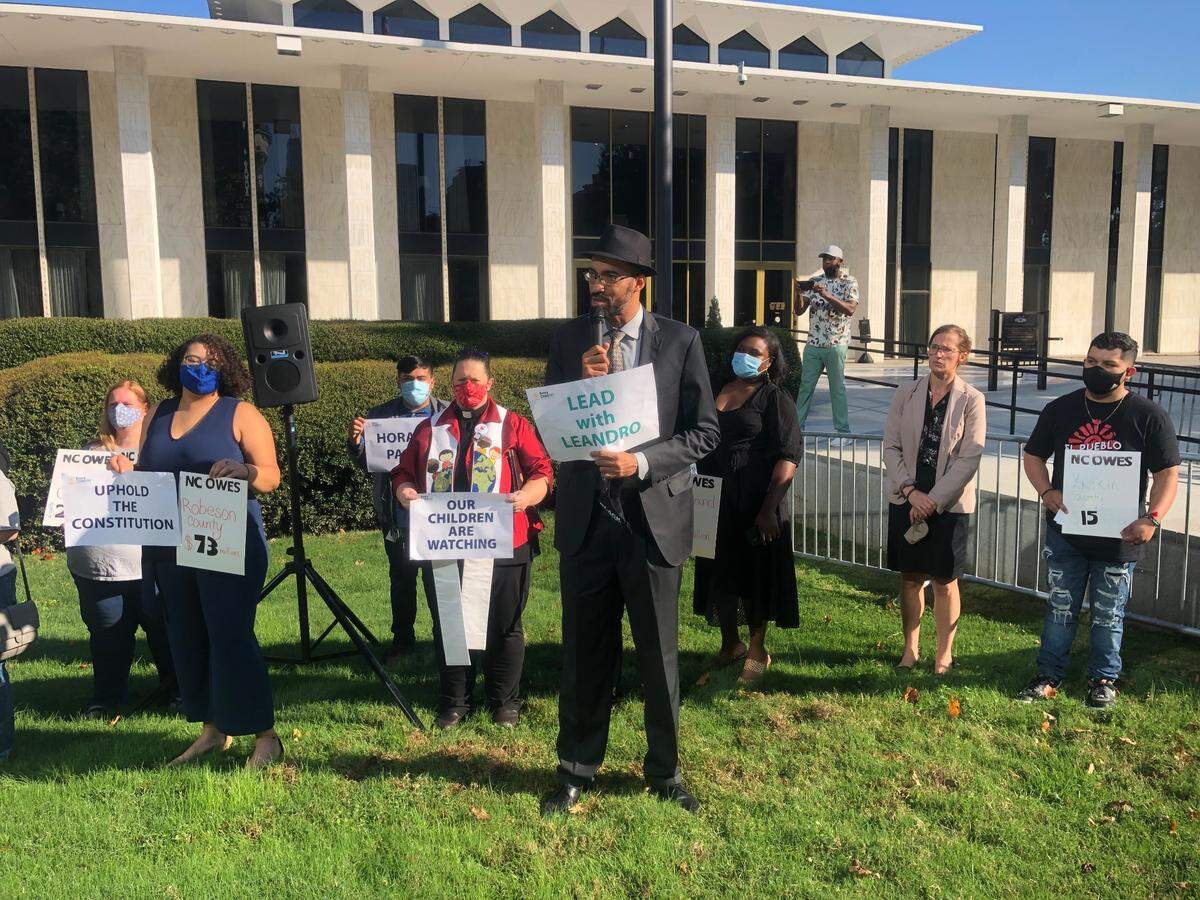
▪ In October 2021, Lee asked plaintiffs to submit a proposed court order on how the court could get the plan funded. The hearing occurred the same day a group of religious leaders held a prayer vigil calling on the plan to be fully funded.
What would the proposed spending pay for?
For the “comprehensive remedial plan,” the proposed legislation funds items such as a 5% teacher pay raise, principal pay raises and additional state funding to expand North Carolina’s Pre-K program and hire more teacher assistants, school nurses, school social workers and school counselors.
The $1.7 billion would fund the first two years of the plan.
Plaintiffs in the Leandro case propose that $1.5 billion be given to the state Department of Public Instruction, $190 million to the state Department of Health and Human Services and $41 million to the UNC System.
Does NC have the money to fund the Leandro plan?
North Carolina is currently sitting on a budget surplus of more than $6 billion, The News & Observer has previously reported.
Who is opposing the school funding?
State Republicans are objecting to the court order, saying only lawmakers have the constitutional authority to appropriate money.
The Republican-controlled General Assembly says Judge Lee has no authority to make them provide the funding.
Terry Stoops, director of the John Locke Foundation’s Center For Effective Education, said Lee’s order is putting the state in line for a constitutional crisis.
The Leandro plaintiffs dispute this, saying the state Constitution does empower the courts to act when the other branches refuse to carry out their constitutional obligations.
What is happening now?
The North Carolina Supreme Court has agreed to take on the question of whether the courts can order the state to increase funding for public schools.
The state Supreme Court issued an order agreeing to hear whether Judge Lee can require $1.7 billion to be transferred from the state treasury to fund the Leandro school action plan. As part of the court order, Lee was given up to 30 days to review whether he should amend his court order based on the new state budget.
The Supreme Court’s 4-3 Democratic majority will decide what power the courts have to require the state to live up to its constituti
This story was originally published March 22, 2022 at 11:26 AM with the headline "The Leandro case explained: What to know about NC’s historic school funding dispute."