
How the UNC System is working to educate more veterans and military-affiliated students
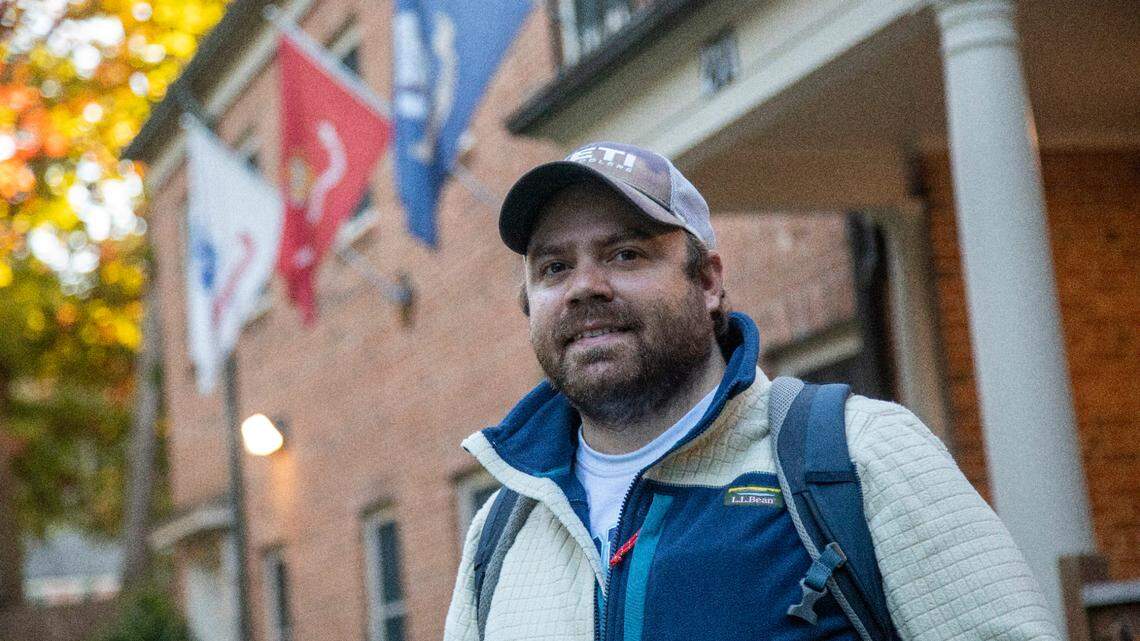
Campus is usually quiet when Tim Raiford steps off the bus about an hour before his 8 a.m. class.
Before most students are awake, he’s walking around the empty sidewalks thinking about the tasks of the day ahead and waking his mind up. It’s not a typical routine for new college students, who usually live in a dorm and might meet their friends for breakfast at a dining hall during their first semester on campus.
But Raiford isn’t a typical student.
He’s a 31-year-old Navy veteran who spent years working as a nuclear operator on a submarine and completing missions off the coast of Guam. He also trained in the nuclear welding program so he’d be prepared to repair watercraft in the fleet after a catastrophic event.
“It was pretty neat to be on a submarine,” Raiford said. “We conducted missions that I felt were important to national security. However, it’s a very arduous life.”
He worked 100 hours each week, including multiple 24-hour workdays, on a submarine that rarely surfaced. He was isolated from family and friends and barely went home for almost five years.
Now, Raiford is on a new mission: to graduate from UNC-Chapel Hill and start a new career as an investment banking analyst. He is a sophomore studying economics at the Kenan-Flagler Business School.
He’s a third-generation student veteran at UNC-CH and one of more than 12,000 veterans working to earn a degree at a UNC System university. More than 20,000 students in the UNC System are military-affiliated, which is just under 10% of all students. That doesn’t count ROTC cadets and only captures those who voluntarily specified their military status.
About 9,000 students are using more than $55 million from the GI Bill and Tuition Assistance Benefits from the Department of Defense to help pay for their college degree, according to the system.
A growing pipeline of student veterans
The number of UNC System students with military ties has grown consistently over the past four years as military status is now asked on admissions applications. UNC System campuses are also investing more in veterans services and seeking out those potential students.
At UNC-CH, nearly 2,000 students enrolled in Fall 2020 were military-affiliated and 375 were veterans or active-duty service members, according to the UNC System. East Carolina University had the largest number of veteran and active-duty students with about 2,400 in Fall 2020, followed by UNC Wilmington with about 2,200.
Military and defense industries are the second-largest employers in North Carolina, with an economic impact of $66 billion annually, according to the state. North Carolina also has the fourth-highest population of active-duty military personnel in the nation, according to UNC-CH.
“Those bases, those communities are really important to North Carolina, and we want to keep them here and keep their families here,” said Kathie Sidner, director of military partnerships at the UNC System.
Veterans, active-duty service members and military families are an important part of North Carolina’s identity, Sidner said. And the UNC System plays an important role in educating the state’s future workforce.
Veterans getting a college education through one of the state’s 16 public universities means they’re more likely to get a job or open a business in North Carolina, Sidner said.
The pipeline of potential students will likely grow due to the Isakson and Roe Veterans Health Care and Benefits Improvement Act of 2020, which made sweeping changes to how universities serve student veterans. One key difference is that veterans can now get in-state tuition through the GI bill outside of the previous 3-year window that started at their military separation date.
The UNC System is also working on using common course numbering to easily allow transfer students to get degree credits based on their military training, experience and specialty.
The process for getting joint services transcripts can be frustrating for student veterans because there’s sometimes a disconnect between what veterans are told will transfer to a university and what actually does. And in Raiford’s case, he didn’t get any course credits for his academic training in the Navy because his work was confidential for national security reasons.
From military to campus life
Raiford enlisted in the Navy shortly after graduating high school. He didn’t know what he wanted to do with his life and saw the military as a way out of his hometown of Winston-Salem.
He called 1-800-NAVY, met a recruiter, aced the Armed Services Vocational Aptitude Battery test and later trained for his service on a submarine.
When Raiford joined the Navy, his goals were to figure out what job he wanted or decide what school he wanted to go to and what degree he wanted to get. He served for about a decade, but always knew it wasn’t going to be a lifelong career.
After several years at sea, Raiford became an instructor at a nuclear power training unit in Charleston, South Carolina. He gave lectures in engineering, math and science and managed the training for about 200 students.
Raiford’s experience and technical training in the Navy set him up to get multiple job offers to work at a power plant, running a nuclear reactor or managing a data center. But he was interested in finance and knew that he needed at least a bachelor’s degree to break into that industry.
Raiford’s journey to UNC-CH’s campus started with a google search: “How do veterans get into college?”
The first search result was the Warrior-Scholar Project, a free academic boot camp that partners with universities to help prepare veterans for college. Although Raiford says it’s nothing like boot camp.
In 2019, he bought a plane ticket and enrolled in the 8-day program at Cornell University, which inspired him to pursue higher education. The curriculum involves intensive reading and writing workshops, plus lectures with university professors. The program is also available at UNC-CH.
When the coronavirus pandemic hit, he took general education classes online at Wake Technical Community College. Those credits transferred easily to UNC-CH through North Carolina’s articulation agreement. As a “born and bred” Tar Heel, Raiford knew he wanted to get his degree at Carolina.
Now, he’s living in Carrboro and taking the bus to campus, where he’s sitting in class with people who are 10 to 13 years younger than him.
Raiford said he feels the generational gap and the lack of connection that comes with a typical college experience. But he doesn’t feel as out of place as some other veterans on campus who have full-time or part-time jobs, children and spouses at home or the potential to get called up to duty.
A lot of personal struggles also go unseen.
“I think some people that go here have severe PTSD from actual war combat,” Raiford said. “And it’s not like people have a sign that says, I was in war, you know.”
That’s why peer support and institutional resources are critical for many student veterans, he said.
How NC universities support student veterans
At least half of UNC System campuses have scholarships specific to student veterans or military spouses and dependents. UNC-CH and other universities also have a certifying official to process students’ Veterans Affairs benefits like tuition money and housing stipends through the GI Bill.
Some UNC System schools have specific academic programs geared toward military students. For example, Fayetteville State University, near Fort Bragg, created a Center for Defense and Homeland Security with a cybersecuity academy for students to get industry-recognized certifications. And UNCW offers a conflict management and resolution program, a condensed course originally designed with marines in mind.
UNC-CH is actively raising money as part of the Red, White and Carolina Blue Scholarship Challenge that launched in 2017 with a $20 million gift from Debbie and Steve Vetter. Their gift established the Steve and Debbie Vetter Military Family Scholars program, which supports low-income children of retired and active-duty military personnel. So far, 73 students have benefitted from that gift and about half of the new military-affiliated undergraduate students in Fall 2020 qualified for the aid.
Nearly all universities have physical veterans resource centers, which offer academic, social, financial and mental health support for students.
“You relate better and trust people more if you have a shared experience,” said Rob Palermo, interim program director at UNC-CH’s center. “Knowing they have their own place really helps them be willing to reach out and engage.
Palermo served in the U.S. Coast Guard and joined Carolina in 2017, where he’s been the only academic advisor who’s also a veteran.
He coordinates the “Boot Print to Heel Print” year-long orientation program for incoming military-affiliated students with information about VA benefits, transfer credits and job training. UNC-CH also offers Green Zone training throughout the semester to educate faculty and staff about military life and the needs, experiences and challenges student veterans face.
It can be a difficult transition, Palermo said, because students are adapting to the freedom and pressure that come with attending an elite university, while trying to reintegrate into civilian life at the same time.
“You bring back with you a lot of ideas about who you can and can’t trust that other people who’ve never had such an experience can’t understand,” Palermo said.
There’s a reality of misunderstanding, but an even stronger perception among veterans that if they reach out for help they are not going to feel heard or feel like they’re being seen, he said. There’s a gap between traditional university faculty and staff and a veteran student, especially one who’s been deployed into a combat zone five times.
“When you’re one face in 20,000 at a huge university that can feel pretty hopeless,” Palermo said. “We don’t want to compound the other issues folks might be dealing with. We want people to be successful, and have high student retention and graduation rates.”
A big part of that success is connecting students to the services the Carolina Veterans Resource Center offers, particularly around Veterans Day. The center organized several events this week, including a football tailgate, a breakfast for military-connected women, a food drive and a reception at the resource center.
“A lot of it is building community and learning from students what they need from us,” Palermo said.
This story was originally published November 10, 2021 at 2:16 PM with the headline "How the UNC System is working to educate more veterans and military-affiliated students."
