2 NC teens — with a 3D printer — invent new way to help heart patients
Prabuddha Ghosh Dastidar was an eighth grader when he staked out a Charlotte hotel lobby to meet players of his favorite soccer team, Liverpool.
He always loved soccer — still does — and hanging out with friends and exploring the woods near his home in Waxhaw.
That same year in a lab at the University of North Carolina at Charlotte, the teen conducted a research experiment using antioxidants to partially neutralize the toxic effect of cancer drugs in order to administer treatments in greater quantities.
“I’m a pretty normal kid,” said Ghosh Dastidar, now 17 years old and entering his senior year at the North Carolina School of Science and Mathematics. “I love soccer and going out with my friends. I like exploring the woods and watching sunsets.
“But, yeah, (research) is pretty much always at the back of my mind.”
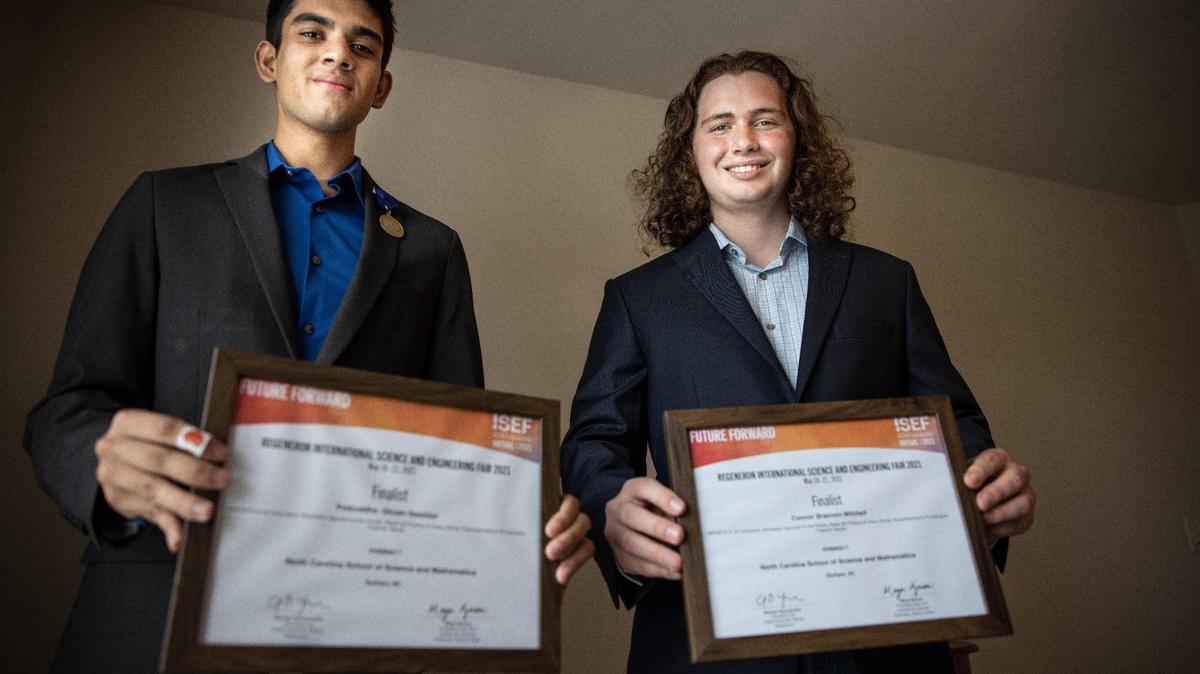
Ghosh Dastidar and Connor Mitchell, a senior at the NC School of Science and Mathematics, who lives in Raleigh qualified for a renowned, international science fair this year. Their project: A novel stent made with 3D printing, which doctors can use to keep a passageway open, such as when an artery to the heart is blocked.
The pair embarked on the stent project as a more affordable and accessible option for low-income communities.
Not only did a panel of Nobel prize winners and scientists at the Regeneron International Science and Engineering Fair honor Ghosh Dastidar and Mitchell with an award in the biomedical engineering field, but Sigma-Xi, one of the oldest scientific research honor societies in the world, also recognized the students’ achievement.
Ghosh Dastidar and Mitchell are in talks with several companies for patents and manufacturing of the ARTHETA-0.
“This stent can solve multiple major issues in the healthcare industry,” Ghosh Dastidar said. “Most current stent manufacturing technology only allows for one-size-fits-all. Our solution results in highly-customized stents and therefore minimizes complications.
“Current stent manufacturing facilities require extensive capital so stents are manufactured away from hospitals. The innovation of the ARTHETA-0 allows us to envision a future where doctors can use current medical scanning techniques to image a patient’s arteries and receive a custom-fabricated stent, available for use well within two hours.”
The Biomedical Engineering Society made a rare move this week: the organization selected the teens to deliver a webinar — chosen speakers are generally professionals and executives in the industry.
Pool and Panera
Ghosh Dastidar’s biology and medicine background collided with Mitchell’s engineering and computer science background last October during a game of pool — a typical downtime sport at the residential school in Durham.
After that initial meeting, they agreed to launch their project idea “into full development” at Panera Bread.
“Almost as an afterthought, I drifted toward an idea for a new 3D printer design and motion system I had been brainstorming on for the past couple months: a Static-Surface, Polar 3D Printer,” Mitchell, 17, said. “He noted that he thought it was an interesting idea and approached me the following day with the proposition of considering applying the concept to printing artery stents.
“At first I thought that, surely, it wouldn’t be able to have a significant impact on this multibillion dollar industry, however, with a little research, we realized just how much of an impact this idea might be able to have.”
Both inventors call the stent industry “incredibly flawed.”
Each year, more than two million Americans undergo stenting procedures for coronary arteries. There are very few methods of manufacturing artery stents which allow for the dimensions and characteristics of the stent to be adjusted, Mitchell said.
Opportunities at UNC-Charlotte
Ghosh Dastidar’s research journey continued through the rest of middle school and into high school at UNC-Charlotte. He was invited to shadow a post-graduate researcher’s work on gene silencing in the pathogen that leads to African Sleeping Sickness.
In the ninth grade, he studied schizophrenia, and he’s also shadowed a researcher’s work on pancreatic cancer cells. After that, he conducted a project where he used gene splicing inhibitors to exploit specific genetic vulnerabilities in pancreatic cancer cells.
“It paves the path for developing a cancer treatment that is more specific toward cancer cells by exploiting their unique vulnerabilities,” he said.
“We started noticing his interest in the first grade,” his father Prithviraj Ghosh Dastidar said. “He did well in math competitions and the elementary school science fairs.”
For both Ghosh Dastidar and Mitchell, their recent stent innovation has earned multiple awards as recently as this week from HOSA Future Health Professionals, Technological Student Association Nationals and CAD Engineering.
“I truly began to fall in love with engineering in the fourth grade and knew that I wanted to pursue it as a career,” Mitchell said.
Ghosh Dastidar has dreams of going into a medical field.
“I want to manipulate these genetic pathways to answer these unknown questions and use them to our advantage during treatment of neural disease,” he said. “Consequently, I yearn to unpack this dense reserve of medical concepts in order to make treatment more effective and better the lives of others.
“I just love helping people. That’s what I want to do.”
This story was originally published July 6, 2021 at 6:00 AM with the headline "2 NC teens — with a 3D printer — invent new way to help heart patients."