NC schools say they need to talk about race. But there’s wide disagreement on how.
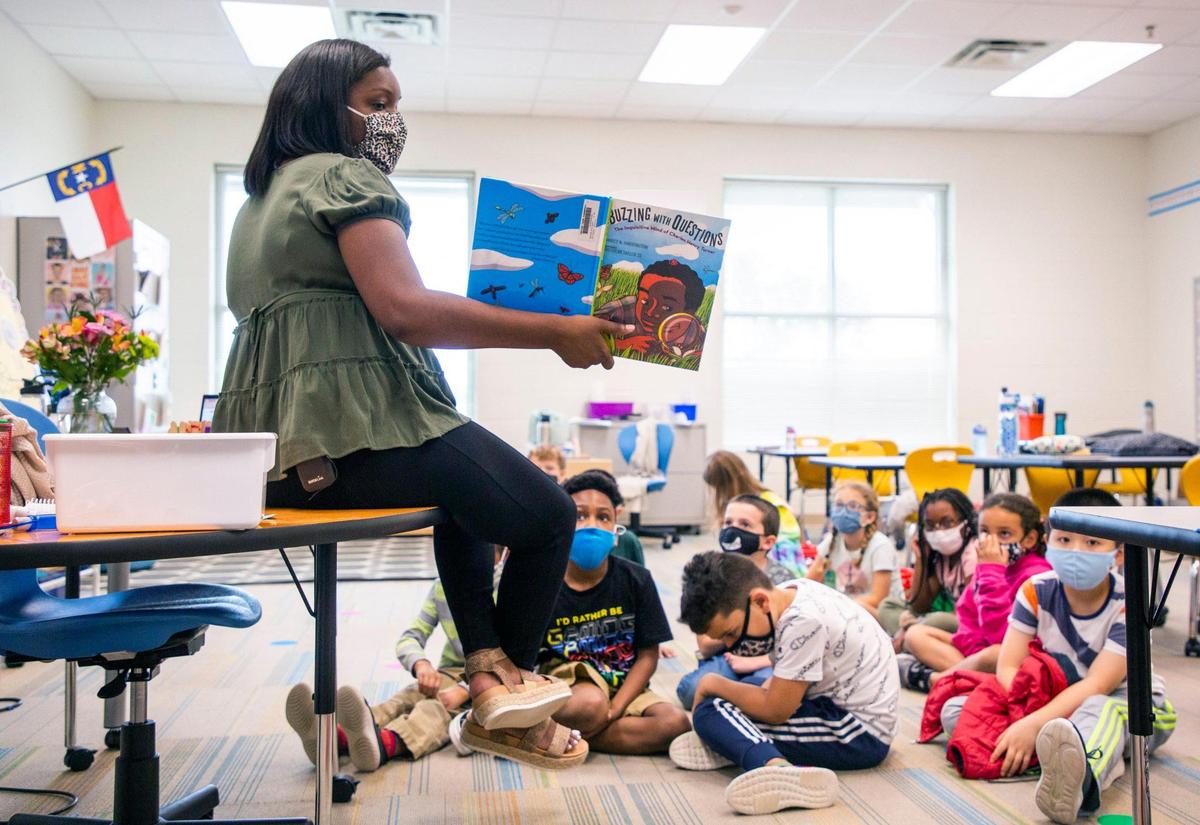
Bria Wright’s 2nd-grade students in Cary are advocating now for the protection of butterflies. But who knows where their budding activism could lead them?
During a recent class, Wright reminded her students that part of the creed for Hortons Creek Elementary School is that they all have a voice that can create change. Wright is hoping that her language arts lesson on protecting butterfly habitats will show these young how they can influence other things they’ll become interested in, including social justice issues.
“What does it mean to advocate?” Wright asked her students. “We talked about this when we talked about the $20 bill.
“We talked about how there were only old white men on the $20 bill and how we wanted other people of different races, different genders represented. We used our voices to advocate.”
Schools in North Carolina and across the nation are addressing the issue of race as part of what they say is an effort to better meet the needs of their students. And such lessons will increase under new state social studies standards that say teachers should discuss racism, discrimination and the perspectives of marginalized groups.
”If we don’t confront the issues that come along with how we address issues of race, then you can never really kind of overcome the negative consequences,” Rodney Trice, the Wake County school system’s assistant superintendent of equity affairs, said in an interview.
Critics question race discussion
But these discussions about race and culture are producing a backlash from some conservatives who says schools have gone too far. It led Republican House lawmakers to pass a bill on Wednesday that puts new rules on how schools teach about race and history, including not promoting teaching that would make students feel guilt or discomfort due to their race or sex.
The legislation, which is on its way to the state Senate, also says schools can’t promote that the United States “was created by members of a particular race or sex for the purpose of oppressing members of another race or sex.”
“Our children, regardless of their background, should know that it is their shared and diverse experiences that make America great, and learning about those experiences should bring them together — not drive them apart,” GOP Lt. Gov. Mark Robinson said in a news release. “This legislation ensures that our students will be taught that we all have value, regardless of who we are – or who our ancestors were.”
Robinson recently created a task force to collect complaints from parents, students and teachers in public schools across the state about what he called “indoctrination” in the classroom.
Supporters of the bill say they’re trying to limit the use of “Critical Race Theory, a “scholarly framework that describes how race, class, gender, and sexuality organize American life,” according to the UNC-Chapel Hill history department. This view holds that systemic racism has been and continues to be a part of the nation’s history.
Critics call it Marxist, anti-American, racist, destructive — and, most concerning to them, pervasive. Republican lawmakers have introduced bills at the state and national level against the use of Critical Race Theory.
Opponents of such bills, meanwhile, say they would stifle classroom discussion of any forms of racism.
“Just because we pass a bill that makes it harder for teachers to talk about systematic racism does not mean that our children will still not experience that same systematic racism,” Rep. Kandie Smith, a Pitt County Democrat, said during Wednesday’s debate on the bill. “Slavery and its legacy of oppression are not only part of North Carolina’s history, they are the reality.”
‘Whiteness in Ed Spaces’
Much of the recent attention about Critical Race Theory in North Carolina has been fueled by stories on conservative websites about what was discussed at a February 2020 training event in Raleigh hosted by the Wake County school system. Wake is North Carolina’s largest school system.
At the EdCamp Equity event, participants talked about topics such as disparities in student enrollment in special-education and academically gifted programs, Critical Race Theory, white privilege, male privilege and why teachers should wear Black Lives Matter shirts.
“White parent’s children are benefiting from the system,” according to session notes from the “Whiteness in Ed Spaces” presentation. “They are perceiving that they are going to lose something. Fear of loss. Hard to let go of power/privilege.”
Christina Spears, special assistant in the Wake County school system’s Office of Equity Affairs, says the district did not sponsor the EdCamp event. She said the sessions were picked by the attendees on the day of the event to discuss ways to close the achievement gaps that exist for some historically marginalized students.
Wright, the 2nd-grade teacher, said attending the EdCamp helped her talk with other people committed to equity work. She’s a leader in the equity work at Hortons Creek.
“Sometimes we think about equity as only serving a specific population or specific race of students,” Wright said in an interview. “But really, equity is we’re trying to make sure that everybody has what they need to succeed.“
Wake County has also drawn attention for how it offered a course on Critical Race Theory on its staff training website. The session was taught by an organization co-founded by state Rep. Graig Meyer, the North State Journal reported.
Lisa Luten, a Wake school spokeswoman, said the class had been mistakenly added without going through proper vetting. She said the class, which was going to be offered again this year, was canceled because it doesn’t align with the district’s equity efforts.
Culturally Responsive Teaching
Despite the coverage, Trice said Wake County does not use Critical Race Theory in its curriculum.
Instead, Trice says Wake uses “Culturally Responsive Teaching,” which he described as finding strategies that help students thrive. One component is looking at how students and school employees perceive race to see the multiple perspectives that Trice said are in play.
“Because of the history of our country, we all experience issues around race and racism,” Trice said. “It’s a part of our experiences living in this country and there are consequences from having that experience.”
Wake has encouraged school employees and students to have what it calls “courageous conversations” about race.
Wright has had those hard talks with her elementary school students.
“The kids really want to learn and want to do better and once you teach them these are kind of the things that have gone wrong, they can recognize it,” Wright said. ‘”Oh, these things are problematic,’ and they really do want the world to be a better place. I always say that kids are better than adults everyday.”
But race is only a small part of Culturally Responsive Teaching, Trice said. He said it involves looking at the whole culture of a student, such as having teachers learn now to pronounce the names of students instead of just using nicknames.
“What we’re saying as a district is that we’re going to confront race head-on,” Trice said. “But we also see that the whole of who people are is also important to educating them, and the more that you can tap into the assets, the cultural assets of any student, the more that they will thrive.”
Trice is soon leaving Wake to become chief equity and engagement officer for the Chapel Hill-Carrboro school system.
Racially inciting students
Despite Wake’s denials, Nancy Andersen of the North Carolina-based Education First Alliance says that Culturally Responsive Teaching and Critical Race Theory are the same thing. She says both focus on race and differences of color.
“It approaches culture from one progressive perspective,” Andersen, a Chapel Hill resident, said in an interview. “That is not going to enable teaches or students to develop a well-rounded education that will help them deal with issues in the future.”
Parents should also be wary of any equity club or diversity and inclusion groups that are in their children’s school, Andersen said.
“Diversity and inclusion are great words,” Andersen said. “But they’re using it as a propaganda technique.”
Andersen says Critical Race Theory is becoming more prevalent in the classroom and is being used by some teachers to racially incite students. As an example, she cited a discussion of Black Lives Matters where teachers don’t mention the property damage and vandalism that has occurred at some protests.
“If you’re the family of a child who have disagreement with the (Black Lives Matter) movement — which you are allowed to have — how are you supposed to feel if you walk into a school where everyone is wearing racial equity attire?” Andersen said. “How is the child supposed to feel?”
Allegations that the state was trying to slip Critical Race Theory into the new social studies standards has produced hours of debate at school board meetings in Moore County, southwest of Fayetteville. The board voted 4-3 on Monday against a motion that would have prohibited Critical Race Theory from being used in the district’s schools.
“We in Moore County must look at what’s going on around us, and what is going on around us is Critical Race Theory on steroids,” said Moore County school board member Robert Levy. “We have to communicate to our staff, we have to communicate to our teachers, we have to communicate to the public, that we will not allow Critical Race Theory to invade our schools.”
But other board members said the district doesn’t plan to use Critical Race Theory and that the ban would micromanage what teachers can do.
“This policy is unnecessary,” said board chairwoman Libby Carter. “It is a Trojan horse that will open the door to further limits on teacher and staff autonomy. Will we ban the theory of evolution next or Einstein’s theory of relativity, or the study of ancient civilizations?”
Deal with racial issues in classroom
Some educators and community leaders say schools must have those challenging conversations about race and racism.
Rodney D. Pierce, an eighth-grade social studies teacher in Nash County Schools, points to the shootings of Black men by police officers, including the April death of Andrew Brown Jr. in Elizabeth City that has sparked protests. He said teachers need to discuss issues like police shootings because their students are watching the news and have questions.
“Why are Black men disproportionately killed by police?” Pierce said in an interview. “Why do officers always say when they summarily execute Black men that they were afraid? What Critical Race Theory tries to explain is the intersection of the issues of law with the intersection of race.”
Black minister and Durham social justice activist Paul Scott says the nation has two choices for how to deal with its racial issues.
“We can either solve the problems by violence or we can solve these problems academically,” Scott said in an interview. “I think they would agree that the best way to solve these racial problems is academically and intellectually.”
This story was originally published May 14, 2021 at 8:00 AM with the headline "NC schools say they need to talk about race. But there’s wide disagreement on how.."