
Three NC colleges topped 1,000 COVID-19 cases this fall. What are their spring plans?
UNC-Chapel Hill, N.C. State University and East Carolina University each saw coronavirus cases spike on campus this semester and abruptly moved classes online and forced students out of dorms.
But despite reporting more than 1,000 COVID-19 cases each this fall, all three schools are preparing to bring students back to campus again this spring.
What will be different next semester? Here’s what each school plans to do to keep students and employees safe during the coronavirus pandemic.
UNC-Chapel Hill
Though the university has not finalized plans for the spring semester, Chancellor Kevin Guskiewicz said the hope is that UNC will bring students back to live on campus with in-person classes.
“We have a lot of questions that we’re asking, options to consider and input to listen to first,” Guskiewicz said.
UNC was one of the first major universities in the nation to bring students back to campus for the fall semester during the pandemic. Just one week later, the university moved classes online and told students to move out of dorms because of COVID-19 clusters.
More than 1,000 UNC students and employees have tested positive for COVID-19 since classes began, and many were forced into isolation and quarantine dorms on campus. Community spread of the virus occurred in dorms, Greek houses and among athletes.
Spring semester classes will likely start in mid-January, which is slightly later than what’s currently scheduled. And there might not be a spring break. That announcement should come next week.
“No final decision has been made, but I’d say everything is on the table,” Guskiewicz said.
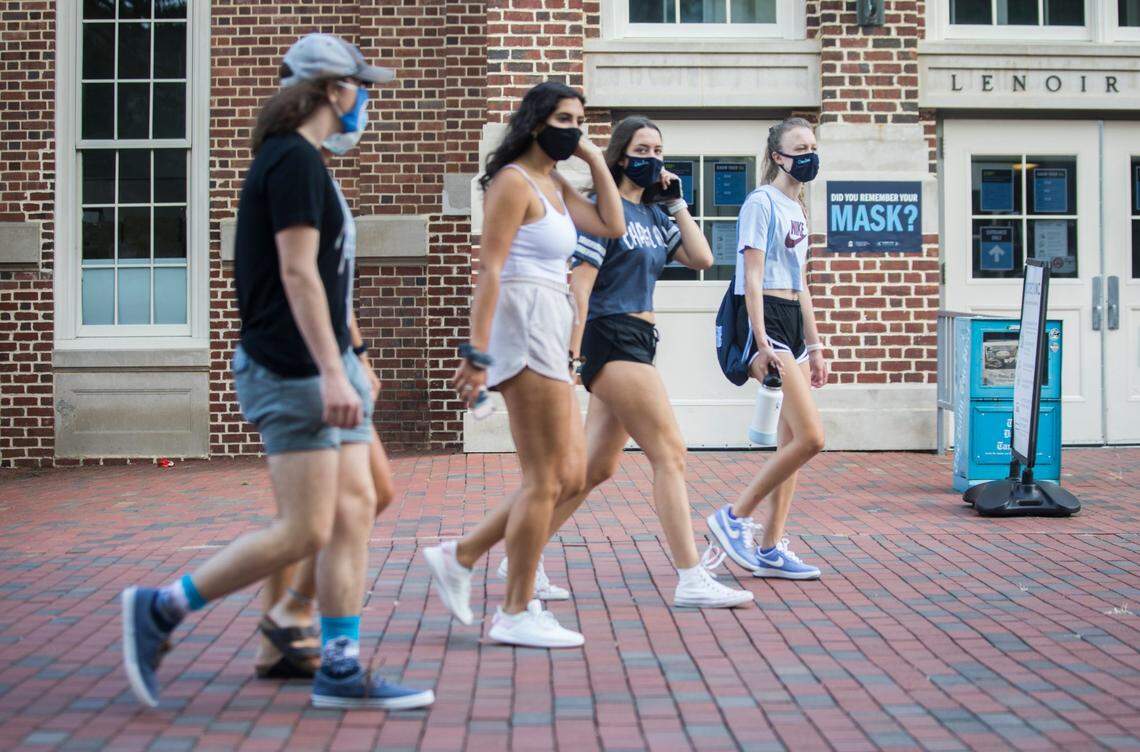
UNC’s fall plan for dining halls, libraries, the student union, student stores and classrooms was well-executed, according to Guskiewicz, but there are some other aspects that need improvement.
“I think we can all learn from mistakes, and that’s what we’re doing,” Guskiewicz said.
The university plans to better enforce student activity off campus. Guskiewicz said students saw the impact of their behavior and have learned what needs to change for a successful spring semester.
UNC also is also reconsidering the residence hall set-up, single-occupancy rooms, who has access to campus facilities, the total number of students allowed to live in dorms and the number of isolation and quarantine rooms.
More COVID-19 testing will also be a key part of spring plans, Guskiewicz said. The university is looking at several different testing options, including re-entry testing for all students and faculty. That testing could be voluntary or mandatory and saliva-based or nasal testing.
Having more robust testing could allow for more students on campus, the chancellor said, but students need to be willing to take those COVID-19 tests, particularly if it’s done throughout the semester.
N.C. State University
N.C. State in Raleigh also said it’s taking the lessons learned about how coronavirus spread this semester to make plans for the spring. When COVID-19 cases rose among students and employees this fall, the university switched to online classes and closed residence halls.
“What we have seen, clearly, is that COVID-19 is easily and quickly spread through social gatherings, such as parties (large and small), as well as communal living spaces where students are in double occupancy bedrooms,” university leaders said in an email to students.
The virus has not spread in classrooms, office spaces, libraries, student centers or shared bathrooms, according to NCSU. And the university has reported low rates of infection among staff members, including those who work in housing and dining facilities.
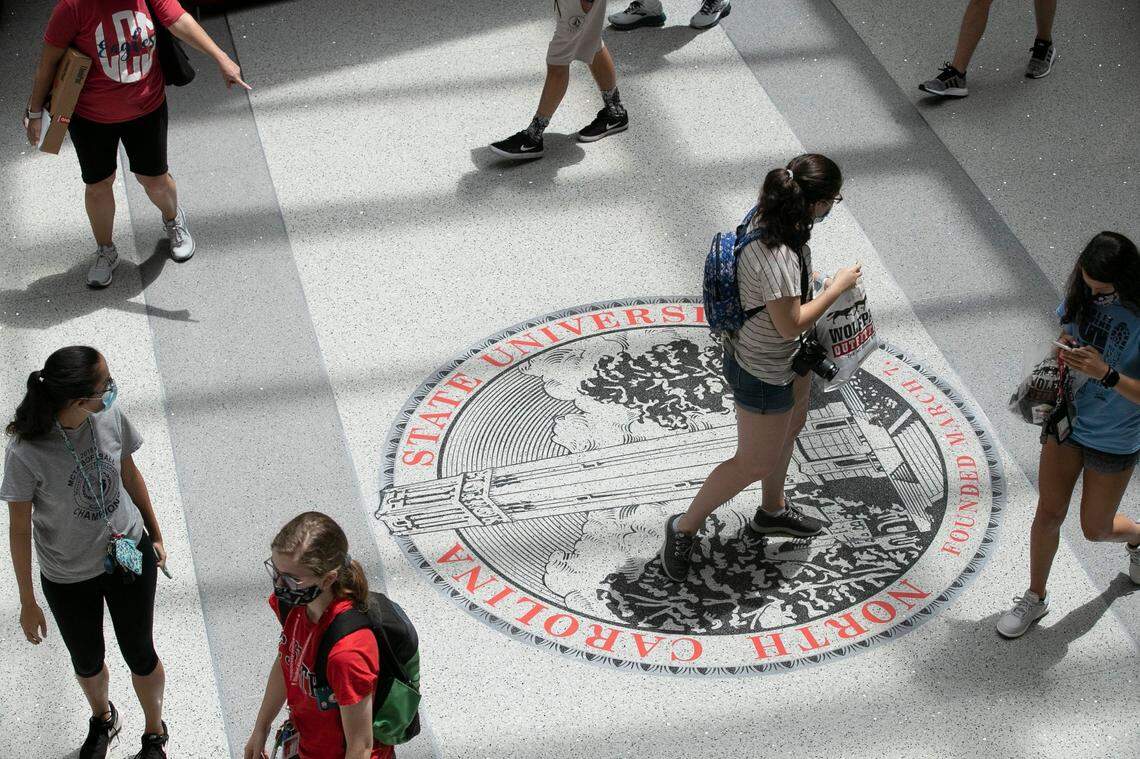
This spring, classes will start as planned on Jan. 11 and end April 29, with a spring break from March 15-19. The university is planning a mix of in-person, hybrid and online classes for undergraduate and graduate students, with the option to take courses completely remote.
Residence halls will reopen with reduced capacity, and N.C. State students who live in dorms won’t have roommates. The university will also set aside more rooms for quarantine and isolation for students who test positive for COVID-19 or are exposed to an individual who has.
The school reported more than 30 clusters of COVID-19 in residence halls, fraternity and sorority houses and in off-campus apartments. N.C. State said it plans to “more aggressively” enforce its community standards on and off campus, including mandatory face masks, limited social gatherings and physical distancing.
The university has not announced a plan to test every student and employee before they come to campus this spring, but it is working on improving testing capabilities.
Some NCSU faculty members say they are “gravely” concerned about the spring plans after seeing what happened this fall. Members of the pending N.C. State chapter of the American Association of University Professors sent out a statement Monday sharing concerns about the decision and saying it was made without serious input from faculty.
“The fall debacle was a failed and dangerous experiment, and the lesson should be to avoid a repeat, or worse,” the statement said. “Half-occupancy residence halls and partially-full Greek houses, as well as partial face-to-face instruction during what epidemiologists have warned, may be an exceptionally dangerous time, invites disaster onto our campus and risks further breaking trust with students, faculty, staff, and the community.”
The faculty members asked that residence halls stay at or below their current occupancy levels and that N.C. State offer only online instruction.
N.C. State will not “fully reopen” and the number of people on campus at any one time will remain much lower than in a typical year to help ensure community safety, university spokesperson Mick Kulikowski said.
Decisions about the format of classes, including whether they’ll be in-person or remote, will be decided by faculty, department heads and deans, according to Kulikowski.
East Carolina University
ECU pivoted to online undergraduate classes in August, after reporting multiple COVID-19 clusters in residence halls in the first two weeks of the fall semester. Most students moved out of their dorms in August, but ECU is now allowing hundreds of students to come back to live on campus in a single room for the rest of the fall semester.
While ECU has reported about 1,000 COVID-19 cases this fall, the cases that university medical staff are aware of all have been fairly mild, according to the director of ECU Student Health Services. The university said it is not aware of any student who has been hospitalized.
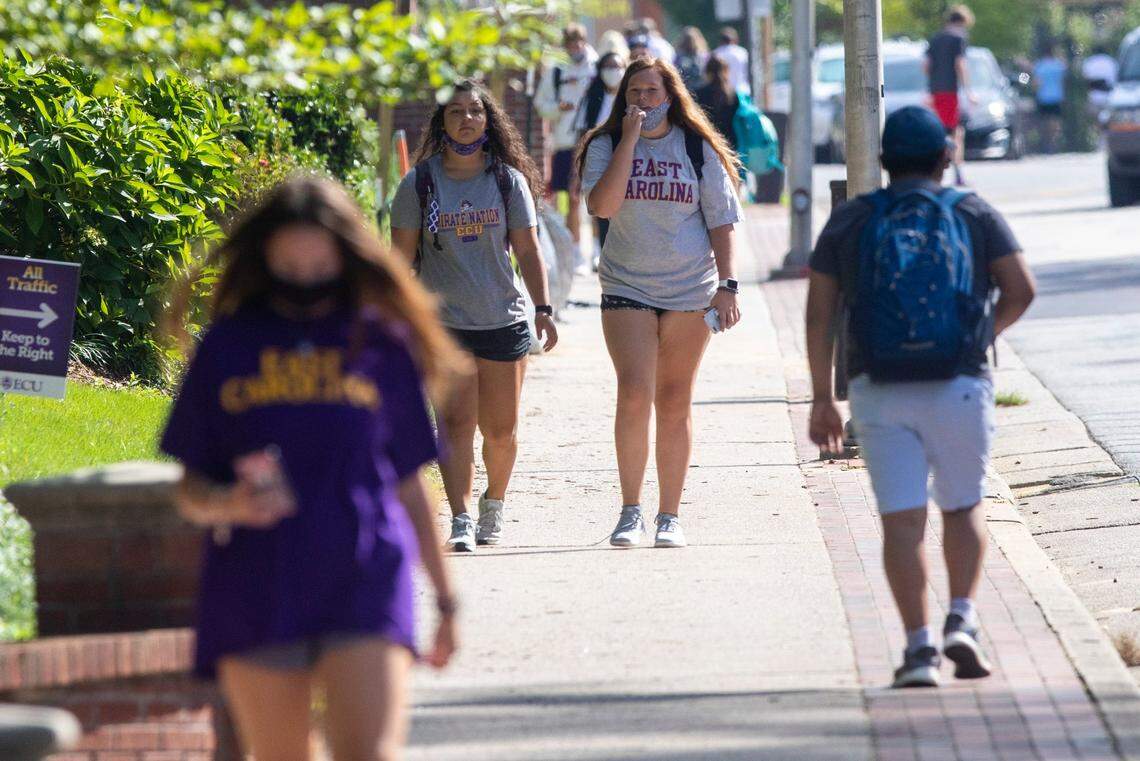
ECU has not made any official announcements about spring plans, but the university expects the Greenville campus and residence halls to be open with a reduced occupancy. Freshman will no longer be required to live on campus for the spring semester, and residence halls will likely be limited to single rooms.
ECU also plans to further reduce density in instructional settings and provide more rooms for isolation and quarantine on campus.
“With these plans for reduced density, and increased isolation and quarantine space, we feel we’re in a better position for spring,” ECU spokesperson Jeannine Hutson said.
The university has not announced mass asymptomatic testing for students. The design for spring testing is not yet final, but it will be an expanded program, she said.
At an ECU Board of Trustees meeting earlier this month, Interim Chancellor Ron Mitchelson said the university is “not going to bring people back here at the same level of intensity, at least not on campus, that we have had previously,” ECU reported.
“But we’re going to be open for business,” Mitchelson said. “That’s not going to change.”
Who will make decisions about spring plans?
While UNC System institutions are governed by the UNC System President Peter Hans and the system Board of Governors, each chancellor has the authority to decide how an individual campus will operate this spring.
As ECU makes further plans for spring, Mitchelson will be advised by the Chancellor’s Cabinet and ECU’s COVID-19 Coordinating Committee and consult with student, staff and faculty leaders. Ultimately, the decisions for reopening will be made in collaboration with Hans and be guided by local data from public health officials, according to Hutson.
At UNC, the final decisions about how to bring students, faculty and staff back to campus will be made by Guskiewicz, but he will consult the UNC System and Board of Governors, the UNC-CH Board of Trustees, local public health officials and university infectious disease experts and researchers.
The newly created Campus and Community Advisory Committee, made up of about 30 students, faculty and staff members and individuals from the Chapel Hill-Carrboro community, will also be part of the process. That committee is tasked with advising Guskiewicz on how to provide the “best Carolina experience for as many students as possible,” including considering in-person versus online classes, campus housing, the academic calendar and COVID-19 testing.
The group had its second meeting Tuesday to discuss concerns, options and ideas about campus plans, including the semester start date and spring break.
Mimi Chapman, chair of the committee and UNC Faculty, shared the news of a 19-year-old Appalachian State University student who died from COVID-19 this week. University officials said he was living off-campus in Boone and taking his classes online.
Chapman said it was a “sobering” way to start a meeting about how UNC should plan for the spring semester.
She also recognized faculty concerns that there is a preexisting reopening plan based on Guskiewicz’s comments about options for a later January start date and a hope to bring students and faculty back to campus this spring. Chapman assured committee members that she and the other co-chairs are confident that their recommendations will be considered.
Sharon Holland, a professor in the Department of American Studies and member of the committee, said students and faculty do not have another pivot from in-person to online in them.
“That would be really, really devastating,” Holland said. “Moving in this direction to abandon it in three weeks is just not only unconscionable, but it’s irresponsible.”
The goal is that whatever the circumstances are in January, that plan will continue throughout the spring semester, Guskiewicz said.
“We don’t want to have to take that pivot again,” he said. “So we’re putting measures in place that I’m confident we will have a successful start and finish to the spring semester.”
This story was originally published October 1, 2020 at 8:00 AM with the headline "Three NC colleges topped 1,000 COVID-19 cases this fall. What are their spring plans?."
