Some NC parents grow more frustrated and vocal as virtual school enters another month
Nearly a month into the new virtual-only school year, some frustrated North Carolina parents are calling for schools to reopen for in-person classes.
Many school districts are only using remote instruction at the start of the school year because they say it’s not safe yet to resume face-to-face classes during the coronavirus pandemic. But a growing number of parents are complaining that their children aren’t benefiting from spending their days in front of a computer screen trying to get an education.
“There are families that prefer this virtual learning platform, and it may work well for them,” Erin Wall, a Cary parent, said in an interview. “But then I feel like there are other children who need to be in school and want to be in school.
“They should have that option to go back, and so I’m just hoping we get to a place soon where we’re allowed to send our children back to school if that’s what we choose to do.”
The frustration has reached a point where some parents have filed a lawsuit to try to force the Charlotte-Mecklenburg school system to reopen schools, the Charlotte Ledger first reported earlier this week.
Families asked to “hang in there”
Wake County school leaders acknowledge the parental backlash that led to 42 public comments at last week’s school board meeting asking for schools to reopen. Wake County school board chairman Keith Sutton said they hear the complaints, but also want the public to extend grace and patience to the schools during this period.
“We know that this is hard,” Sutton said to parents at last week’s board meeting. “We know that this is difficult. But we’re here with you, and again we are working to open schools as soon as we can safely do so. So hang in there.”
The majority of North Carolina’s 1.5 million public school students haven’t had face-to-face classes since Gov. Roy Cooper ordered campuses closed in mid-March to try to slow the spread of COVID-19. Cooper has allowed schools to reopen under social-distancing rules, but the majority of districts opted to stick with virtual instruction.
School officials say the remote learning being provided this fall is better than what was offered in the spring. But they also admit that nothing can replace the value of face-to-face instruction.
“I ask that you have patience and stay in close contact with your child’s teachers,” Wake County Superintendent Cathy Moore said to parents at last week’s board meeting. “They’re committed to making sure every student has the opportunity to succeed in remote learning.”
Students feel isolated
The past month has turned Mary Deaton’s daughter from a happy, straight-A high school student to one who complains daily after every single class that she hates virtual school. Deaton, a Wake County parent, said the teachers are doing what they can to keep students engaged, but virtual classes are too isolating.
“My daughter is an extremely social person,” Deaton said in an email. “Now she spends the entire school day by herself in front of a computer screen, then spends additional hours every day on the same screen doing additional homework. Any parenting expert in the country will tell you this isn’t a healthy way to spend time.”
Only having virtual classes is mentally unhealthy, especially for teenagers, according to Deaton. The Wake County school system offers tips to parents on how to help with their children’s social and emotional health (https://www.wcpss.net/domain/17142), but Deaton says it’s not enough.
“I understand the seriousness of the health concerns about the spread of COVID-19 and that precautions are necessary,” Deaton said. “I just think that the mental health concerns of the students should also be a top priority for our society.”
Virtual learning hurting special-ed students
Some of the most vocal complaints about remote instruction have come from parents of special-education students.
Sarah Baker, a Raleigh parent, says watching her 10-year-old son, James, struggle with the virtual classes has been the hardest thing in her life since he was born. James is in a special-education class for students with severe disabilities at Lead Mine Elementary in Raleigh.
“School is not just academics,” Baker said in an interview. “His goal is not to learn to read. It’s to learn how to use a fork. Everything about his school experience is physical and tangible.”
Wake County had initially planned to bring back some special-education students like James and Pre-K students for in-person classes this week. But the district postponed the return, citing difficulties with staffing, transportation and lack of personal protective requirement.
Wake is currently offering virtual therapy sessions for special-education students, but Baker says options such as virtual physical therapy aren’t viable for James. Baker said she had suggested options such as doing the physical therapy outdoors at school in a one-on-one setting, but the district said no.
“It’s becoming more sad and devastating when we’re trying to get our kids everything they need and the county isn’t working with us,” Baker said.
Parents point to reopened private schools
The virtual therapy sessions have been more helpful for Wall, the Cary parent. Her 8-year-old son, Carter, doesn’t have as severe disabilities as some special-education students.
But Wall says Carter’s ADHD makes attending virtual 2nd-grade classes at Penny Road Elementary in Cary not practical. Wall says she, her husband and their nanny take turns sitting with Carter to make sure he stays focused on the classes.
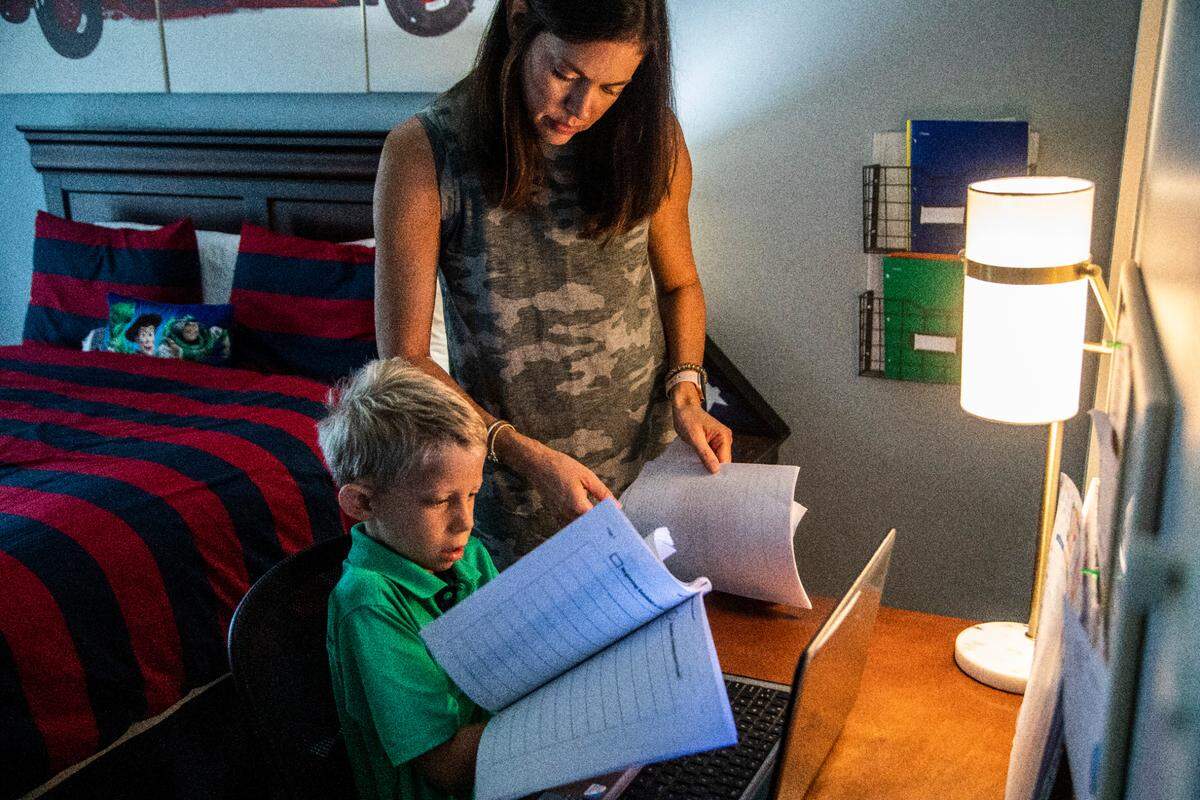
Like the other parents interviewed for the story, Wall said that their complaints are not with the teachers, who she says are doing a phenomenal job given the circumstances. But Wall says there’s going to be an academic cost from continuing to delay the return for in-person classes.
“I believe that this online virtual platform is not going to allow him to grow and develop on a normal scale like if he were physically in school,” Wall said. “I definitely think that we had some regression from the end of last school year.”
In contrast, Wall enrolled her 5-year-old son for kindergarten at GRACE Christian School, one of the many private schools that reopened last month for in-person classes. If it was possible, she said they would have put Carter in a private school too over using virtual classes.
“We looked at countless private schools and unfortunately none of them were a good fit for the educational needs that he has,” Wall said. “So we’re just hoping and praying that the public schools will come through and make some changes and we can get back to the classroom sooner rather than later.”
Metrics on school reopening
Wall says she wants to know details on how Wake County, the state’s largest school system, will decide on when to reopen. That was a common message among parents who submitted comments to the last board meeting.
Wake, along with Durham Public Schools, Orange County schools and Chapel Hill-Carrboro schools, is partnering with Duke University’s newly created COVID Scientific Advisory Board to provide “scientific data-driven guidance” on school reopening.
“There is no magic bullet, obviously, at this point,” Moore, the Wake superintendent, told the school board. “But we want to make sure that our confidence and our understanding when we go back to schools is high, and so that is a big goal of this partnership for us.”
Sutton, the Wake school board chairman, said the district will review the data and trends to decide when it’s safe for students to return.
“It is our goal as a district to return soon, to hopefully do that in cohorts, or groups of students, starting with our youngest and most vulnerable students first,” Sutton said. “Those plans may change, but right now that is our plan. But we cannot tell you when that will start, how that will start at this point.”
Wake hasn’t publicly released details on what the metrics will be for reopening. The district say the scientific advisory board hopes to unveil a website for the public during the week of Sept. 28.
In contrast, Charlotte-Mecklenburg has created a district metrics advisory committee that reviewed Thursday a draft of a “dashboard” that could guide a return to the classroom, the Charlotte Observer reported. The dashboard outlines three levels of community spread trends in Mecklenburg County: Minimal, moderate and substantial.
Some parents defend reopening delays
As parents wait for more details on school reopening, some are defending the decision to stay with only online classes.
Jake Smith wants to see his first-grade daughter back at Sanford Creek Elementary in Rolesville since virtual classes aren’t a long-term substitute for in-person instruction. But Smith, whose family is among those who’ve received a laptop from the Wake County school system, says everything with remote learning so far has exceeded his expectations.
“We fully realize that it has been a challenge transitioning all of the traditional classwork and instruction to an online environment,’ Smith said in an email. “But, it’s working out very well! Tremendous improvements were instituted over the Summer break to the virtual experience.”
Lisa Mead, whose three children attend Turner Creek Elementary School in Cary, says she sympathizes with families who are having difficulties with remote learning. But Mead says she doesn’t want to send students back to campus unless teachers feel it’s safe to return.
“The situation is not ideal,” Mead said in an interview. “It’s not the district’s situation. It’s the country’s situation as a whole.”
This story was originally published September 10, 2020 at 2:26 PM with the headline "Some NC parents grow more frustrated and vocal as virtual school enters another month."