Raleigh police won’t face charges for fatally shooting man carrying knife at I-440 crash
Wake County District Attorney Lorrin Freeman said Wednesday she won’t press charges against Raleigh Police officers in the fatal shooting of Daniel Turcios, who was shot earlier this year on Interstate 440 after swinging a knife at officers.
On Jan. 11, a Raleigh police officer shot the 43-year-old Salvadoran immigrant following a crash that he was in with his wife and children. He did not respond to repeated commands to drop a knife that he produced at the scene.
In Freeman’s review of the shooting and the subsequent investigation by the State Board of Investigations, she said that evidence supports the justified use of force, both non-fatal and fatal, in this case.
“(Police) responded to reports of an accident where witnesses and the scene showed evidence of reckless driving that endangered the public by Mr. Turcios,” Freeman said. “Mr. Turcios was acting erratically, wielding a knife and refusing to follow officer commands even as additional civilians on scene pleaded with him in Spanish to do so.”
Freeman told The N&O that she met with Turcios’ widow, Rosa Jerez, before releasing her review of the shooting on Wednesday evening.
Freeman wrote in her decision that the North Carolina State Bureau of Investigation interviewed over two dozen witnesses, including first responders, officers and Turcios’ oldest son. She also reviewed all bodycam and dashcam videos that were released earlier this year.
Her goal was to determine “solely” the question “as to whether the use of force was unlawful such that it gives rise to the commission of a crime.”
“Based on these facts, the use of deadly force in that moment by the Raleigh Police Officer was not unlawful,” she wrote. “Therefore, no criminal prosecution is appropriate.”
The shooting was the first of two shootings in which Raleigh police officers fatally shot a civilian.
What happened in the Turcios shooting
On Jan. 11, five officers responded to the scene, and body camera footage released in February depicted a chaotic scene that stemmed from an argument between Turcios, police and other drivers.
As part of the investigation, Turcios’ older son said that the family was riding together to get lunch that Tuesday and that his dad began to “drive erratically” and hit two vehicles on the highway. The truck hit the concrete barrier and flipped, prompting officers to respond to the scene of the crash and talk to the drivers.
After he got out of his truck, Turcios attempted to chase the driver of one of the cars involved in the crash while at the scene, Freeman said.
Footage shows that Turcios pulled out a knife while surrounded with his family, bystanders, police and fire personnel. Freeman’s report and police have not determined why.
Turcios was seen walking away with his infant son, age 7, and his wife, who was with their 20-year-old son. The older son had been injured after the crash, which left their car turned over on one side.
Turcios’ wife eventually took their younger son away from him. While Turcios was walking away from officers with the knife in hand, Sgt. W. B. Tapscott tased him in the back, causing him to fall to the ground.
Tapscott was justified in tasing Turcios, Freeman said, since Tapscott was concerned for the infant son whose hand Turcios held while having a knife in the other hand and because of his “erratic behavior.”
As the officers tried to subdue Turcios, he continued to hold the knife and swung it at multiple officers while attempting to get up. According to Freeman’s report, Turcios swung the knife at Officer Begin, which prompted him to fall backward. Turcios’ arm hit Begin, and he was able to get to his feet before the officer.
The officer “indicated at that moment he was afraid Turcios was going to stab him,” Freeman wrote.
Officer A.A. Smith then fired three times at Turcios, followed by two more shots when he tried to get up.
The situation made the use of deadly force lawful, Freeman said in her decision.
Protests over Turcios’ death
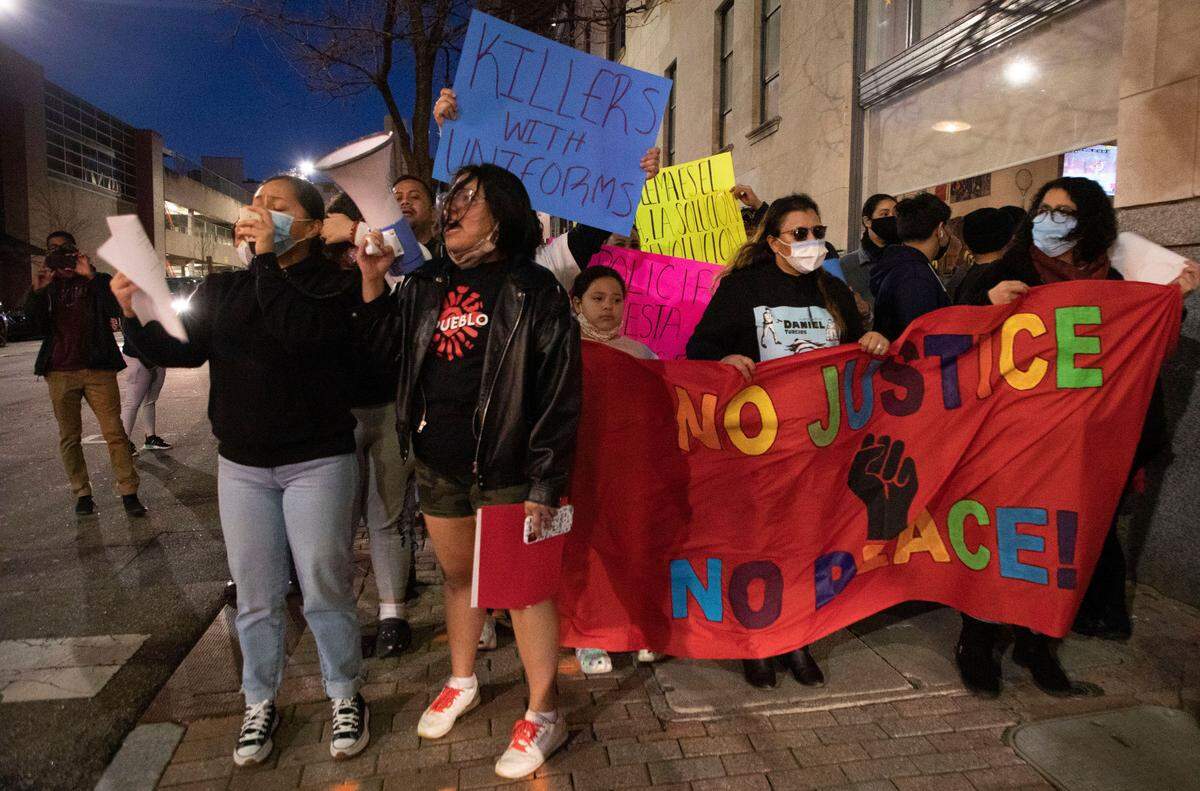
Activists and Turcios’ wife protested following the shooting, saying Raleigh police could have done a better job of defusing the situation. They said there were circumstances that contributed to Turcios’ behavior. They said he was heavily disoriented by the crash and did not speak English well.
Body camera footage showed Turcios distraught and only speaking in Spanish to another driver and to officers. A bystander told him in Spanish to stay calm and sit down until an ambulance arrived.
“Throughout this incident as these events unfolded, Mr. Turcios’ wife and others on scene were speaking to Mr. Turcios in Spanish in attempts to get him to allow his son to be treated by first responders and to have Mr. Turcios comply with the law enforcement commands,” Freeman said.
A 911 caller suggested Turcios was drunk at the time of the crash, which Police Chief Estella Patterson later cited at a news conference. But an autopsy report did not detect alcohol or drugs in his system, The N&O reported.
Kerwin Pittman, a local social justice activist who has worked with the Turcios family, said Wednesday that Freeman’s decision is “not surprising at all, especially given her supportive stance for Raleigh Police Department.”
“What will be surprising is if Raleigh Police Department adopts or crafts an effective cultural competency policy and training, advocates for a program, such as STARS, that responds to crisis situation external of law enforcement; and revises their continuum use of force training and policy to value life and not escalate,” Pittman said in a statement to The N&O.
The Raleigh Police Department is updating its de-escalation of force policy and is seeking public input this month at several community “listening sessions.” The effort includes training for officers to “strategically slow down incidents” but also to “enhance the legitimacy and trust of the police department among the public.”
Jerez said in February that officers should have shot Turcios in his hand or in his feet.
“Police are supposed to be trained, where is their training?” Jerez said in Spanish at a February protest. “Why didn’t they give me a chance and tell me, ‘Ma’am, control your husband. We’re going to shoot him.’ They didn’t tell me anything … they left me alone with my children.”
Two former law enforcement officials with expertise in police use of force told The N&O that Smith’s decision to shoot Turcios when he swung the knife at another officer was reasonable.
“If he committed (a crime), he had to pay for it,” Jerez said, surrounded by a crowd of nearly 100 people who showed up to march for her husband. “That’s what jail is there for. Why take his life? The father of a family?”
Following the shooting, Tapscott and Smith were placed on administrative leave pending the results of the investigation.
This story was originally published June 15, 2022 at 5:09 PM with the headline "Raleigh police won’t face charges for fatally shooting man carrying knife at I-440 crash."